「未来高端铝包装:创新与可持续的力量,迈向循环经济时代」 SO OK TRADING:2026年8月30日
最后更新: 30 8月 2026
1079 浏览量
「铝包装:迈向泰国与东盟的绿色包装与智能创新时代」 SO OK TRADING|2026年8月30日
引言 (Introduction)
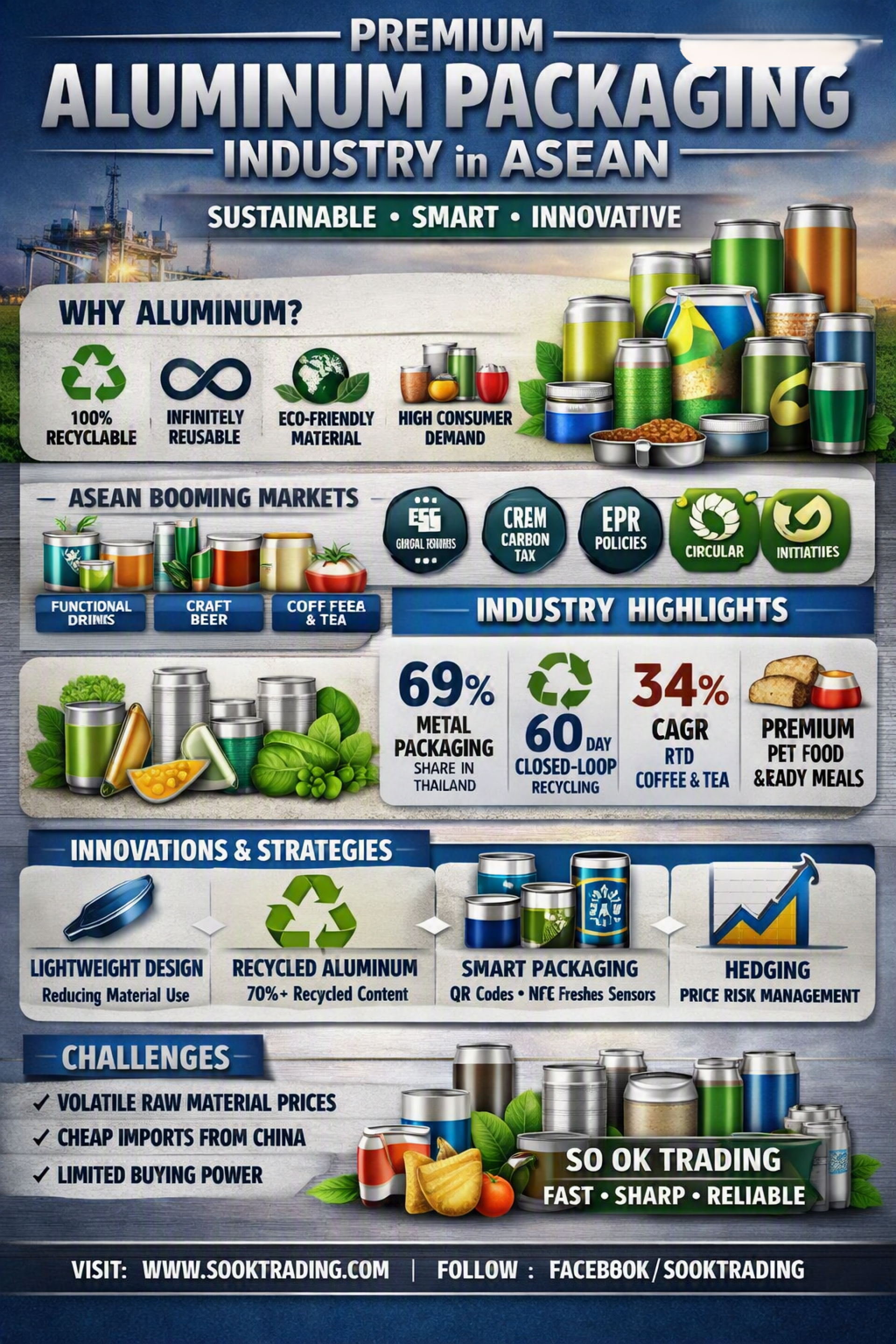
包装产业正处于重大转型期。在环境(ESG)理念的推动下,以及新一代消费者更加重视“可持续性”的趋势中,铝包装脱颖而出。它具有 100% 可回收 的特性,并且可以无限次重复使用而不损失品质,因此被视为未来的材料,既符合环保要求,也契合循环经济(Circular Economy)的发展方向。
展望 (Outlook)
全球层面:绿色包装已不再是选择,而是新的国际贸易标准,由 ESG、CBAM 和 EPR 法规推动。
泰国:通过 Aluminium Loop、太阳能屋顶以及 BGC(Bangkok Glass)等大型投资,积极迈向循环经济。
东盟:中产阶级的扩大,以及功能性饮料、精酿啤酒和即饮咖啡的流行,推动市场快速增长。
深度分析 (Industry Insights)
1️⃣ 变革支柱
可持续性:单一材料、生物基、可重复填充与再利用
智能包装:QR/NFC、鲜度指示器、延长保质期
电商包装:适配尺寸、运输即展示
法规驱动:EPR、CBAM、PPWR
2️⃣ 饮料产业
在泰国,铝罐占金属包装的 69%
RTD 咖啡与茶:年均增长 34%
罐装水:在豪华酒店和旅游城市(如普吉岛、巴厘岛)开始替代塑料瓶
功能性饮料与精酿酒:几乎全面转向铝罐
3️⃣ 食品产业
高端宠物食品:由塑料袋转向铝箔托盘和小罐
即食与外卖食品:在泰国和印尼对铝箔托盘的需求快速增长
4️⃣ 闭环回收系统 (Closed-Loop Recycling)
60 天循环:泰国饮料罐公司在 60 天内完成废罐回收再利用
EPR 法规:要求生产商承担包装废弃物的责任
5️⃣ 挑战
原材料价格波动(3,100–3,300 美元/吨)
来自中国的低价产品(占全球产能的 36%)
区域购买力有限
6️⃣ 竞争策略
套期保值:通过期货合同降低价格风险
轻量化:薄壁罐降低成本与重量
提高再生铝比例
7️⃣ 印刷与智能包装创新
数字印刷:高分辨率直接印在罐体上
热变色油墨:随温度变化而变色
特殊表面处理:哑光或触感涂层
连接包装:QR/NFC 与数字世界互动
智能罐盖:可重新封闭的铝罐盖
东盟市场趋势
在 CLMV 国家、印尼、菲律宾和越南,功能性饮料、啤酒和即饮咖啡消费快速增长。铝包装因其 可持续性与便利性 而越来越受到青睐。
结论 (Conclusion)
2026 至 2032 年间,泰国与东盟的铝包装产业将实现 高质量与高端化增长。ESG、创新技术与闭环回收将成为核心。能够通过智能包装创造附加价值并有效控制成本的企业,将在全球市场中占据优势,并引领真正的循环经济转型。
SO OK TRADING:您的商业合作伙伴 SO OK TRADING:FAST • SHARP • RELIABLE 访问我们:www.sooktrading.com 关注我们:Facebook/SOOKTRADING
引言 (Introduction)
包装产业正处于重大转型期。在环境(ESG)理念的推动下,以及新一代消费者更加重视“可持续性”的趋势中,铝包装脱颖而出。它具有 100% 可回收 的特性,并且可以无限次重复使用而不损失品质,因此被视为未来的材料,既符合环保要求,也契合循环经济(Circular Economy)的发展方向。
展望 (Outlook)
全球层面:绿色包装已不再是选择,而是新的国际贸易标准,由 ESG、CBAM 和 EPR 法规推动。
泰国:通过 Aluminium Loop、太阳能屋顶以及 BGC(Bangkok Glass)等大型投资,积极迈向循环经济。
东盟:中产阶级的扩大,以及功能性饮料、精酿啤酒和即饮咖啡的流行,推动市场快速增长。
深度分析 (Industry Insights)
1️⃣ 变革支柱
可持续性:单一材料、生物基、可重复填充与再利用
智能包装:QR/NFC、鲜度指示器、延长保质期
电商包装:适配尺寸、运输即展示
法规驱动:EPR、CBAM、PPWR
2️⃣ 饮料产业
在泰国,铝罐占金属包装的 69%
RTD 咖啡与茶:年均增长 34%
罐装水:在豪华酒店和旅游城市(如普吉岛、巴厘岛)开始替代塑料瓶
功能性饮料与精酿酒:几乎全面转向铝罐
3️⃣ 食品产业
高端宠物食品:由塑料袋转向铝箔托盘和小罐
即食与外卖食品:在泰国和印尼对铝箔托盘的需求快速增长
4️⃣ 闭环回收系统 (Closed-Loop Recycling)
60 天循环:泰国饮料罐公司在 60 天内完成废罐回收再利用
EPR 法规:要求生产商承担包装废弃物的责任
5️⃣ 挑战
原材料价格波动(3,100–3,300 美元/吨)
来自中国的低价产品(占全球产能的 36%)
区域购买力有限
6️⃣ 竞争策略
套期保值:通过期货合同降低价格风险
轻量化:薄壁罐降低成本与重量
提高再生铝比例
7️⃣ 印刷与智能包装创新
数字印刷:高分辨率直接印在罐体上
热变色油墨:随温度变化而变色
特殊表面处理:哑光或触感涂层
连接包装:QR/NFC 与数字世界互动
智能罐盖:可重新封闭的铝罐盖
东盟市场趋势
在 CLMV 国家、印尼、菲律宾和越南,功能性饮料、啤酒和即饮咖啡消费快速增长。铝包装因其 可持续性与便利性 而越来越受到青睐。
结论 (Conclusion)
2026 至 2032 年间,泰国与东盟的铝包装产业将实现 高质量与高端化增长。ESG、创新技术与闭环回收将成为核心。能够通过智能包装创造附加价值并有效控制成本的企业,将在全球市场中占据优势,并引领真正的循环经济转型。
SO OK TRADING:您的商业合作伙伴 SO OK TRADING:FAST • SHARP • RELIABLE 访问我们:www.sooktrading.com 关注我们:Facebook/SOOKTRADING

相关文章
An analysis of the aluminum market in 2026 indicates a likely continued market deficit and upward price pressure, driven by constrained supply and resilient demand from green energy sectors. However, significant volatility is expected due to policy uncertainties and the potential for new Indonesian supply to eventually balance the market.
Key Drivers and Projections for 2026
Supply Side Analysis
Capacity Constraints: China's primary aluminum output is approaching its self-imposed 45 million-tonne capacity cap, limiting global supply growth.
Power Challenges: Smelters outside of China face intense competition for power from energy-intensive sectors like AI data centers, which are willing to pay higher prices for long-term contracts. This has kept significant capacity offline in Europe and the US.
Production Disruptions: Outages and potential shutdowns at existing smelters in Iceland and Mozambique further tighten the market.
Scrap Supply Pressure: The EU's planned implementation of the Carbon Border Adjustment Mechanism (CBAM) and potential scrap export tariffs in spring 2026 are expected to impact global scrap flows, creating regional shortages and price volatility.
New Capacity: Indonesia is a key source of new supply, with several projects in the pipeline. However, analysts suggest the pace of the ramp-up may be slower than expected due to infrastructure and policy challenges, meaning it is unlikely to fully offset near-term tightness.
Demand Side Analysis
Green Transition Demand: Demand from "green" sectors such as solar panels, new energy vehicles, and energy transition infrastructure remains strong, providing fundamental support for the market.
Substitution Effect: Aluminum's wide price discount relative to copper has encouraged substitution in electrical applications, acting as a tailwind for demand and prices.
Construction and Automotive: The construction and automotive industries continue to be major consumers, with growing demand for lightweight, low-carbon aluminum products.
Price Forecasts and Volatility
The market is expected to remain in a deficit in 2026, with estimates ranging from 200,000 to 600,000 tonnes. This structural tightness is leading most analysts to forecast sustained or rising prices.
Bullish Views: Analysts at Bank of America project prices of $3,000/tonne as early as 2026. J.P. Morgan also expects prices to approach $3,000/tonne in Q1 2026. ING forecasts an average price of $2,900/tonne for the year.
Bearish/Conservative Views: Goldman Sachs is an outlier, forecasting prices to decline to $2,350/tonne by Q4 2026, anticipating a market surplus later in the year. SMM forecasts a "high first, then lower" pattern, with prices finding equilibrium in the $2,700–$2,800/tonne range by year-end.
Premiums: Regional premiums, particularly the US Midwest premium, are expected to remain high and volatile due to tariffs and regional supply dynamics, creating a disconnect from the LME benchmark price.
In essence, 2026 is projected to be a year of high volatility where participants need to focus on scenario readiness rather than relying on a single price forecast, as geopolitical and energy policies significantly influence regional supply and costs
31 12月 2025

Aluminum is ideal for beverages due to its light weight, strength for carbonation, and excellent barrier properties (blocking light/air) to keep drinks fresh, plus it's infinitely recyclable, requiring much less energy to recycle than to produce new, making it highly sustainable for packaging sodas, beers, juices, and more. Its high recycling rate and ability to form a perfect, airtight seal make it a superior choice for preserving flavor, extending shelf life, and reducing environmental impact.
Key Benefits of Aluminum for Beverages:
Preserves Freshness: Blocks 100% of light and oxygen, preventing contamination and spoilage, protecting flavor.
Sustainable & Recyclable: Infinitely recyclable in a true closed-loop system, using 95% less energy to recycle than to make new aluminum, with high recycled content.
Lightweight & Efficient: Easier and cheaper to transport, store, and display, reducing carbon footprints.
Durable & Strong: Withstands the pressure of carbonated drinks and resists breakage during transport, unlike glass.
Versatile: Used for soda, beer, hard seltzers, energy drinks, juices, and more.
Cooling: Has a natural cooling effect, keeping drinks cool with minimal energy.
How it Works:
Manufacturing: Bauxite ore is refined into pure aluminum, then rolled into thin sheets, stamped into discs, and drawn into the can shape.
Lining: An epoxy lacquer or polymer lining is sprayed inside to prevent the aluminum from corroding and imparting a metallic taste.
Sealing: A double-seam process creates an airtight, hygienic seal for the lid, locking in freshness.
Recycling: Cans can be melted and reformed into new cans in as little as 60 days, making aluminum a circular packaging material.
20 12月 2025