Aluminum For Packaging How it used and it application
ALUMINUM FOR PACKAGING HOW IT WORK AND IT APPLICATION AND HOW IT RECYCLING
An aluminum can (British English: aluminium can) is a single-use container for packaging made primarily of an aluminum exterior with an epoxy resin or polymer coated interior. It is commonly used for food and beverages such as olives and soup but also for products such as oil, chemicals, and other liquids. Global production is 180 billion annually and constitutes the largest single use of aluminum globally.
Usage
See also: Drink can
Use of aluminum in cans began in 1957. Aluminum offers greater malleability, resulting in ease of manufacture; this gave rise to the two-piece can, where all but the top of the can is simply stamped out of a single piece of aluminum, rather than constructed from two pieces of steel. The inside of the can is lined by spray coating an epoxy lacquer or polymer to protect the aluminum from being corroded by acidic contents such as carbonated beverages and imparting a metallic taste to the beverage. The epoxy may contain bisphenol A. A label is either printed directly on the side of the can or will be glued to the outside of the curved surface, indicating its contents.
Most aluminum cans are made of two pieces. The bottom and body are "drawn" or "drawn and ironed" from a flat plate or shallow cup. After filling, the can "end" is sealed onto the top of the can. This is supplemented by a sealing compound to ensure that the top is air tight.
The advantages of aluminum over steel (tinplate) cans include;
1) light weight
2) competitive cost
3) usage of easy-open aluminum ends: no need for a can opener
4) clean appearance
5) aluminum does not rust
6) easy to press into shape
7) The easy-open aluminum end for beverage cans was developed by Alcoa in 1962 for the Pittsburgh Brewing Company and is now used in nearly all of the canned beer market.
Recycling
Aluminum cans pressed into bales to recycling
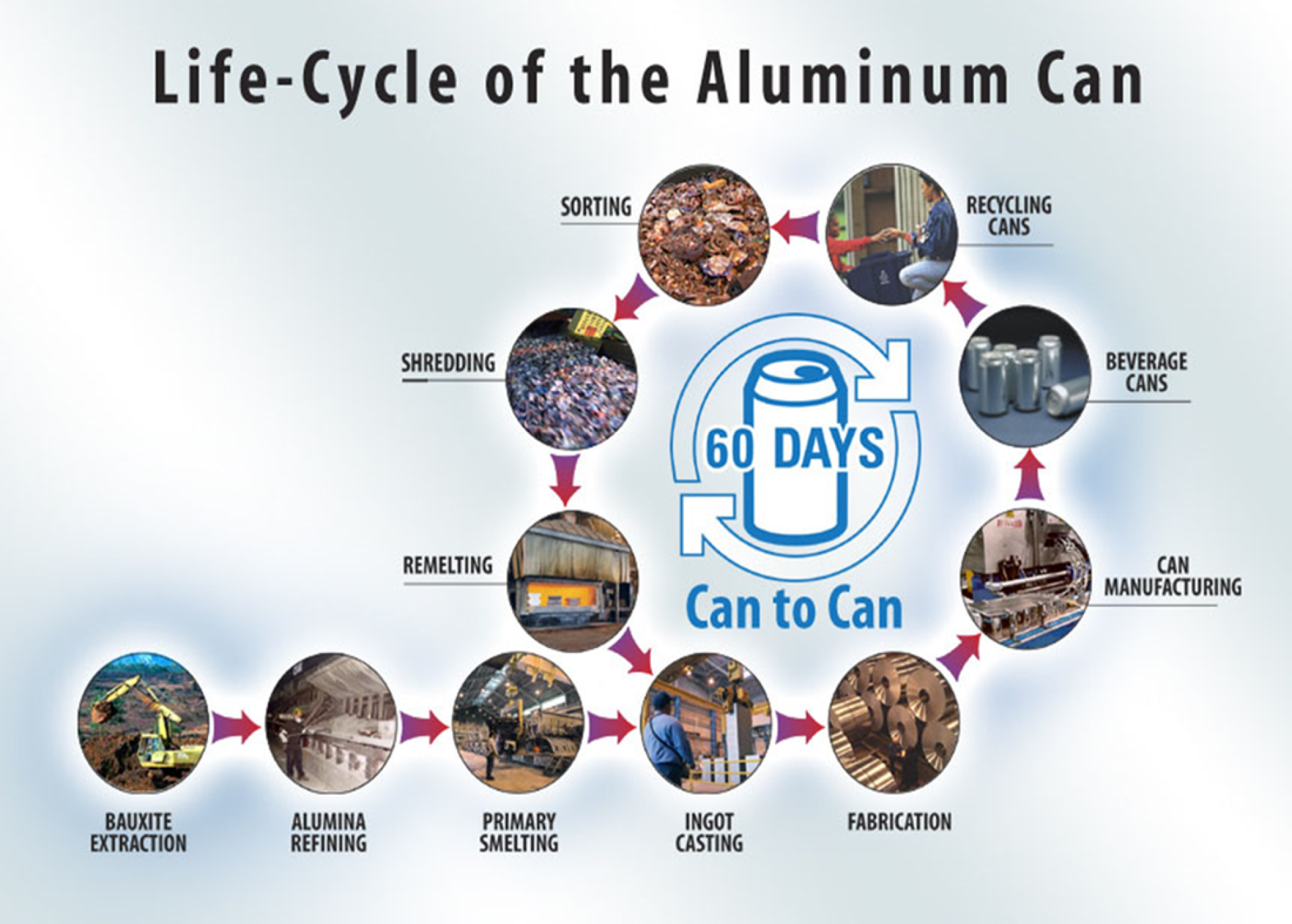
Aluminum cans can be made with recycled aluminum. In 2017, 3.8 million tons of aluminum were generated in the US of which 0.62 million tons were recycled - a recycling rate of 16%. According to estimates from the Aluminum Association, a large amount of aluminium remains unrecycled in the US, where roughly $700 million worth of cans end up in landfills each year. In 2012, 92% of the aluminum beverage cans sold in Switzerland were recycled. Cans are the most recycled beverage container, at a rate of 69% worldwide. There are many ways to recycle aluminum cans, such as shredding by scrap metal shredder.
One issue is that the top of the can is made from a blend of aluminum and magnesium to increase its strength. When the can is melted for recycling, the mixture is unsuitable for either the top or the bottom/side. Instead of mixing recycled metal with more aluminum or magnesium (to harden it), a new approach uses annealing to produce an alloy that works for both.
The aluminum can is also considered the most valuable recyclable material in an average recycling bin. It is estimated that Americans throw away nearly 1 billion dollars a year in wasted aluminum. The aluminum industry pays nearly 800 million dollars a year for recycled aluminum since it is so versatile. Because of the advantages of aluminium packaging (shelf life, durability, food grade factor) over plastics, it is considered an alternative to PET bottles, with the possibility of replacing the majority of them in the next decades.
Cans as collectibles
Some people collect cans as a hobby. Can collections can be exclusive to one sector only, eg., some collectors may collect soda cans only, while others may dedicate themselves to collecting beer cans or oil cans exclusively, but some collectors may collect cans regardless of the type of can.
One aspect that may make someone interested in building a can collection as a hobby is the variety of cans available worldwide promoting such things as films, musical albums and tours, sporting teams and events, countries, ideals and even some non-food or petrol-oriented brands and companies.
Celebrities can also be featured on collectible cans; such was the case of tennis player Andre Agassi, who had a set of four Pepsi Max soda cans dedicated to him in 1996.
Davide Andreani of Italy is in the Guinness Book of World Records for having the largest collection of soda cans of one specific brand in the world, with over 20,000 cans in his collection. According to a website named canmuseum.com, the largest collection of Pepsi Cola cans belongs to Chris Cavaletti, also of Italy, who owned 12,402 Pepsi Cola cans from 81 countries as of 2022, while the largest collection of Coca-Cola soda cans belonged to Gary Feng of Canada with 11,308 variations of the Coca-Cola cans from 108 countries collected, with William B. Christensen of the United States owning the largest collection of beer cans with 75,000 from 125 countries and Allan Green, of the United States also, with the largest collection of wine cans, at 449.
------
ALUMINUM PACKAGING IN THAILAND SUMMARY
Aluminum is a popular, sustainable choice for beverages in Thailand, championed by companies like Thai Beverage , SINGHA , OSOTSAPHA , RED BULL are focusing on 100% closed-loop recycling, downgauging (using less material), and excellent product freshness by blocking light/oxygen. Major brands utilize aluminum for carbonated and non-carbonated drinks, promoting its lightweight, recyclable nature through nationwide collection points and consumer awareness campaigns.
Key Aspects of Aluminum Packaging in Thailand
Recyclability: Thailand has a strong circular economy for aluminum cans, allowing for 100% recycling into new cans without quality loss, a system supported by government and industry partnerships.
Sustainability: Companies actively reduce raw material use (downgauging) and increase recycled content, aiming for high recycled content rates by 2030.
Product Quality: Aluminum keeps drinks cold, protects against light and oxygen, and maintains fizziness, ideal for carbonated soft drinks.
Industry Players: All leading manufacturer, partners are promote recycling.
Consumer Engagement: to return used cans at designated pick-up points nationwide for recycling into new cans.
----------------
TOTAL ALUMINUM PACKAGING USAGE IN THAI MARKET
Thailand uses a significant amount of aluminum for beverage cans, with major players are weight and aiming for high recycled content (85% by 2030), supported by an impressive recycling rate over 90% for aluminum cans, making Thailand a leader in closed-loop recycling in Southeast Asia. While exact tonnage isn't pinpointed, the high recycling rate and industry efforts show substantial ongoing usage and recovery, driven by beverages (42% of metal packaging) and growing food sectors.
Key Usage & Recycling Statistics:
Recycling Rate: Over 90% of aluminum cans in Thailand are recycled.
Recycled Content Goal: Companies aim to boost recycled content in new cans to 85% by 2030.
Industry Scale: The metal packaging market in Thailand was valued at $5.8 billion in 2023, with beverages being a primary driver.
CAN MAKING Efforts: Plan to reduce aluminum usage by thousands of tonnes through can downgauging compared to 2020 levels.
Why Aluminum Cans?
Sustainability: Aluminum is infinitely recyclable, allowing for a true circular economy.
Local Capability: Thailand is unique in Southeast Asia for its ability to perform closed-loop recycling for aluminum cans.
In essence, Thailand has a large and active aluminum can market, with a strong emphasis on recycling and reducing primary material usage, especially within the beverage industry.
----------