Share

“Hormuz on Fire! Global Logistics Shaken, Freight Costs Soar – Middle East Supply Shock, The Year of High Costs and Extreme Volatility” Article by SO OK TRADING | March 13, 2026
Last updated: 13 Mar 2026
649 Views

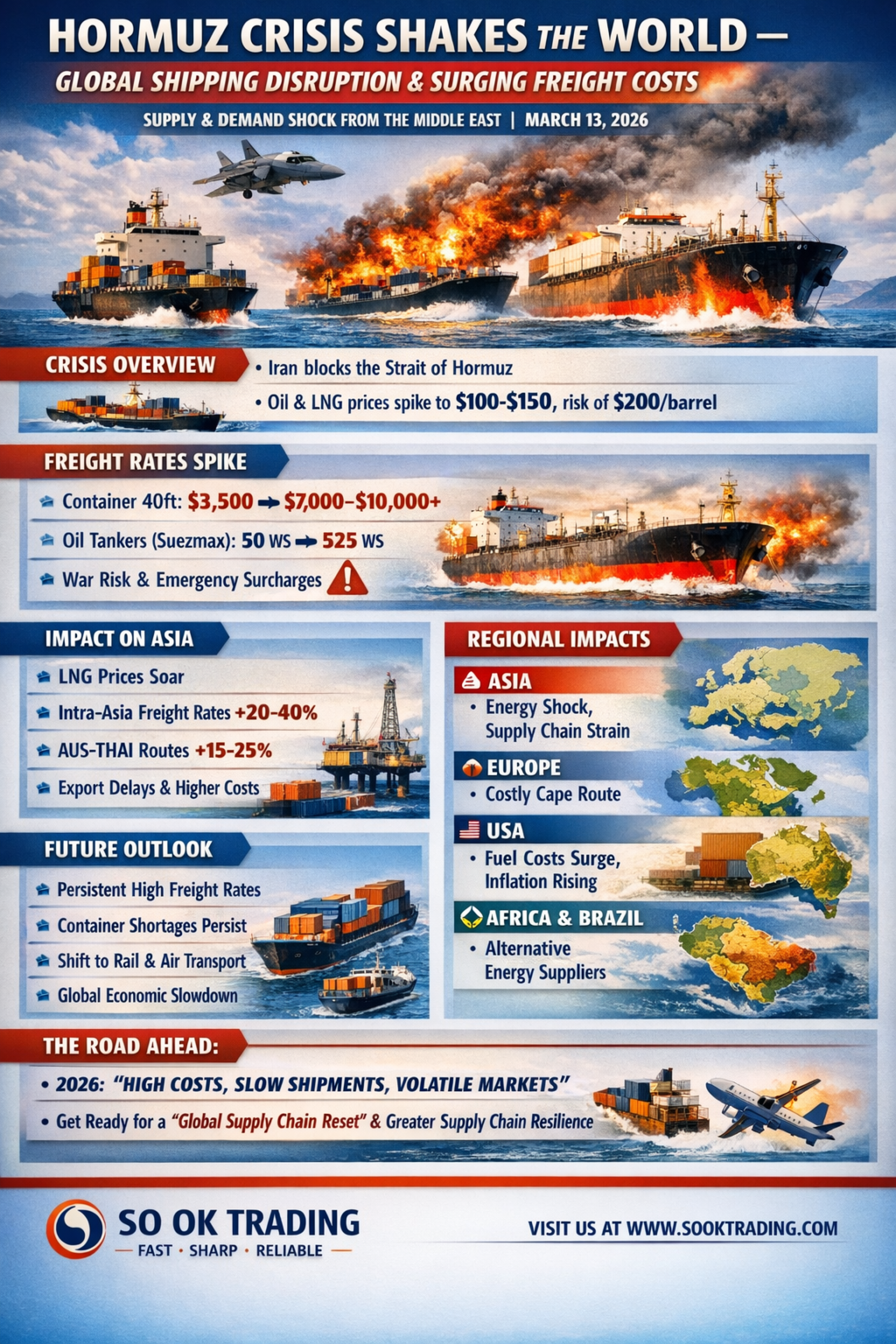
“Hormuz Strait on Fire – Global Logistics Shaken, Freight Costs Exploding”
SUPPLY & DEMAND SHOCK from the Middle East | March 13, 2026
Article by SO OK TRADING

Latest Situation

In March 2026, Iran effectively blocked the Strait of Hormuz and attacked several merchant vessels, including Thailand’s Mayuree Naree. This immediately disrupted 20–30% of the world’s oil and LNG shipping routes. Crude oil prices surged to $100–150 per barrel, with risks of hitting $200 per barrel if the crisis prolongs.

Freight Rates Skyrocket

40ft container freight: from ~$3,500 ➜ $7,000–10,000+
Oil tankers (Suezmax): from 50–225 Worldscale ➜ 525 Worldscale
SCFI Middle East route index: jumped 72% in just one week
Emergency surcharges, War Risk, and Bunker fees applied globally
⚡ Impact on Thailand and Asia

LNG spot prices surge, pushing up Thailand’s electricity generation costs
Intra-Asia routes (Thailand–China, Thailand–Japan): freight up 20–40%, container shortages
Australia–Thailand routes: freight up 15–25% due to bunker surcharges and insurance premiums
Agricultural exports: delays and higher costs reduce competitiveness
Regional Impact Comparison

Asia: Directly hit by soaring energy prices. Japan and South Korea, heavily reliant on Middle Eastern LNG, face severe shocks. Thailand suffers from both higher electricity costs and freight rates.
Europe: Forced to reroute via the Cape of Good Hope, raising energy and logistics costs instantly, fueling inflation.
United States: Domestic oil production exists, but global market impacts still drive fuel and transport costs higher.
Africa & Brazil: Emerging as alternative energy suppliers, gaining new export opportunities.
Future Outlook if Crisis Prolongs

High freight rates become the New Normal
Container shortages worsen, disrupting Asian exports in Q2–Q3
Shift toward Sea-to-Air and China–Europe rail transport for urgent cargo
Bunker surcharges adjusted monthly, fuel prices remain volatile
Global economy slows, inflation rises, purchasing power declines
Conclusion

2026 is a year of “High Costs, Long Lead Times, and Extreme Volatility.”
If the Hormuz Strait crisis continues, the world will enter a “Global Supply Chain Reset” where transport and energy costs will not easily return to previous levels. Thai and Asian businesses must adapt by diversifying risks, exploring new routes, and investing in supply chain resilience to maintain competitiveness.

✨ This crisis is not just temporary—it is a warning that the world is entering a new era of logistics and energy. Companies that adapt quickly and pursue proactive strategies will be the ones to survive and grow amid volatility.

SO OK TRADING — Your Business Partner
FAST • SHARP • RELIABLE
WWW.SOOKTRADING.COM


Would you like me to also craft a short, punchy English caption for LinkedIn that pairs with this article—something like “Hormuz Strait crisis resets global supply chains. High costs and volatility are the new normal. SO OK TRADING stands ready as your resilient partner.”?


Related Content
“Rare Earth: The Vitamins of Modern Global Industry : SO OK TRADING and Rare Earth Business Opportunities”
Rare Earth Elements (REEs): The Vitamins of Modern Industry From strategic resources to global business opportunities, Rare Earths are the key drivers of clean energy and advanced technologies—from EVs and batteries to defense systems and medical innovation.
16 Jan 2026
“2026 Global & Thai Economy Outlook: AI, Clean Energy, and the Rise of Strategic Commodities” Article by SO OK TRADING
2026 is shaping up to be a pivotal year for both the global and Thai economies. The world is being driven by Artificial Intelligence (AI) and Clean Energy, alongside the rise of strategic commodities such as gold, silver, copper, and aluminum. While global growth continues, risks from trade wars and geopolitical tensions remain strong headwinds. Thailand, meanwhile, is still in a transition phase, where attracting more Foreign Direct Investment (FDI) and boosting Research & Development (R&D) are critical to avoid falling behind. In this article, SO OK TRADING explores the 2026 outlook for the global and Thai economies, highlighting new opportunities across rising industries — from digital technology and integrated healthcare to clean energy and niche lifestyle markets that are expanding rapidly. 2026 marks a pivotal transition for the global and Thai economies. Driven by Artificial Intelligence (AI) and Clean Energy, the world is witnessing the rise of strategic commodities — gold, silver, copper, and aluminum. While global growth continues, Thailand remains in transition, seeking FDI and stronger R&D to capture opportunities in medical hub, green manufacturing, and lifestyle markets.
17 Feb 2026
HNY 2026 with a First Analysis on Thai Baht Value
he Thai baht in Q1 2026 is expected to strengthen against the US dollar, driven primarily by a weaker dollar globally, a seasonal tourism boost, and expectations of US Federal Reserve rate cuts. This strength is occurring despite a weak domestic economic outlook and the Bank of Thailand's (BoT) likely continued easing of its policy rate. Exchange Rate Drivers and Forecast External Factors: The primary driver for the strengthening baht is external, mainly the broad weakness of the US dollar as global markets price in expected Fed rate cuts. The baht is also correlated with global gold prices, which have been climbing. Tourism High Season: The period extending into Q1 2026 is the high season for tourism, which typically brings in foreign currency and supports the baht's value. Policy Divergence: The BoT is expected to continue its easing cycle, potentially cutting the policy rate further to 1.00% by Q1 2026 to stimulate the sluggish domestic economy. This divergence from a potentially less aggressive US Fed in Q1 could support the baht in the short term, though some analysts warn the currency could weaken later in 2026. Forecasts: Projections for 2026 generally place the baht in a range of 30.80–33.00 per US dollar. Some models estimate it could trade around 31.06 by the end of Q1. A persistently strong baht below 31 per US$ is seen as a significant risk to the Thai export and tourism sectors. Key Economic Context Weak Growth: Thailand's economy is expected to slow down to a 5-year low growth rate of around 1.6-1.8% in 2026, pressured by US tariffs, global trade tensions, and high household debt. The central bank chief expects an improvement in Q1 2026 after a weak second half of 2025. Political Uncertainty: A general election expected in February 2026 could also introduce volatility, though some historical trends suggest the baht may strengthen following the formation of a new government. Low Inflation: Headline inflation is projected to remain subdued or even negative, providing the central bank with justification for further rate cuts to stimulate demand. In summary, Q1 2026 is characterized by a strong and volatile baht driven by external factors, contrasting sharply with a weak domestic economy and accommodative monetary policy.
1 Jan 2026
This website uses cookies for best user experience, to find out more you can go to our Privacy Policy and Cookies Policy
Compare product
0/4
Remove all
Compare
Powered By MakeWebEasy Logo MakeWebEasy