ADC12: The Metal Hero Forging the Future of Industry — The Strategic Material of the EV Era and High-Energy Costs Article by SO OK TRADING | 27 March 2026
ADC12: The Strategic Material of the EV Era and High-Energy Costs — The Hero Spec in Aluminum Die Casting and Industry
Article by SO OK TRADING | 27 March 2026
ADC12 in the World of Die Casting
ADC12 (A383) is far more than just an aluminum alloy. It is the “hero” most chosen by foundries across Asia and the world. Today, ADC12 is being elevated into a Strategic Material that answers the dual challenge of reducing energy costs and enabling the transition to electric vehicles (EVs). No other aluminum specification has yet matched or replaced its role.
✨ Why ADC12 Wins Global Industry Trust
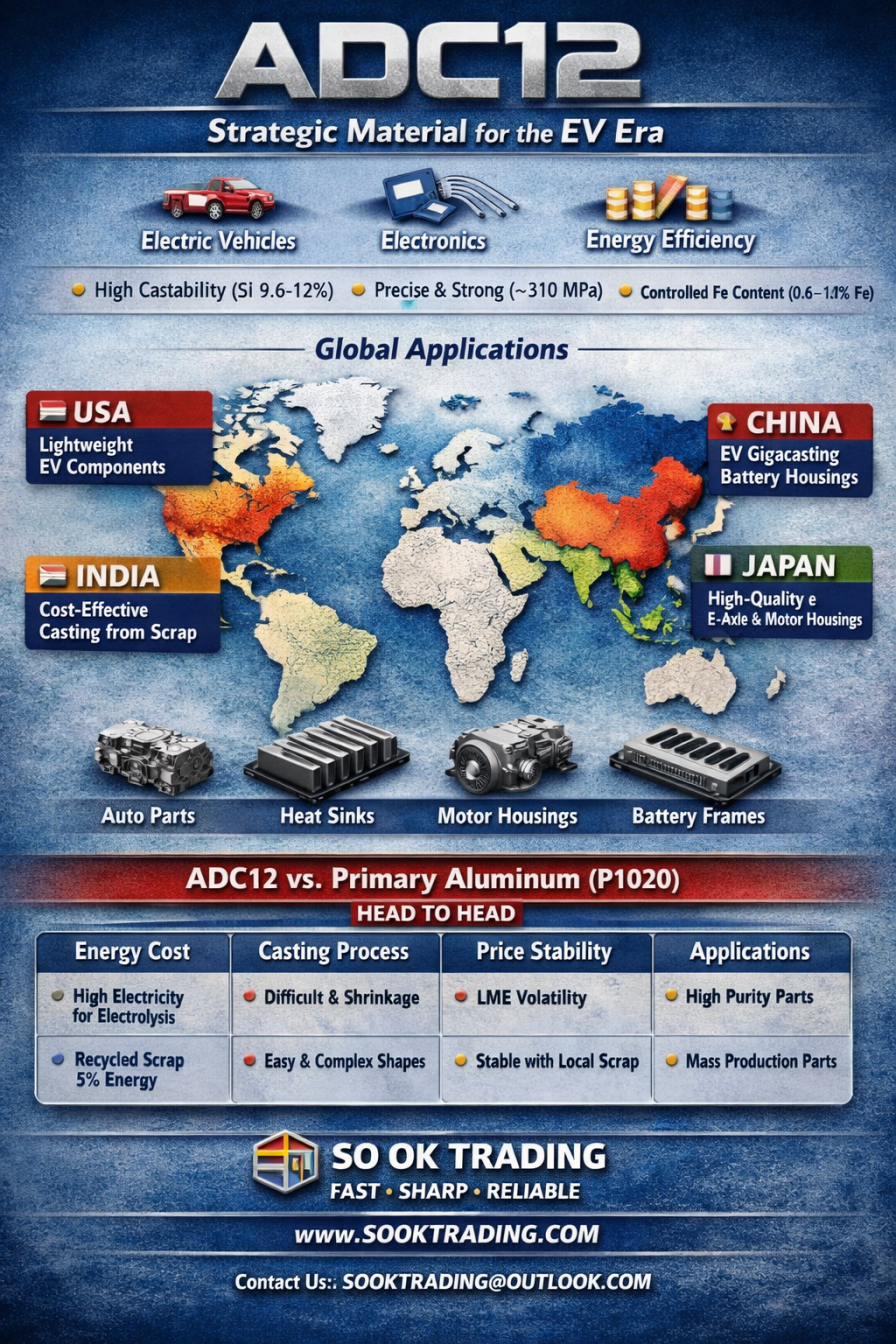
Superior Fluidity & Castability: High silicon (9.6–12%) → perfect for complex shapes and thin walls
Dimensional Precision: Low shrinkage, less waste, higher efficiency
Strength & Machinability: Tensile strength ~310 MPa, easy to machine
Heat Resistance: Better hot-cracking resistance than A380
Versatile Applications
Automotive: Engine covers, gear housings, sensor brackets, e-Axle housings
Electronics: Heat sinks, housings, connectors
Appliances: Tool frames, washing machine parts, communication devices
EV Components: Battery frames, motor housings requiring lightweight precision
Fe Content: A Small Factor with Big Impact
JIS Standard: Fe ≤ 1.3%
Optimal Range: 0.6–1.0%
<0.6% → risk of die soldering
1.2% → brittle, poor machinability
Conclusion: Controlling Fe is the key to ADC12 quality
Global EV Boom: Market Trends & Directions
China: Largest EV producer, extensive use in battery housings and gigacasting components
India: Rapid EV growth, local foundries adopt ADC12 from scrap to cut energy costs
Japan: High-quality e-Axle and motor housings, strict Fe control for durability
Europe: Energy crisis reduces primary aluminum output → shift to recyclable, low-energy ADC12
USA: A380 is standard, but EV demand drives ADC12 adoption for lightweight, stable casting with less scrap
ADC12 vs Primary Aluminum (P1020)
Energy Cost:
Primary → massive electricity for electrolysis, ultra-high purity
ADC12 → recycled scrap, only 5% of primary’s energy
Casting Process:
Primary → poor fluidity, high shrinkage, mold sticking
ADC12 → excellent flow, ready-to-use alloy for complex shapes
Price Stability:
Primary → volatile, tied to LME and currency
ADC12 → buffered by local scrap prices, more stable supply
Applications:
Primary → high-purity specialty parts
ADC12 → cost-effective mass production
Conclusion
ADC12 is not just a die casting alloy — it is a strategic material enabling the automotive and electronics industries worldwide to overcome the energy crisis and embrace the EV era with confidence.
ADC12: Lightweight, Strong, Easy to Cast, and Eco-Friendly — The Alloy Foundries Choose for the Future
SO OK TRADING — FAST • SHARP • RELIABLE
www.sooktrading.com
sooktrading@outlook.com
Would you like me to also craft a short, punchy English tagline (5–6 words) that pairs with this article title for LinkedIn or infographic campaigns?