Share

Battery to Bullion: Thailand’s Circular Power Play: Lead the Future: Car Batteries & Circular Economy: From Cars to Commodities: The Rise of Lead Recycling
Last updated: 17 Feb 2026
622 Views

Car Batteries & Lead Recycling Industry: Golden Opportunity in the Transition Era

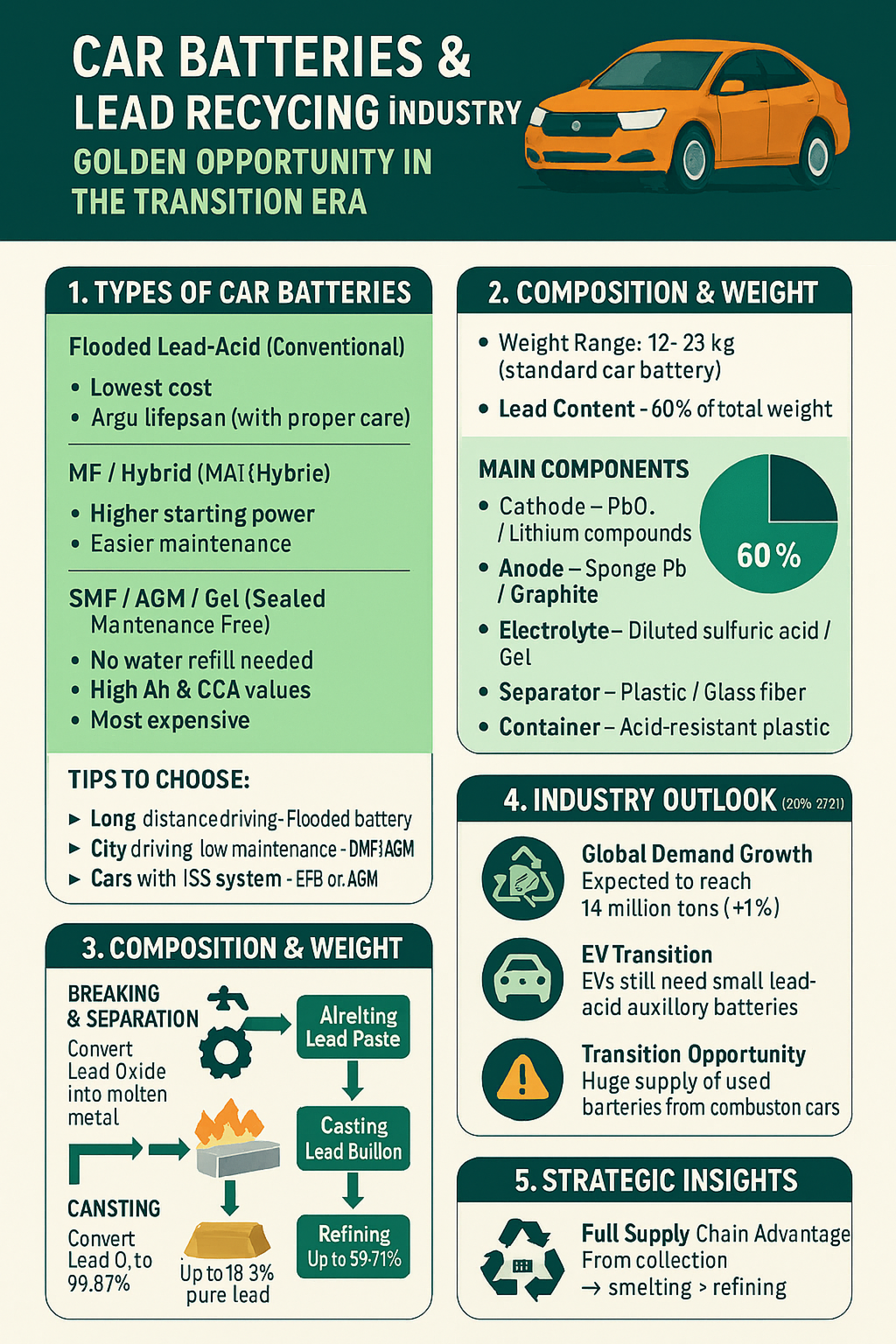
1. Understanding Car Batteries

Car batteries are the heart of a vehicle’s electrical system. Whether in combustion-engine cars or electric vehicles, every car requires a battery to start the engine and power essential systems.

Main Types of Car Batteries

Flooded Lead-Acid (Conventional)
Lowest cost
Long lifespan if properly maintained
⚠ Requires regular distilled water refills
MF / Hybrid (Maintenance Free)
⚡ Higher starting power
Easier maintenance
Higher price, occasional water checks still needed
SMF / AGM / Gel (Sealed Maintenance Free)
✅ No water refills required
High Ah and CCA values
Flexible installation
Most expensive
Tips for Choosing:

Long-distance driving → Flooded battery for durability
City driving, low maintenance → SMF/AGM for convenience
Cars with ISS system → EFB or AGM
 

2. Composition & Weight

Standard car batteries weigh 12–23 kg, with lead making up about 60% of the total weight.

Key Components

Cathode: PbO₂ or lithium compounds
Anode: Sponge lead or graphite
Electrolyte: Diluted sulfuric acid or gel
Separator: Plastic or glass fiber
Container: Acid-resistant plastic
Examples by Capacity (Ah):

45 Ah → 12–13 kg
75 Ah → 17–19 kg
100 Ah → 22–25 kg
200 Ah → 55–60 kg
 

3. Recycling Batteries: From Scrap to Lead Bullion

Thailand already has a comprehensive recycling system for lead-acid batteries.

Process Steps

Breaking & Separation: Plastic, acid, and lead paste are separated
Smelting: Lead oxide is converted into molten metal
Casting: Lead Bullion produced (95–98% purity)
Refining: Purity raised to 99.97%
Key Fact: Over 80% of new lead worldwide comes from recycled batteries.


4. Industry Outlook (2026–2027)

Demand Growth: Global demand expected to reach 14 million tons (+1%)
EV Transition: EVs still require small lead-acid auxiliary batteries
Transition Opportunity: Large supply of scrap batteries from combustion cars
⚠ Challenges:
Competition for scrap batteries
Rising energy costs and stricter environmental standards
Lead price volatility linked to LME
 

5. Strategic Summary

Full Supply Chain Advantage: Companies managing collection → smelting → refining gain cost and profit edge
Eco-Friendly Technology: Key to long-term sustainability
Circular Economy: Recycling is the golden opportunity
 

✨ Conclusion
Car batteries are more than just a starting device. They represent a business that connects circular economy principles with the global metals industry. In 2026, Thai entrepreneurs have a unique chance to become key players if they embrace sustainable technology and complete supply chain management.

If you are interested in high-quality Lead Bullion or Lead Ingot, produced through advanced recycling processes in Thailand, please contact SO OK TRADING.

Visit our website: www.sooktrading.com and submit your request via the “Give Inquiry” field on the homepage.
Or, you can send us an email directly at sooktrading@outlook.com.


Related Content
เกร็ดความรู้ การใช้งาน ALUMINUM INGOT (อลูมิเนียม INGOT) P1020 A7
Aluminum Ingot P1020 , A7 อลูมิเนียมเป็นหนึ่งในรูปแบบทั่วไปของโลหะผสมอลูมิเนียมที่ใช้ในอุตสาหกรรมสมัยใหม่ การผสมผสานคุณสมบัติที่เป็นเอกลักษณ์ของอลูมิเนียมทำให้เป็นวัสดุที่มีคุณค่าสำหรับการใช้งานที่หลากหลาย รวมถึงการก่อสร้าง การบินและอวกาศ การขนส่ง และสินค้าอุปโภคบริโภค ในบทความนี้ เราจะพิจารณากระบวนการผลิตแท่งอลูมิเนียมอย่างละเอียดมากยิ่งขึ้น กระบวนการผลิตแท่งอลูมิเนียมเริ่มต้นด้วยการสกัดแร่บอกไซต์ แร่นี้จะถูกบดเป็นผงละเอียดก่อนแล้วจึงผสมกับโซเดียมไฮดรอกไซด์ในกระบวนการที่เรียกว่ากระบวนการไบเออร์ สารละลายที่ได้จะถูกบำบัดด้วยความร้อนและความดันเพื่อสร้างอะลูมิเนียมไฮดรอกไซด์ ซึ่งจะถูกทำให้แห้งเพื่อผลิตผงอะลูมินาจากนั้นนำผงอลูมินามาผสมกับไครโอไลต์ ซึ่งเป็นแร่ธาตุหายากที่ทำหน้าที่เป็นฟลักซ์ ส่วนผสมจะถูกวางในเซลล์อิเล็กโทรไลต์ขนาดใหญ่ที่เต็มไปด้วยเกลือหลอมเหลว และกระแสไฟฟ้าจะถูกส่งผ่านเซลล์ กระบวนการนี้เรียกว่ากระบวนการ Hall-Héroult ทำให้อะลูมิเนียมออกไซด์แยกตัวออกจากออกซิเจน เหลือแต่อโลหะอะลูมิเนียมบริสุทธิ์ จากนั้นโลหะอลูมิเนียมจะถูกเทลงในแม่พิมพ์เพื่อสร้างรูปทรงลิ่ม แม่พิมพ์มักทำจากเหล็กหรือกราไฟต์และมีหลายขนาดและรูปร่าง แท่งอโลหะจะถูกทำให้เย็นและแข็งตัว จากนั้นนำออกจากแม่พิมพ์และตัดตามความยาว (Aluminum Slab) ก่อนที่แท่งอโลหะจะสามารถนำมาใช้ในอุตสาหกรรมได้ จะต้องผ่านกระบวนการต่อไป โดยทั่วไปแล้วจะละลายและหล่อเป็นรูปแบบเฉพาะสำหรับการใช้งานเฉพาะ ซึ่งอาจเกี่ยวข้องกับการผสมอลูมิเนียมกับอโลหะอื่นเพื่อให้ได้คุณสมบัติเฉพาะ เช่น ความแข็งแรง ความทนทานต่อการกัดกร่อน หรือการทนความร้อน แท่งอะลูมิเนียมมีขนาดตั้งแต่ไม่กี่ปอนด์ไปจนถึงหลายตัน ขึ้นอยู่กับการใช้งาน โดยปกติแล้วจะจัดส่งในปริมาณมากไปยังผู้ผลิต ซึ่งจะนำไปแปรรูปเป็นผลิตภัณฑ์ที่หลากหลายต่อไป (Aluminum Ingot, Aluminum Billet, Aluminum Slab) ETC. โดยสรุปแล้ว การผลิตแท่งอะลูมิเนียมเป็นกระบวนการที่ซับซ้อนซึ่งเกี่ยวข้องกับการเปลี่ยนแปลงทางเคมีและกายภาพหลายขั้นตอน จำเป็นต้องมีความเข้าใจอย่างลึกซึ้งเกี่ยวกับวัสดุศาสตร์และหลักการทางวิศวกรรม เช่นเดียวกับแรงงานที่มีทักษะในการใช้งานอุปกรณ์ที่ซับซ้อนที่ใช้ในกระบวนการ แท่งอลูมิเนียมมีบทบาทสำคัญในอุตสาหกรรมสมัยใหม่ และความสามารถรอบด้านและความน่าเชื่อถือทำให้เป็นวัสดุที่ขาดไม่ได้สำหรับการใช้งานที่หลากหลาย ตั้งแต่เครื่องครัว ไปจนถึง เครื่องบิน และ ชิ้นส่วนในยานอวกาศ
28 Nov 2025
“Lead Bullion: Powering Batteries, Forging the Green Energy Future — An Article by SO OK TRADING, April 7, 2026”
Lead Bullion & Battery Market: The Metal Power Driving the New Energy World In an era of rapid change in energy and technology, lead remains at the heart of the global battery industry. Especially Lead Bullion (crude lead), refined from Galena ore (PbS) through sintering and blast furnace smelting, then purified to 99.97% pure lead under ASTM B29 standards. This refined lead is essential for producing lead-acid batteries widely used in automobiles, backup power systems (UPS), and energy infrastructure. With global energy prices and shipping costs surging, the Lead Bullion market has regained attention. Particularly in battery production and recycling, recycled lead can reduce energy consumption by up to 75% compared to primary smelting, aligning with the principles of the Circular Economy and ESG standards valued worldwide. Between 2025–2030, the world is entering the era of Secondary Lead — high-quality, environmentally friendly recycled lead expected to account for 60–70% of global demand. This opens new opportunities for Thai manufacturers to build Closed-loop Systems, ensuring long-term sustainability and resilience.
7 Apr 2026
Analyzing the Global Economy at a Turning Point: From War to Adaptation — Rising Energy Costs, Surging Production Expenses, Yet Business Opportunities Remain Article by SO OK TRADING  March 31, 2026
Global Turning Point: Rising Energy Costs, Economic Volatility, Yet Business Opportunities Ahead ✨ Analysis by SO OK TRADING On March 31, 2026, the Middle East conflict shook the global economy. Oil and gas prices surged to multi‑year highs, driving production costs across industries — from plastics and fertilizers to food and metals. Stock markets worldwide faced heavy volatility, while gold remained a “safe haven” asset with heightened risk. Yet amid this uncertainty, new opportunities emerge for businesses ready to adapt — whether through embracing the Circular Economy, investing in renewable energy, or accelerating recycling and low‑carbon technologies. SO OK TRADING sees this as a pivotal moment: - Companies shifting toward sustainability will gain an edge. - Investors seeking opportunities in crisis will find new pathways in Green Energy and alternative supply chains. - Consumers will increasingly turn to eco‑friendly, cost‑efficient products.
31 Mar 2026
This website uses cookies for best user experience, to find out more you can go to our Privacy Policy and Cookies Policy
Powered By MakeWebEasy Logo MakeWebEasy