SO OK TRADING'S INSIGHT | 15 NOV 2026 Aluminum 360°: A Comprehensive Guide to Aluminum Types, Alloy Grades, Applications, and Global Industry Trends
SO OK TRADING'S INSIGHT
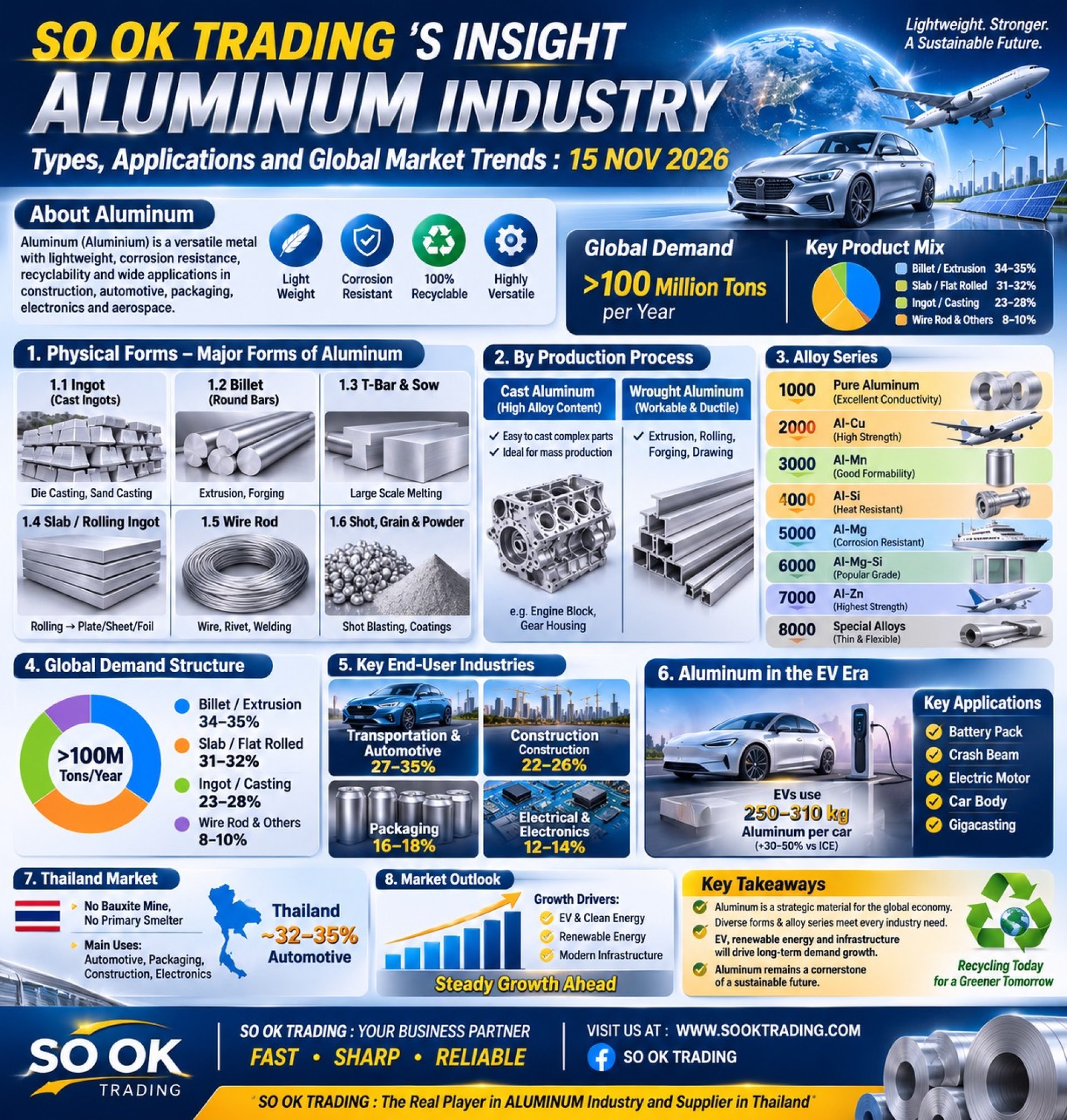
The Aluminum Industry: Product Types, Applications, and Global Market Trends
15 NOV 2026
Aluminum (or Aluminium) is one of the most important metals in modern industry. Thanks to its lightweight nature, corrosion resistance, near-100% recyclability, and excellent formability, aluminum is widely used across construction, automotive, packaging, electrical and electronics industries, as well as aerospace applications.
Aluminum Classification in Industry
Industrial aluminum can generally be classified into two major dimensions:
Physical Forms (Primary Forms)
Alloy Series
Both classifications are essential for selecting the right material to meet manufacturing requirements and desired end-product performance.
1. Classification by Physical Forms
After smelting and refining, aluminum is cast into various forms to support different downstream manufacturing processes.
1.1 Ingot
An ingot is a cast aluminum block, typically trapezoidal in shape with grooves for easy handling and remelting. It serves as a primary feedstock for casting operations.
Main Applications
Die Casting
Sand Casting
Gravity Casting
Typical Products
Transmission housings
Engine blocks
Aluminum alloy wheels
Machinery components
EV structural parts
1.2 Billet
A billet is a solid cylindrical aluminum bar and serves as the primary feedstock for extrusion processes.
During production, billets are typically heated to approximately 450–500°C before being forced through a die under high pressure to achieve the desired profile.
Main Applications
Extrusion
Forging
Typical Products
Door and window frames
Aluminum profiles
Aluminum tubes
Solar mounting systems
EV battery structures
Heat sinks
Forged wheels
1.3 T-Bar and Sow
A T-Bar is a large T-shaped aluminum casting, while a Sow is a large aluminum block weighing several hundred kilograms.
These forms are designed for large-scale remelting operations in industrial foundries.
Advantages
Easy forklift handling
Reduced metal losses from oxidation and dross formation
Suitable for continuous industrial production
Main Applications
Large aluminum foundries
Billet and slab production
Alloy composition adjustment and remelting
1.4 Slab or Rolling Ingot
A slab is a large rectangular aluminum block used as feedstock for rolling operations.
It can be processed into heavy plate, sheet, coil, and foil products.
Hot Rolling
Produces thick plates.
Typical Products
Marine structures
LNG storage tanks
Aerospace structures
Industrial molds
Cold Rolling
Produces sheet and coil products.
Typical Products
Automotive body panels
Aluminum roofing
Ceiling systems
Beverage cans
Foil Rolling
Typical Products
Food packaging foil
Pharmaceutical packaging
Lithium-ion battery foil
1.5 Wire Rod
Wire rod is aluminum formed into large coils of round wire.
Main Applications
Electrical conductors
Welding wire
Rivets
Fasteners
Typical Products
High-voltage transmission lines
Industrial cables
Aluminum welding wire
Structural rivets
1.6 Aluminum Shot, Grain and Powder
Granular and powdered aluminum are used in specialized applications requiring high surface area or controlled material dispersion.
Key Applications
Shot blasting
Paint and printing ink industries
Chemical industries
Metal 3D printing
2. Classification by Manufacturing Process
Industrial aluminum is generally divided into two major categories:
Cast Aluminum
Cast aluminum contains higher levels of alloying elements to improve fluidity in the molten state.
Advantages
Excellent for complex geometries
Ideal for mass production
Typical Applications
Engine blocks
Transmission housings
Alloy wheels
Electric motor housings
Gigacasting components
Wrought Aluminum
Wrought aluminum offers excellent ductility and can be rolled, drawn, bent, or extruded.
Common Processes
Extrusion
Rolling
Forging
Drawing
Wrought aluminum is classified under the internationally recognized Alloy Series system.
3. Classification by Alloy Series
Series 1000 – Pure Aluminum
Contains more than 99% aluminum.
Key Characteristics
Excellent electrical conductivity
High thermal conductivity
Outstanding corrosion resistance
Applications
Electrical conductors
Reflective sheets
Foil
Cookware
Series 2000 – Aluminum-Copper
Key Characteristics
Very high strength
Excellent load-bearing properties
Applications
Aircraft structures
Aerospace components
High-strength engineering applications
Series 3000 – Aluminum-Manganese
Key Characteristics
Good formability
Excellent corrosion resistance
Applications
Fuel tanks
Architectural panels
Automotive radiators
Beverage cans
Series 4000 – Aluminum-Silicon
Key Characteristics
Lower melting point
Good heat resistance
Applications
Welding wire
Engine pistons
Heat-resistant components
Series 5000 – Aluminum-Magnesium
Key Characteristics
Excellent seawater resistance
Superior corrosion resistance
Good weldability
Applications
Shipbuilding
Chemical tanks
Outdoor structures
Series 6000 – Aluminum-Magnesium-Silicon
The world's most widely used aluminum alloy family.
Key Characteristics
High strength
Corrosion resistant
Easy to weld
Excellent extrusion properties
Applications
Windows and doors
Building structures
Bicycle frames
Automotive components
Solar mounting systems
Series 7000 – Aluminum-Zinc
Key Characteristics
Highest strength among aluminum alloys
Applications
Aerospace
Sporting equipment
Defense applications
High-load structural components
Series 8000 – Special Alloys
Contains additional elements such as iron and silicon.
Applications
Food packaging foil
Pharmaceutical packaging
Specialized thin and flexible products
4. Global Aluminum Demand Structure
Global aluminum consumption currently exceeds 100 million metric tons per year.
Approximate Share by Product Form
Product Form
Market Share
Billet / Extrusion
34–35%
Slab / Flat Rolled Products
31–32%
Ingot / Casting
23–28%
Wire Rod & Others
8–10%
5. Major Global Aluminum End-Use Industries
Transportation & Automotive
27–35%
The largest aluminum-consuming sector, driven by vehicle lightweighting, energy efficiency improvements, and EV growth.
Construction
22–26%
A major consumer of billet and extruded products, particularly for windows, doors, curtain walls, and solar mounting structures.
Packaging
16–18%
Uses rolled aluminum sheet and foil for food, beverage, and pharmaceutical packaging.
Electrical & Electronics
12–14%
Utilized in power transmission lines, heat sinks, and cooling systems.
6. Aluminum's Role in the Electric Vehicle (EV) Era
The transition to electric mobility is significantly increasing global aluminum demand.
Modern EVs typically contain 250–310 kilograms of aluminum per vehicle, approximately 30–50% more than conventional internal combustion engine vehicles.
Key Aluminum Applications in EVs
Battery enclosures
Crash management systems
Electric motor housings
Vehicle body structures
Gigacasting components
In particular:
Series 5000 and 6000 alloys are widely used for body structures.
Al-Si casting alloys are extensively used for large structural castings.
7. Overview of Thailand's Aluminum Industry
Thailand does not possess bauxite mines or primary aluminum smelters and therefore relies heavily on imported raw materials, including:
Aluminum Ingots
Aluminum Billets
Recycled Aluminum Scrap
Major Aluminum-Consuming Industries in Thailand
Automotive and Auto Parts (32–35%)
Packaging (22–25%)
Construction and Real Estate (20–22%)
Electrical and Electronics (12–15%)
Machinery and Consumer Products
Thailand is also a significant ASEAN manufacturing hub for:
Aluminum alloy wheels
Aluminum castings
Aluminum packaging products
Conclusion
Aluminum is a strategic material that plays a vital role across nearly every major sector of the global economy, from construction, transportation, and packaging to renewable energy technologies and electric vehicles.
Understanding both the physical forms of aluminum, such as Billet, Ingot, T-Bar, Slab, and Wire Rod, as well as the characteristics of each Alloy Series, enables manufacturers to optimize performance, cost efficiency, and production effectiveness.
Looking ahead, aluminum demand is expected to continue growing, driven primarily by electric vehicles, renewable energy, energy storage systems, and modern infrastructure development. As a result, the aluminum industry will remain a key pillar of global industrial and economic growth for decades to come.
SO OK TRADING: Your Trusted Business Partner
SO OK TRADING: FAST • SHARP • RELIABLE
VISIT US AT: www.sooktrading.com
FACEBOOK: SO OK TRADING
SO OK TRADING: A Leading Aluminum Industry Partner and Aluminum Supplier in Thailand