Share

Underground Superpower – Australia: Dissecting the Billion-Dollar Global Aluminum Supply Chain, from upstream mining to Thailand’s automotive industry!
Last updated: 13 Jul 2026
2363 Views

Australia: Mineral Superpower and Pillar of the Global Economy Article by SO OK TRADING | 13 July 2026

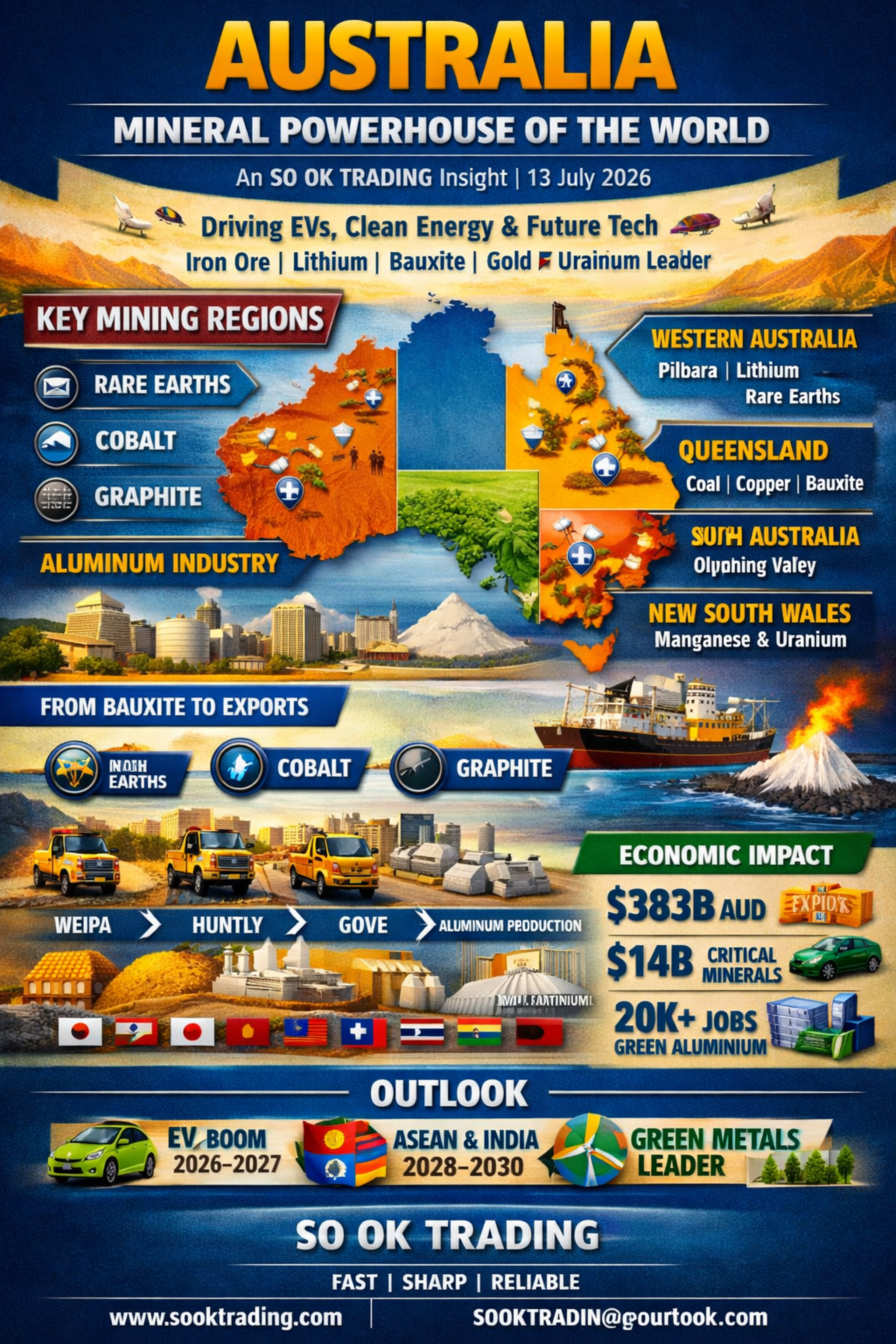
Australia is far more than the land of kangaroos and koalas. It is one of the world’s most influential “mineral treasure troves,” ranking among the top producers and holders of reserves in iron ore, lithium, bauxite, gold, and uranium. This makes Australia a cornerstone of the global supply chain, powering industries from electric vehicles (EVs) to clean energy and future technologies.

 
✨ Key Mining Regions

Western Australia (WA): Pilbara iron ore, Greenbushes lithium, Super Pit gold, nickel, and rare earths
Queensland (QLD): Bowen Basin coal, Mount Isa copper–zinc, Weipa bauxite (largest in the world)
South Australia (SA): Olympic Dam (uranium and copper), Jacinth-Ambrosia (zircon), Coober Pedy (opal)
New South Wales (NSW): Hunter Valley coal, Cadia Valley gold, Broken Hill mines
Northern Territory (NT): Groote Eylandt manganese, uranium
 
⚡ Critical Minerals for the Future Australia is positioning itself as a global supply chain leader, reducing reliance on China:

Rare Earths (REE): Mount Weld (Lynas) → permanent magnets for EVs and wind turbines
Cobalt: Murrin Murrin nickel mines → lithium-ion batteries
Graphite: Eyre Peninsula → battery anodes
 
Industry Giants

BHP Group: Pilbara iron ore, Olympic Dam uranium & copper
Rio Tinto: Bauxite and aluminium leader
Fortescue (FMG): Iron ore powerhouse, now expanding into clean energy
 
Economic Highlights

Mineral & energy exports: AUD 383 billion
Critical minerals revenue: AUD 14 billion
Aluminium industry: 20,000+ jobs, supporting 60,000 households
Government investment: AUD 2 billion in “Green Aluminium” projects
 
 Major Bauxite Deposits

Cape York (QLD): Weipa (Rio Tinto), Bauxite Hills (Metro Mining) → AUD 6 billion/year
Darling Range (WA): Huntly & Willowdale (Alcoa) → supplying alumina refineries
Arnhem Land (NT): Gove (Rio Tinto) → 98% of raw bauxite exported directly to China
 
Aluminium Products

Raw Bauxite: Almost entirely exported to China
Primary Aluminium Ingots: Tomago Smelter (NSW) → Korea, Japan, Vietnam, Taiwan, Thailand
Semi/Finished Products: Sheets, extrusions, foil → USA (aerospace), New Zealand (construction), ASEAN
 
Export Markets – Aluminium

China: 98% of raw bauxite
South Korea: ~USD 1.1B → EVs, electronics, shipbuilding
Japan: ~USD 820M → automotive, infrastructure
Vietnam: ~USD 449M → appliances, metals
Taiwan: ~USD 370M → semiconductors, IT hardware
Thailand: ~USD 370M → automotive parts, wiring (EEC)
 
Summary & Outlook

Short-term (2026–2027): Rising demand for critical minerals & aluminium from EVs and Smart Cities → sustained revenue growth
Mid-term (2028–2030): ASEAN & India markets drive diversification, reducing reliance on China, with major investment in “Green Aluminium”
Long-term: Australia poised to become the global leader in green metals, anchoring EV and renewable energy supply chains
 
Key Takeaway: Australia is the “true player” in the global mineral and aluminium market — from bauxite to advanced products. Thailand is a vital destination, especially in automotive and electrical industries, directly linked to the growth of EVs and Smart Manufacturing.

 
SO OK TRADING: Your Business Partner FAST | SHARP | RELIABLE www.sooktrading.com sooktrading@outlook.com

Related Content
SO OK TRADING'S INSIGHT | The Global Metals Market Turning Point 2027: From the Commodity Cycle to the Critical Minerals Economy | 24 NOV 2026
SO OK TRADING'S INSIGHT As we approach the end of 2026, the global metals market is entering a significant structural turning point. Market dynamics are no longer driven solely by economic cycles. Instead, geopolitical developments, technological security concerns, the global race for AI leadership, and the ongoing restructuring of supply chains are becoming increasingly influential in determining the value of strategic resources. The market is now clearly dividing into two distinct categories. The first consists of Industrial Metals, such as Silicon, Lead, Cobalt, and Molybdenum, whose performance remains closely tied to global economic activity and manufacturing demand. The second consists of Strategic Metals or Critical Minerals, including Antimony, Gallium, Germanium, Tin, and Bismuth, which are benefiting from their growing strategic importance in next-generation industries. Within the industrial metals sector, Silicon and Lead continue to face pressure from slower demand growth and adequate supply conditions. Meanwhile, Cobalt and Molybdenum remain constrained by the moderation of global manufacturing activity. However, Silicon could enter a recovery phase in the second half of 2027 if investment in renewable energy and electric vehicle industries accelerates once again. In contrast, Critical Minerals are attracting increasing attention from investors, manufacturers, and governments worldwide. Antimony is evolving from a traditional industrial raw material into a strategic resource due to its essential role in energy systems, backup power infrastructure, solar glass production, and defense applications. At the same time, Gallium and Germanium have become indispensable materials for AI, semiconductors, 5G telecommunications, and advanced defense technologies. Their strategic significance is increasingly viewed as comparable to that of Rare Earth Elements during previous technology cycles. Tin remains one of the most promising metals, supported by strong demand growth from AI infrastructure, data centers, semiconductor packaging, and advanced electronics manufacturing. Meanwhile, Bismuth continues to benefit from stricter environmental regulations and the global transition toward Lead-Free Manufacturing. Outlook 2027 High Conviction Bullish ✅ Antimony ✅ Gallium ✅ Germanium ✅ Tin ✅ Bismuth Likely to Recover Alongside Global Economic Growth ✅ Silicon ✅ Copper ✅ Aluminum ✅ Zinc Likely to Face Continued Pressure ⚠️ Lead ⚠️ Cobalt ⚠️ Molybdenum SO OK TRADING's Strategic Perspective The year 2027 may mark the beginning of a full-scale transition from a Commodity Economy to a Strategic Materials Economy. Resources linked to AI, semiconductors, renewable energy, and defense technologies are increasingly positioned to command valuation premiums that exceed those traditionally associated with commodity market cycles. As governments and corporations prioritize supply chain resilience and technological sovereignty, access to critical resources is becoming as important as price and production capacity. Consequently, the most important question for industry leaders in the coming decade may no longer be: "Will metal prices rise or fall?" but rather: "Who will be best positioned to secure, manage, and control the critical resources required for the AI era and strategic technologies of the future?" The answer to that question is likely to shape global investment flows, industrial competitiveness, and supply chain strategies throughout the next decade.
24 Nov 2026
“High Oil Prices Today = Inflation Tomorrow: Global Energy Volatility and Thailand’s Strategic Response in Q4 2026”   SO OK TRADING|October 9, 2026
Global Oil Prices, October 9, 2026: Extreme Volatility and Impact on Thailand By SO OK TRADING In October 2026, the global oil market stands at a critical turning point. Crude prices have surged to their highest levels of the year, driven by geopolitical tensions and natural disruptions affecting supply worldwide. Brent Crude briefly broke above $104 per barrel before easing slightly, while West Texas Intermediate (WTI) traded within the range of $90.48 – $91.49 per barrel. This volatility reflects the deep uncertainty in global energy markets, fueled by political, economic, and environmental factors. Key drivers include: Middle East tensions: Houthi attacks on Saudi Arabia and Riyadh, alongside tanker strikes in the Hormuz Strait — a route that carries 20% of global oil shipments. President Donald Trump’s statement: Confirming no military action against Iran before the U.S. midterm elections, easing some market panic. Hurricane Isaias: Shutting down Gulf of Mexico oil platforms, halting production of over 1.3 million barrels per day, or 62.9% of regional output. In this article, SO OK TRADING explores: The latest developments in the global oil market Price outlooks from leading financial institutions Scenario analysis for the coming week Direct impacts on Thailand’s economy — from consumers to businesses and government Follow our in-depth analysis and international trade insights to understand how “High Oil Prices Today = Inflation Tomorrow” will shape the future of Thailand’s economy.
9 Oct 2026
Steel Industry Outlook 2026: Gradual Recovery with Rising Price Potential BY SOOK TRADING
Steel Industry Outlook 2026: Gradual Recovery with Rising Price Potential The year 2026 marks a turning point for the global steel industry. After hitting its lowest point in 2025, the market is entering a “new equilibrium,” with demand gradually recovering and prices showing signs of stable upward movement. Global steel demand is forecast to grow 1.3%, reaching 1,773 million tons. India will be the main driver, with growth of 9% fueled by infrastructure investments in roads, railways, and energy. The United States and Europe are also expected to recover steadily, supported by interest rate cuts, clean energy projects, and the automotive sector—1.8% growth in the US and 3.2% in the EU. China, while still facing a slowdown in real estate, will see demand decline ease to -1%, supported by infrastructure projects and steel exports. Meanwhile, Southeast Asia and the Middle East are expected to contribute to diversified demand growth through infrastructure and energy investments. On the pricing side, steel bars (Rebar) are expected to average 16,000–17,000 THB/ton (450–530 USD/MT). Iron ore costs are projected at 83–95 USD/ton, with new supply from Guinea and Australia helping to stabilize input costs. Although trade barriers in the US and EU may keep domestic prices above global levels, the market is moving toward a more stable balance. In Thailand, steel demand is expected to grow modestly, driven by construction and automotive industries, with a base of 16.2 million tons in 2025. However, cheap Chinese steel could account for up to 50% of the market, putting pressure on local producers. Thai businesses must adapt by developing value-added specialty products, enhancing quality standards, and targeting premium and niche export markets such as ASEAN, the Middle East, and Africa. SO OK Trading: Partnering Thai Steel with Global Markets SO OK Trading supports Thai steel producers with comprehensive solutions: - Market Connectivity: Linking Thai producers with buyers in China and East Asia through an extensive partner network and integrated rail–sea–road logistics. - Market Analysis & Pricing Strategy: Providing insights into steel and iron ore price trends, with index-linked pricing recommendations to reduce volatility. - Stable Contracts & Compliance: Assisting in contract structuring, export documentation, standards, and certifications to ensure reliable trade. - Customer Development: Delivering tailored technical and commercial proposals to meet the needs of Chinese buyers seeking specialty steel. SO OK Trading is more than an exporter—it is a trusted business partner, helping Thai steel enterprises compete with stability and sustainability in the global steel market.
15 Jan 2026
This website uses cookies for best user experience, to find out more you can go to our Privacy Policy and Cookies Policy
Powered By MakeWebEasy Logo MakeWebEasy