SO OK TRADING'S INSIGHT | The Global Metals Market Turning Point 2027: From the Commodity Cycle to the Critical Minerals Economy | 24 NOV 2026
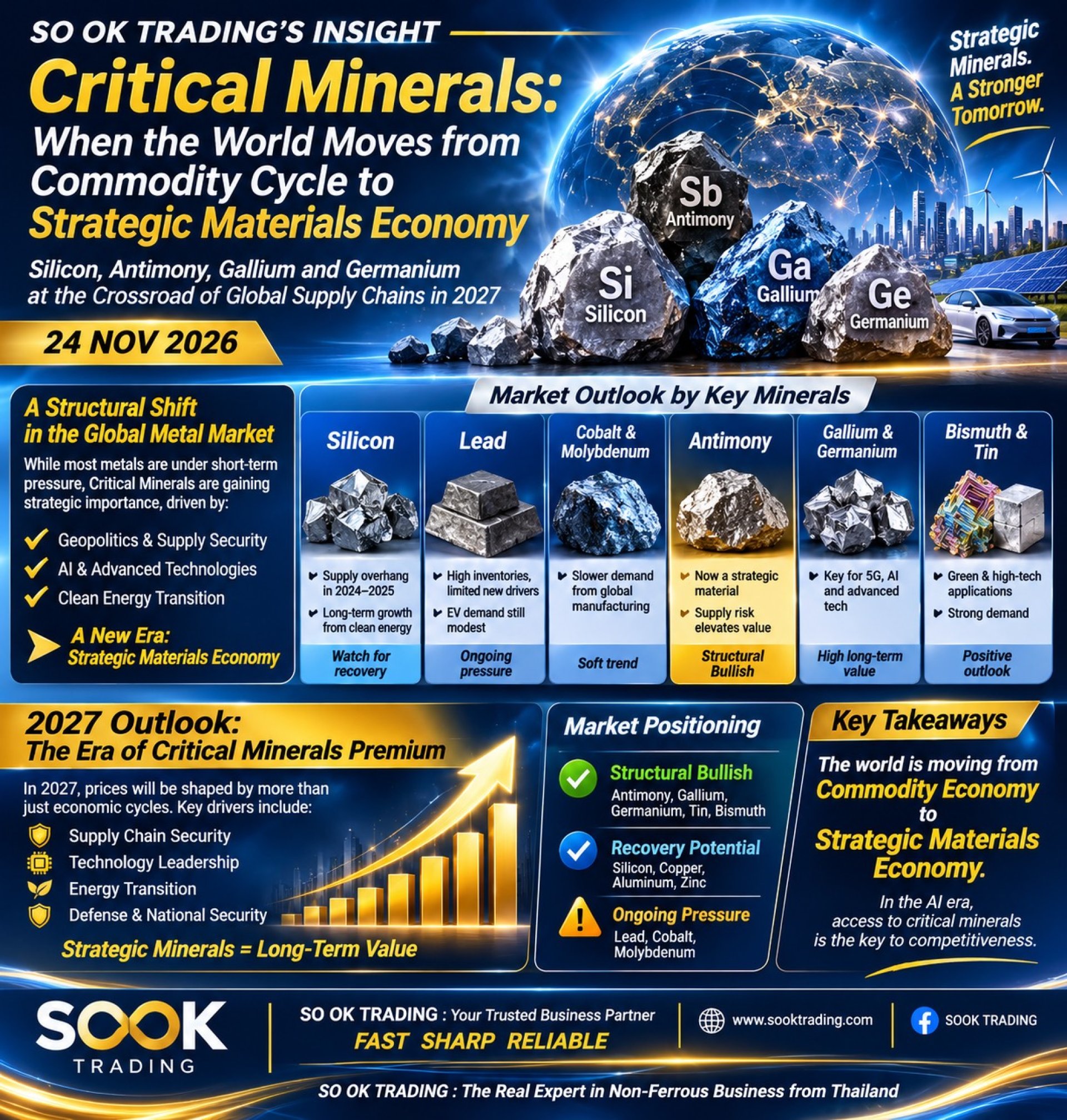
SO OK TRADING'S INSIGHT
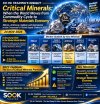
Critical Minerals: As the World Transitions from the Commodity Cycle to the Strategic Materials Economy
Silicon, Antimony, Gallium, and Germanium at the Turning Point of Global Supply Chains Heading into 2027
At the end of November 2026, the global metals market is signaling a structural transformation that extends far beyond short-term price movements. While many metals remain in a correction phase due to seasonal demand weakness, industrial inventory destocking, and ongoing uncertainty in the global economy, a deeper analysis of supply chains and industrial policy reveals that the market is entering a new era.
The factors determining metal values are no longer limited to supply and demand fundamentals alone.
The global metals market is increasingly dividing into two distinct categories. The first consists of Industrial Metals, which continue to move largely in line with global economic cycles. The second consists of Critical Minerals or Strategic Materials, whose valuations are increasingly influenced by geopolitics, technological security, AI competition, and national industrial strategies.
This transition may represent one of the most significant transformations in global raw material markets since the rise of the clean energy era over the past decade.
Industrial Metals Continue to Face Cyclical Pressure
Silicon: A Correction Driven by Short-Term Oversupply
The Silicon Metal market remains under pressure from slower purchasing activity in the aluminum alloy and solar panel industries. Benchmark prices in China have declined to approximately RMB 8,305 per metric ton, while spot prices remain near RMB 9,570 per metric ton.
Although the long-term outlook for renewable energy and electric vehicles remains strong, the aggressive capacity expansion seen during 2024-2025 has led to temporary oversupply conditions, prompting buyers to delay purchases in anticipation of more favorable pricing.
Nevertheless, silicon's long-term fundamentals continue to be supported by growth in renewable energy infrastructure, power transmission networks, and advanced materials used in the electric vehicle sector.
Lead: A Market Still Searching for New Growth Drivers
Lead remains one of the most pressured metals within the base metals sector. LME cash prices continue to trade around US$1,820-1,845 per metric ton, representing their lowest levels in nearly two years.
The primary factors behind this weakness include elevated LME inventories and limited growth in lead-acid battery demand.
While electric vehicles continue to require lead-acid batteries for auxiliary applications, long-term trends suggest that this demand alone may not be sufficient to significantly alter the global lead market's supply-demand balance.
Cobalt and Molybdenum: Impacted by Slowing Global Manufacturing
Both cobalt and molybdenum continue to trade in relatively weak ranges.
Cobalt is facing additional pressure from changes in battery technology, particularly the increasing adoption of LFP (Lithium Iron Phosphate) batteries, while molybdenum remains affected by slower activity in the global steel and stainless-steel sectors.
Antimony: From Commodity to Strategic Asset
Among all metals, antimony may be one of the clearest examples of the world’s ongoing transition.
Following record-high prices reached in 2025, the market entered a correction phase during 2026, with European prices falling to approximately US$25,000-27,000 per metric ton and Asian prices trading between US$15,000-19,000 per metric ton.
Although demand from flame retardants and solar glass applications has moderated due to substitution efforts, antimony's strategic importance continues to rise.
Today, many governments classify antimony as a Critical Mineral because of its importance to energy security, backup power systems, defense applications, and advanced manufacturing technologies.
In this context, antimony prices increasingly reflect supply security and geopolitical risk rather than production costs alone.
Gallium and Germanium: The Foundation of the AI Economy
If oil was the strategic resource of the 20th century, Gallium and Germanium may emerge as two of the most strategically important resources of the 21st century.
Gallium is a key raw material in the production of Gallium Nitride (GaN) and Gallium Arsenide (GaAs), both of which are essential for:
5G telecommunications infrastructure
Advanced radar systems
High-performance semiconductors
AI computing infrastructure
Germanium plays a similarly critical role in:
Fiber optic communication networks
Infrared systems
Defense technologies
Aerospace applications
With China maintaining a dominant position in the production and processing of both metals, global markets are increasingly assigning a "Geopolitical Premium" to these strategic materials.
While short-term volatility may arise from economic cycles, long-term demand continues to be supported by digital infrastructure expansion and AI-driven technological growth.
Bismuth and Tin: Beneficiaries of Technological Transformation
Bismuth is receiving growing attention due to global trends toward Lead-Free Manufacturing and increasingly stringent environmental regulations.
Industries ranging from electronics and automotive manufacturing to healthcare and advanced materials are gradually increasing their use of bismuth as an environmentally friendly substitute for lead.
At the same time, tin remains one of the strongest fundamental stories in the AI era.
Although prices have corrected from their 2026 highs, demand from semiconductor manufacturing, advanced packaging, data centers, and AI hardware continues to expand.
Combined with low global inventories and supply constraints from major producing countries, tin remains well-positioned for medium- and long-term growth.
Outlook 2027: Entering the Era of the Critical Minerals Premium
The year 2027 may become a major turning point for global metals markets.
Historically, metal valuations were primarily driven by:
Global GDP growth
Manufacturing expansion
Production costs
However, the new economic landscape increasingly places value on:
Supply chain security
Access to critical resources
AI technology competition
Industrial policy initiatives
Energy security
National defense priorities
The result is the emergence of what can be described as the:
Critical Minerals Premium
Under this framework, certain strategic resources may continue to trade at premiums above historical averages, even during periods of slower economic growth.
Structural Bullish Outlook
✅ Antimony
✅ Gallium
✅ Germanium
✅ Tin
✅ Bismuth
Potential Recovery Alongside Global Economic Growth
✅ Silicon
✅ Copper
✅ Aluminum
✅ Zinc
Metals Likely to Face Continued Pressure
⚠️ Lead
⚠️ Cobalt
⚠️ Molybdenum
Executive Summary
What the market is reflecting at the end of 2026 is not merely a correction within the traditional commodity cycle. It is a broader structural transformation of the global economy.
The world is increasingly moving from a Commodity Economy to a Strategic Materials Economy.
In the years ahead, the value of certain metals will no longer be determined solely by production volumes or manufacturing costs. Instead, their importance will be measured by their ability to support strategic industries such as AI, semiconductors, renewable energy, defense technology, and next-generation infrastructure.
For industry executives, investors, and business leaders, 2027 may not simply be a year of price recovery. It may represent the beginning of a fundamental revaluation of strategic resources that will shape industrial competitiveness for the next decade.
The key question is therefore no longer:
"Will metal prices rise or fall?"
but rather:
"Who will secure and control the critical resources required to power the AI-driven global economy?"
That question is increasingly becoming the defining force behind the global Critical Minerals market today.
SO OK TRADING: Your Trusted Business Partner
SO OK TRADING: FAST • SHARP • RELIABLE
VISIT US AT: www.sooktrading.com
FACEBOOK: SOOK TRADING
SO OK TRADING
A Leading Non-Ferrous Metals Specialist from Thailand