Share

“Aluminum’s Black Swan: War and Energy Crisis from the Strait of Hormuz to a Global Supply Shock — March 2026”
Last updated: 1 Mar 2026
41 Views

Here’s the full English translation of your text:


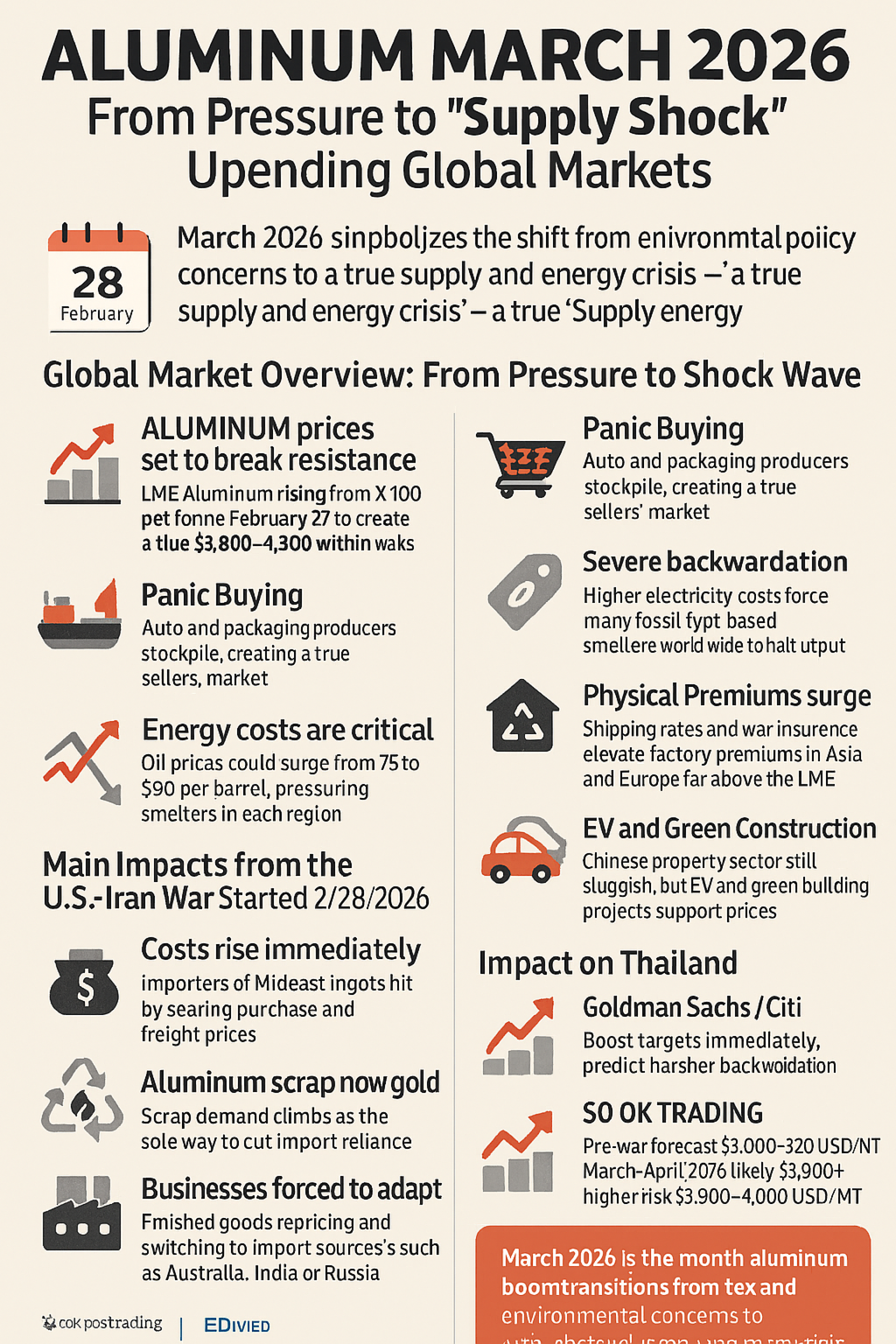
Aluminum in March 2026 – From Pressure to a “Supply Shock” Shaking the Global Market: The Impact of the U.S.–Iran War

March 2026 is not merely a month when the aluminum market must contend with tariffs and environmental measures. It is also the month when the entire world faces a “Black Swan Event” triggered by the closure of the Strait of Hormuz, a consequence of the war between the United States and Iran that began on February 28, 2026. This event has shifted the market equation from policy concerns to a true crisis of supply and energy.


Global Market Overview: From Pressure to Shock Wave

Aluminum prices likely to break resistance: LME aluminum may surge to the range of USD 3,800–4,300 per ton within weeks, from the closing price of USD 3,100 per ton on February 27, 2026. On March 2, the first trading day after the outbreak of the U.S.–Iran war, prices could immediately jump to USD 3,350–3,500 per ton.
Panic buying: Automakers and packaging producers worldwide are rushing to secure raw materials, pushing the market into a true “seller’s market.”
Severe backwardation: Immediate delivery prices are far higher than forward prices, as everyone wants material “right now.”
Energy costs as the decisive factor: Oil prices may rise from USD 75 per barrel to USD 90 per barrel in the short term, exerting heavy cost pressure on smelters across regions.
 

Key Impacts of the U.S.–Iran War (Beginning February 28, 2026)

Supply disruption: The closure of the Strait of Hormuz instantly removes aluminum supply from the Middle East (UAE, Bahrain, Qatar, Saudi Arabia), which accounts for 10% of global output.
Energy crisis: Rising electricity costs worldwide force many fossil-fuel-dependent smelters to halt production.
Physical premium surge: War insurance and freight costs push factory-gate prices in Asia and Europe far above LME screen prices.
EV and green construction demand: Despite China’s property slowdown, demand for aluminum in EVs and green building projects continues to support prices.
 

Impact on Thailand

Costs rise immediately: Importers of aluminum ingots from the Middle East face soaring product and shipping costs.
Scrap becomes “gold”: Domestic demand for aluminum scrap surges, as it is the only viable option to reduce import dependence.
Immediate adaptation required: Manufacturers must adjust finished product prices and seek new import sources from Australia, India, or Russia.
Inventory gains: Those holding old stock benefit from price differentials, but new procurement carries high risk.
 

Financial Institutions’ View

Goldman Sachs / Citi: Raised price forecasts immediately, expecting backwardation to intensify.
 

SO OK TRADING’s Aluminum Price Forecast

Pre-war forecast: USD 3,000–3,200 per MT
Post-war (March–April 2026): Likely above USD 3,500 per MT
If conditions worsen: Prices could rise to USD 3,800–4,000 per MT
 

✨ Conclusion

March 2026 marks the month when the global aluminum market shifted from “concerns over tariffs and environmental measures” to a full-blown “supply and energy crisis.” Those who adapt quickly will not only survive but also seize opportunities from this upheaval.

Recycling is the answer: Investing in aluminum recycling systems ensures cost advantages and sustainability.
Green aluminum carries a premium: Producers complying with CBAM can sell at higher prices.
EV and green construction demand: High-quality aluminum demand remains a long-term driver.
Diversifying import sources: Turning to Australia, India, or Russia reduces reliance on the Middle East.
*** If you require aluminum products, whether ADC12 or primary ingots, please contact SO OK TRADING at www.sooktrading.com → Give Inquiry, or email us at sooktrading@outlook.com.


Related Content
Rare Earths: Neodymium & Dysprosium Powering the Future of Clean Technology and Global Energy Quick Insight by SOOK TRADING
Rare Earth: Neodymium & Dysprosium Strategic Resources Driving the Future of Clean Energy and Global Industry Insight by SOOK TRADING Key Properties - Neodymium (Nd): A silver-gray metal, the core component of Neodymium-Iron-Boron (NdFeB) permanent magnets — the most powerful magnets in the world. It delivers extremely high magnetic strength in a compact size, enabling powerful yet small devices. - Dysprosium (Dy): A rare metal with very high melting and boiling points. It enhances the heat resistance of NdFeB magnets, ensuring stable performance in high-temperature environments such as electric vehicle motors and offshore wind turbines. Strategic Applications (2026) - Electric Vehicles (EVs): NdFeB magnets make motors smaller, lighter, and more powerful, while Dy improves heat resistance and prevents magnetic energy loss. - Renewable Energy: Offshore wind turbines require hundreds of kilograms of NdFeB magnets per megawatt, boosting efficiency and reducing long-term maintenance costs. - Robotics & Automation: Applied in precision joints and drive systems, supporting the growth of industrial robots and smart agricultural robotics. - Electronics & Medical Devices: Used in smartphone speakers, headphones, haptic feedback systems, MRI scanners, and advanced military radar systems. SOOK TRADING — Your Strategic Partner in Rare Earths and Clean Energy Solutions We provide high-quality materials and integrated solutions to power the future of your industry.
22 Jan 2026
COPPER PRICE AND TREND  2026
Copper prices are expected to remain elevated and bullish in 2026, driven by strong demand from the green energy transition (EVs, renewables, grid upgrades) and persistent mine supply constraints/disruptions, with forecasts generally placing prices in the $10,000 to over $12,000 per tonne range, although some analysts foresee a slight cooling to $10,000-$11,000 as market balances tighten. Key factors include IRA spending, AI infrastructure needs, constrained new mine supply, and potential Chinese economic recovery, creating tight markets despite some projected minor surpluses. Key Price Predictions (2026): Goldman Sachs: $10,000 - $11,000/tonne range, averaging $10,710/tonne in H1 2026. J.P. Morgan: Averaging around $12,075/tonne, with potential spikes to $12,500/tonne in Q2. Bank of America: Average of $11,313/tonne, with potential for $15,000/tonne spikes. UBS: $11,000/tonne by Sept 2026. World Bank: Average of $9,800/tonne. Bullish Drivers: Energy Transition: Massive demand for grid expansion, EVs, and renewable infrastructure. AI Infrastructure: Increased demand for data centers. Supply Deficit: Mine disruptions (Grasberg, Kamoa-Kakula, etc.) and difficulty bringing new mines online. China: Potential economic rebound acting as a catalyst. Potential Headwinds/Volatility: Policy-induced Surpluses: E.g., from IRA incentives or scrap availability. Stronger USD: Can weigh on commodity prices. Slower Demand: If China's recovery falters. Overall Outlook: Expect a tight market with strong underlying demand, leading to high prices, but with significant volatility due to policy shifts and mine output fluctuations. The market is moving towards a structural deficit, supporting higher prices long-term
30 Dec 2025
Tin: The Rare Metal Driving Tomorrow’s Technology: SO OK TRADING — Your Bridge in the Era of Scarce Metals
TIN IS NO LONGER JUST METAL — IT’S STRATEGY. As the world races toward clean energy and advanced tech, tin becomes the silent force powering progress. At SO OK TRADING, we deliver high-grade tin from trusted global sources — because your future deserves nothing less.
8 Feb 2026
This website uses cookies for best user experience, to find out more you can go to our Privacy Policy and Cookies Policy
Compare product
0/4
Remove all
Compare
Powered By MakeWebEasy Logo MakeWebEasy