SO OK INSIGHT: Thailand Flood Report – October 10, 2026 | After the Waters Recede, the Recovery Market Booms! Motors, Pumps, and Raw Materials Surge as Demand for Restoration, Repair, and Replacement Products Skyrockets
Last updated: 10 Oct 2026
167 Views
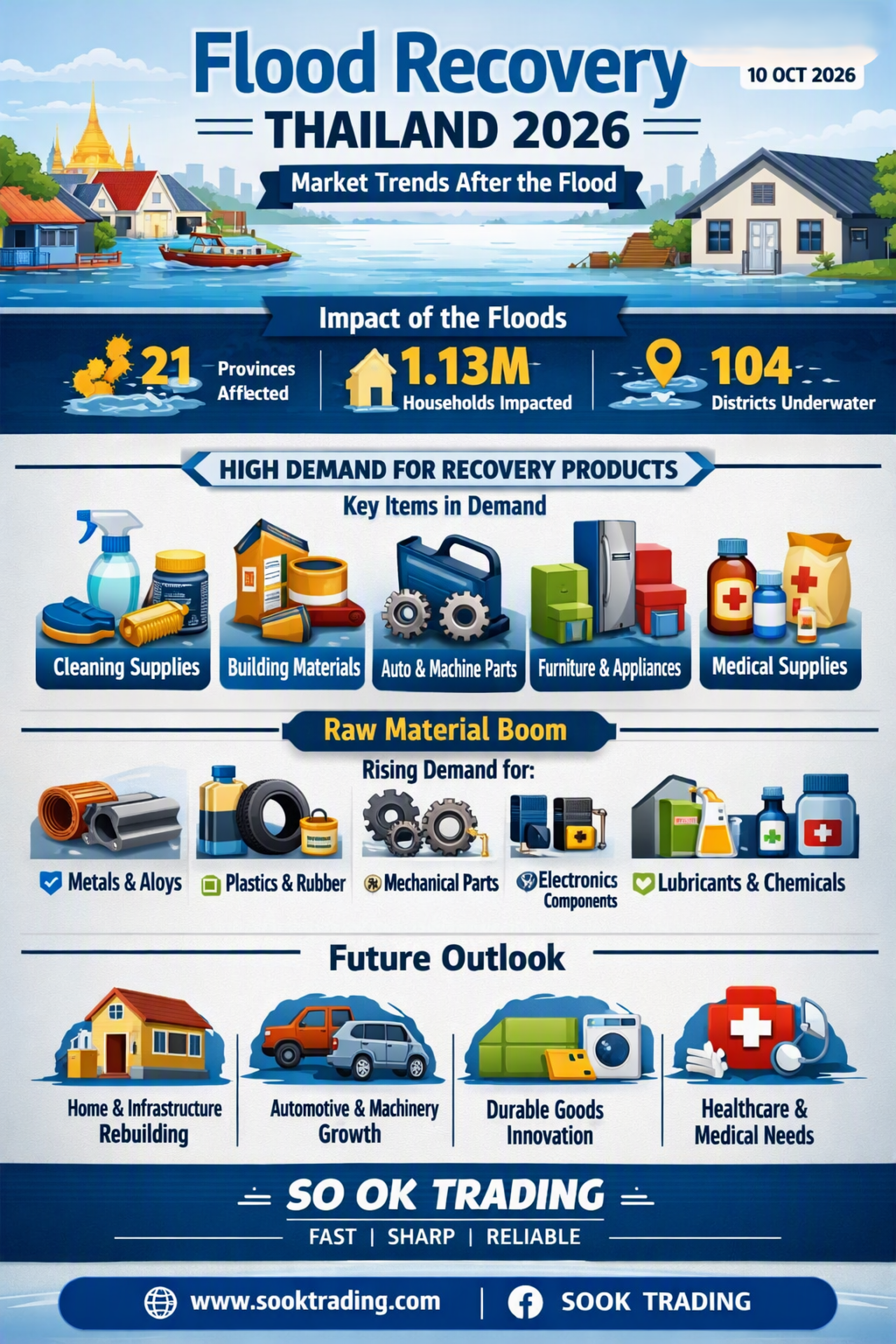
Thailand Flood Situation – October 2026 and Market Recovery Outlook After the Waters Recede SO OK TRADING | October 10, 2026
Introduction
The floods in Thailand in 2026, though not as severe as the great flood of 2011, have still caused widespread impacts on both the population and the economy. Low-lying areas and regions outside flood barriers remain inundated. Post-flood recovery has therefore become a crucial mission involving government, private sector, and local communities. At the same time, it has driven massive demand for recovery, repair, and replacement products and services.
Content
1. Recovery Product Categories After the Flood
Cleaning and Mold Removal Products: floor cleaners, disinfectants, bleach, cleaning tools (coconut brooms, scrubbing brushes, high-pressure water jets)
Construction and Home Repair Materials: paints, moisture-proofing agents, cement, tiles, gypsum boards, electrical supplies (wires, plugs, breakers)
Automotive and Machinery Parts: engine oil, brake pads, air filters, motors, water pumps
Furniture and Replacement Appliances: plastic furniture, stainless steel, steel-frame furniture, basic appliances (fans, refrigerators, washing machines)
Medical and Health Supplies: antifungal creams, disinfectants, anti-diarrheal medicine, paracetamol, mosquito repellent sprays
2. Linkages with Raw Material Industries
The surge in demand for water pumps and air compressors during recovery directly boosts five major raw material sectors:
Metals and minerals: copper, steel, cast iron, aluminum
Petrochemicals, plastics, and rubber: ABS, nylon, PP, synthetic rubber, electrical insulation
Mechanical parts: bearings, steel pressure tanks
Electronic components: capacitors, pressure switches, wires
Lubricants and chemicals: compressor oil, grease
Current Situation
Thailand continues to face flooding in 21 provinces and Bangkok, covering more than 104 districts and affecting 1.13 million households (approx. 3.15 million people). While conditions have eased in many areas, some remain at risk due to new rainfall.
Bangkok and Metropolitan Area: 30 districts declared safe, but 6 eastern districts (e.g., Nong Chok, Lat Krabang, Saphan Sung) remain under watch. Surrounding provinces such as Samut Prakan, Pathum Thani, Nakhon Pathom, and Ratchaburi still have flood pockets.
Central and Eastern Regions: The Chao Phraya River continues discharging 2,200–2,300 m³/s, leaving floodwaters in Ayutthaya, Ang Thong, Sing Buri, and Chai Nat. Chachoengsao remains at high water levels.
Northern Region: Mostly resolved, except for low-lying areas in Bang Rakam (Phitsanulok) and parts of Nakhon Sawan.
⚠️ Precautionary Measures (October 10–13)
Meteorological Department warns of heavy rainfall that may worsen existing flood zones.
Government orders preparedness in 14 southern provinces entering rainy season.
Future Outlook
Housing and Community Recovery Market: continued growth in construction materials and electrical supplies
Automotive and Machinery Industry: strong demand for repair and replacement
Furniture and Appliances: consumer preference shifting toward water- and moisture-resistant products
Raw Material Industries: metals, plastics, and rubber benefiting from motor and compressor production
Medical and Healthcare Sector: rising demand for disease prevention and treatment
Conclusion
The 2026 floods are a critical test for Thailand’s water management and disaster recovery. Although conditions are gradually improving, demand for recovery, repair, and replacement products remains high and will continue to drive the economy in the short to medium term. Meanwhile, raw material and component industries linked to water pumps and compressors will see clear positive impacts.
SO OK TRADING: Your Trusted Business Partner SO OK TRADING: FAST | SHARP | RELIABLE www.sooktrading.com Facebook: SO OK TRADING
Introduction
The floods in Thailand in 2026, though not as severe as the great flood of 2011, have still caused widespread impacts on both the population and the economy. Low-lying areas and regions outside flood barriers remain inundated. Post-flood recovery has therefore become a crucial mission involving government, private sector, and local communities. At the same time, it has driven massive demand for recovery, repair, and replacement products and services.
Content
1. Recovery Product Categories After the Flood
Cleaning and Mold Removal Products: floor cleaners, disinfectants, bleach, cleaning tools (coconut brooms, scrubbing brushes, high-pressure water jets)
Construction and Home Repair Materials: paints, moisture-proofing agents, cement, tiles, gypsum boards, electrical supplies (wires, plugs, breakers)
Automotive and Machinery Parts: engine oil, brake pads, air filters, motors, water pumps
Furniture and Replacement Appliances: plastic furniture, stainless steel, steel-frame furniture, basic appliances (fans, refrigerators, washing machines)
Medical and Health Supplies: antifungal creams, disinfectants, anti-diarrheal medicine, paracetamol, mosquito repellent sprays
2. Linkages with Raw Material Industries
The surge in demand for water pumps and air compressors during recovery directly boosts five major raw material sectors:
Metals and minerals: copper, steel, cast iron, aluminum
Petrochemicals, plastics, and rubber: ABS, nylon, PP, synthetic rubber, electrical insulation
Mechanical parts: bearings, steel pressure tanks
Electronic components: capacitors, pressure switches, wires
Lubricants and chemicals: compressor oil, grease
Current Situation
Thailand continues to face flooding in 21 provinces and Bangkok, covering more than 104 districts and affecting 1.13 million households (approx. 3.15 million people). While conditions have eased in many areas, some remain at risk due to new rainfall.
Bangkok and Metropolitan Area: 30 districts declared safe, but 6 eastern districts (e.g., Nong Chok, Lat Krabang, Saphan Sung) remain under watch. Surrounding provinces such as Samut Prakan, Pathum Thani, Nakhon Pathom, and Ratchaburi still have flood pockets.
Central and Eastern Regions: The Chao Phraya River continues discharging 2,200–2,300 m³/s, leaving floodwaters in Ayutthaya, Ang Thong, Sing Buri, and Chai Nat. Chachoengsao remains at high water levels.
Northern Region: Mostly resolved, except for low-lying areas in Bang Rakam (Phitsanulok) and parts of Nakhon Sawan.
⚠️ Precautionary Measures (October 10–13)
Meteorological Department warns of heavy rainfall that may worsen existing flood zones.
Government orders preparedness in 14 southern provinces entering rainy season.
Future Outlook
Housing and Community Recovery Market: continued growth in construction materials and electrical supplies
Automotive and Machinery Industry: strong demand for repair and replacement
Furniture and Appliances: consumer preference shifting toward water- and moisture-resistant products
Raw Material Industries: metals, plastics, and rubber benefiting from motor and compressor production
Medical and Healthcare Sector: rising demand for disease prevention and treatment
Conclusion
The 2026 floods are a critical test for Thailand’s water management and disaster recovery. Although conditions are gradually improving, demand for recovery, repair, and replacement products remains high and will continue to drive the economy in the short to medium term. Meanwhile, raw material and component industries linked to water pumps and compressors will see clear positive impacts.
SO OK TRADING: Your Trusted Business Partner SO OK TRADING: FAST | SHARP | RELIABLE www.sooktrading.com Facebook: SO OK TRADING

Related Content

Copper Crunch 2026: When Copper Becomes the “Strategic Metal” of the Future
1 Apr 2026
