“China Reshaping the Global Metals Game: Aluminium–Copper Investment Strategy Towards a Clean Energy and AI Future” SO OK TRADING’s Insight | October 28, 2026
China and the Battlefield of Aluminum & Copper: Structural Transition and Global Investment Strategy (2026)
SO OK TRADING | October 28, 2026
Introduction
In 2026, China remains the dominant player shaping the global base metals market, particularly aluminum and copper. Both metals face mounting pressures from environmental regulations, AI-driven technological competition, and strategic adjustments to safeguard economic stability and global supply chains. Aggressive overseas investment has become both China’s “lifeline” and “offensive strategy.”
1. Aluminum Industry
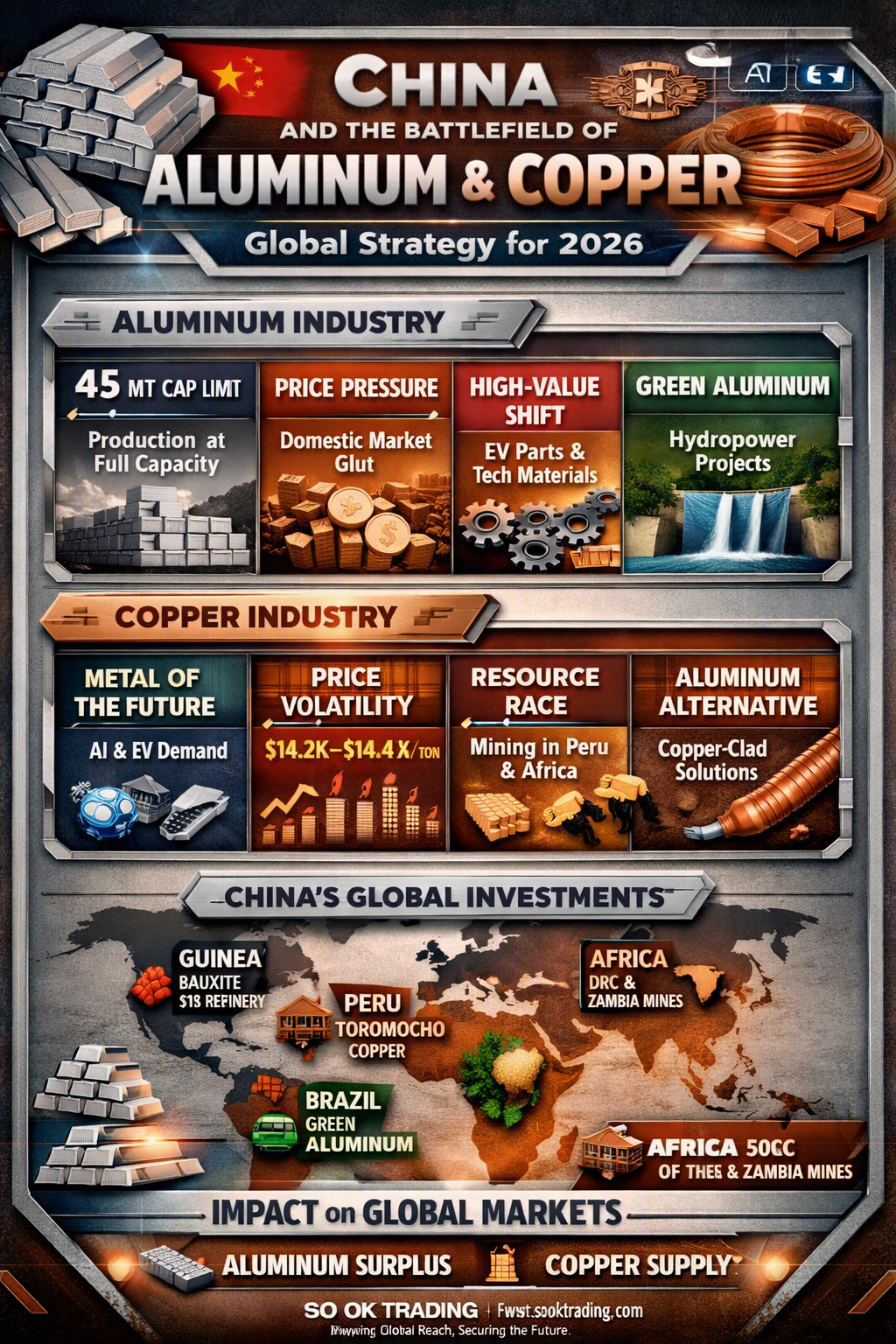
Production Cap Reached: China has set an annual production ceiling of 45 million tons to control pollution. Current output is near full capacity, reducing net exports and tightening global supply.
Domestic Price War: The slowdown in real estate has led to oversupply of construction-grade aluminum, sparking intense price competition.
Strategic Shift: Chinese factories are pivoting toward high-value products such as electronic components, EV parts, and aerospace materials, while relocating production bases to Indonesia and Malaysia.
Green Aluminum: The government promotes renewable energy–based production, notably hydropower projects in Malaysia’s Sarawak state, to meet strict EU and U.S. carbon border tax (CBAM) requirements.
2. Copper Industry
Metal of the Future: Copper is vital for AI infrastructure, EVs, and renewable energy, driving surging demand.
Price Volatility: In recent quarters, global copper prices (LME) fell to USD 14,200–14,400 per ton, pressured by slowing Chinese industrial profits and U.S. tariff concerns.
Global Resource Race: China and the U.S. compete for access to copper mines in Peru and other regions to secure supply chains.
Aluminum Substitution: High copper prices have prompted industries to substitute aluminum in applications such as wiring and motors. China is advancing “Copper-Clad Aluminum” technology to cut costs.
3. China’s Overseas Investment Strategy
Guinea (West Africa): Boffa bauxite mine (reserves of 1.75 billion tons) and a new USD 1 billion alumina refinery.
Peru (South America): Toromocho copper mine, accounting for 10% of national output, with an additional USD 700 million investment and AI/5G technology integration.
Brazil: Acquisition of a 68.6% stake in Companhia Brasileira de Alumínio (CBA) for USD 903 million, securing a green aluminum production base.
Indonesia: Emerged as the fastest-growing aluminum hub after banning raw bauxite exports, with major Chinese investors (Tsingshan, Nanshan, East Hope, Weiqiao) building large smelters.
Malaysia: Focus on Sarawak, leveraging hydropower to produce low-carbon aluminum for EV and advanced technology markets.
4. Copper Expansion in Africa
DRC (Democratic Republic of Congo): One of the world’s largest copper and cobalt producers. China has invested in Kamoa-Kakula and Tenke Fungurume mines to secure raw materials for EVs and AI.
Zambia: Joint ventures with local and international firms in Lumwana and Kansanshi mines to boost copper output for global markets.
Namibia & Tanzania: Exploration and investment in new copper projects to supplement the Copperbelt region.
Strategic Connectivity: Mining investments are paired with infrastructure development—railways and ports—to ease logistics bottlenecks and enhance export capacity.
5. Impact on Global Markets
Aluminum supply from Indonesia is expected to reach 2.5 million tons, creating a global surplus of about 1.5 million tons.
Copper from Africa and South America will serve as new “lifelines” for global supply chains, with China controlling over 50% of global smelting and processing capacity.
Outlook and Future Direction
Aluminum: China will continue advancing green aluminum and high-value products to avoid price wars and meet stringent environmental standards.
Copper: Demand from AI and EVs will keep copper a strategic metal, with China accelerating African expansion to secure supply.
Overseas Investment: Expansion in ASEAN, South America, and Africa will be central to balancing domestic production control with global demand.
Conclusion
China is at a critical turning point in the base metals industry. Aluminum must transition from volume-driven production to quality and clean energy, while copper remains a strategic metal amid fierce competition with other global powers. Expanding investment bases in Africa, ASEAN, and South America represents both China’s “survival path” and “offensive strategy,” shaping the future of the global metals market in the coming decade.
SO OK TRADING — FAST • SHARP • RELIABLE Your trusted partner in metals business www.sooktrading.com Facebook: SO OK TRADING
SO OK TRADING — The true force in Non-Ferrous Metals from Thailand