“Vietnam 2026: Economic Boom Surpassing Thailand on the ASEAN Stage” Article by SO OK TRADING | August 21, 2026
Vietnam’s Economy 2026 – Leap Toward ASEAN Leadership
By: SO OK TRADING | August 21, 2026
Current Economic Landscape
Vietnam’s economy in 2026 continues to maintain outstanding high growth within ASEAN. The main drivers are exports and foreign direct investment (FDI), pushing Vietnam’s GDP close to Thailand’s and likely to surpass it soon. Meanwhile, the government faces challenges in balancing aggressive growth with domestic financial stability.
Key Growth Drivers
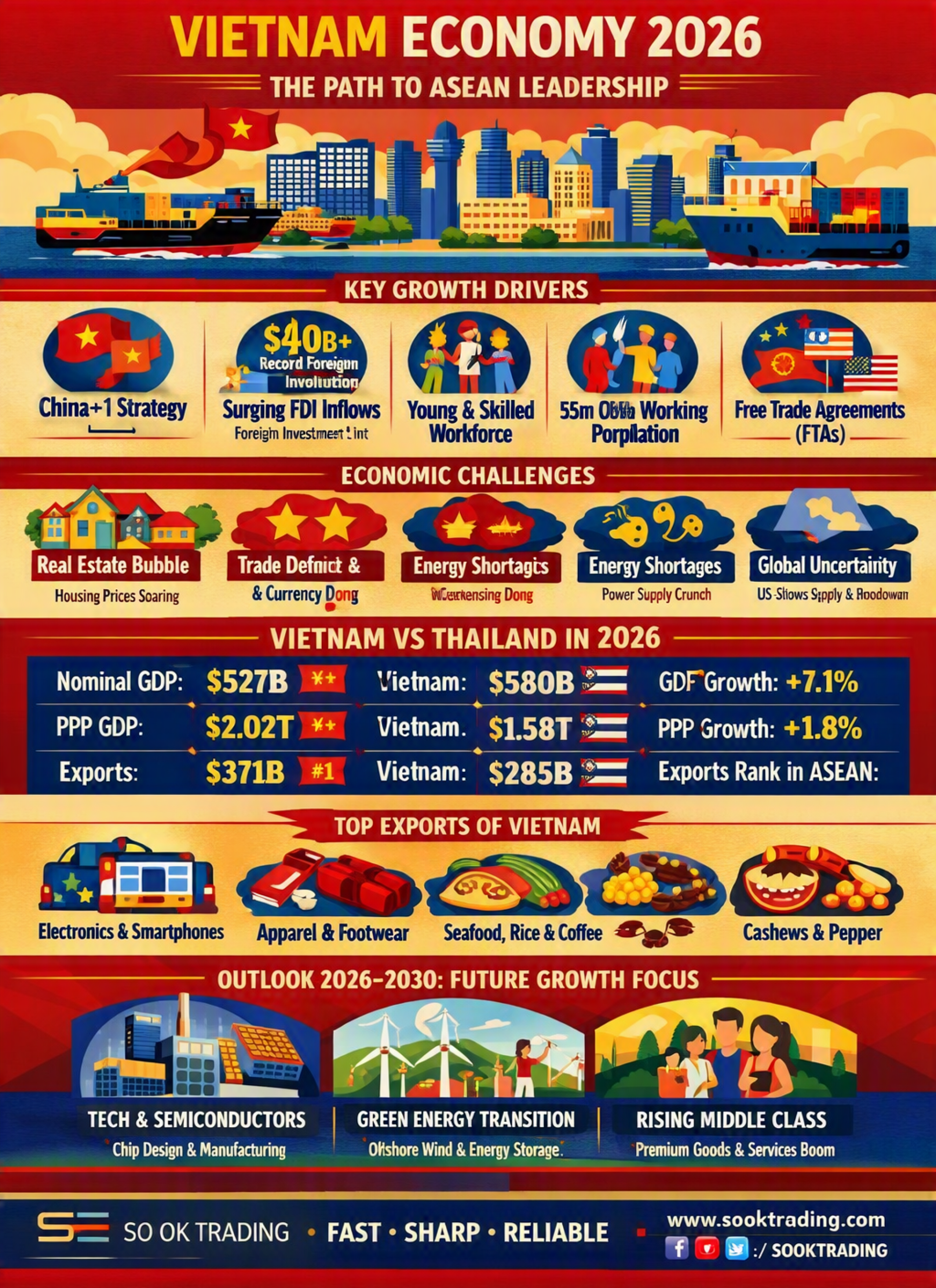
Global Production Base (China+1): Relocation of manufacturing from China has positioned Vietnam as a hub for electronics and technology.
Investor Confidence: FDI has surged to record highs, with business confidence indices remaining strong.
Demographic Advantage: A large young workforce, competitive wages, and a rapidly expanding middle class.
Exports and FTAs: Free trade agreements give Vietnam an edge in exports to the U.S. and Europe.
⚠️ Risks and Challenges
Overheated Real Estate: Housing prices in Hanoi and Ho Chi Minh City far exceed household incomes, threatening financial stability.
Trade Deficit and Currency Volatility: Imports growing faster than exports put pressure on the dong.
Infrastructure and Energy Shortages: Electricity supply gaps and delays in major projects.
Global Economic Slowdown: Risks from U.S.–China trade tensions and downturns in key trading partners.
Thailand vs Vietnam Economic Comparison (2026 Forecast)
Nominal GDP: Thailand $580 billion / Vietnam $527.27 billion → Thailand slightly higher
GDP Growth: Thailand 1.5–2% / Vietnam 7.1% → Vietnam growing ~4 times faster
PPP GDP: Vietnam $20.25 trillion → Already surpassing Thailand when adjusted for cost of living
Per Capita Income: Thailand $8,105 / Vietnam $5,115 → Thailand ~1.6 times higher
Exports: Thailand $285 billion / Vietnam $371 billion → Vietnam clearly ahead
Industry Deep Dive
Technology & Electronics: Vietnam is a production base for smartphones and advanced chips, attracting Samsung, Intel, and Foxconn.
Clean Energy: Leading in solar and wind power, though transmission systems remain incomplete.
Real Estate: Market is booming but faces liquidity risks; Thailand’s property market is slowing except for commercial real estate.
Strategic Directions for Thai Businesses
Competitive Strategy: Upgrade to automation, leverage clean energy strengths, and develop creative economy and high-value services.
Cooperation Strategy: Adopt the Thailand + Vietnam model, expand retail and services in Vietnam, and pursue joint ventures in clean energy and infrastructure.
Vietnam’s Key Export Products
Mobile phones and electronic devices (over 30% of total exports)
Machinery and electrical wiring
Textiles and footwear (Nike, Adidas)
Rice, Robusta coffee, seafood, cashew nuts, pepper
Major Markets: U.S., China, EU, ASEAN, Japan
Vietnam’s Economic Outlook (2026–2030)
GDP growth: Average 6.5–7.1% per year
Inflation: 3.5–4%
FDI growth: 8–10% per year
Three Pillars of Vietnam’s Future Economy
Semiconductor & Tech Boom – Moving into chip design and packaging
Green Transition – Offshore wind power and energy storage systems
Domestic Consumption Premiumization – Middle class shifting toward branded goods, EVs, life insurance, and education
✨ Conclusion
Vietnam is transforming from a “manufacturing factory” into a “new economic trendsetter of ASEAN.” Quality growth focused on technology and stability will be the key. For Thai investors and entrepreneurs, this is a golden opportunity to participate, but careful risk management regarding regulations, currency, and real estate is essential.
SO OK TRADING: Your Business Partner FAST SHARP RELIABLE VISIT US : WWW.SOOKTRADING.COM FACEBOOK : SO OK TRADING