Share

“Aluminum Scrap = The New Gold of Recycling : Driving the Circular Economy, Rising as a Global Strategic Asset — Aluminum Scrap 2026” SO OK TRADING | 30 MAY 2026
Last updated: 30 May 2026
4749 Views

Aluminum Scrap: From Waste to Strategic Asset in the Circular Economy Era
SO OK TRADING | 30 May 2026

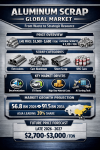
Aluminum scrap, once regarded as mere “waste,” is now being elevated into a premium raw material fiercely contested in global markets. In 2026, prices have surged to their highest level in four years, positioning aluminum scrap as the “new gold” of recycling and future industries.

 
Types of Aluminum Scrap
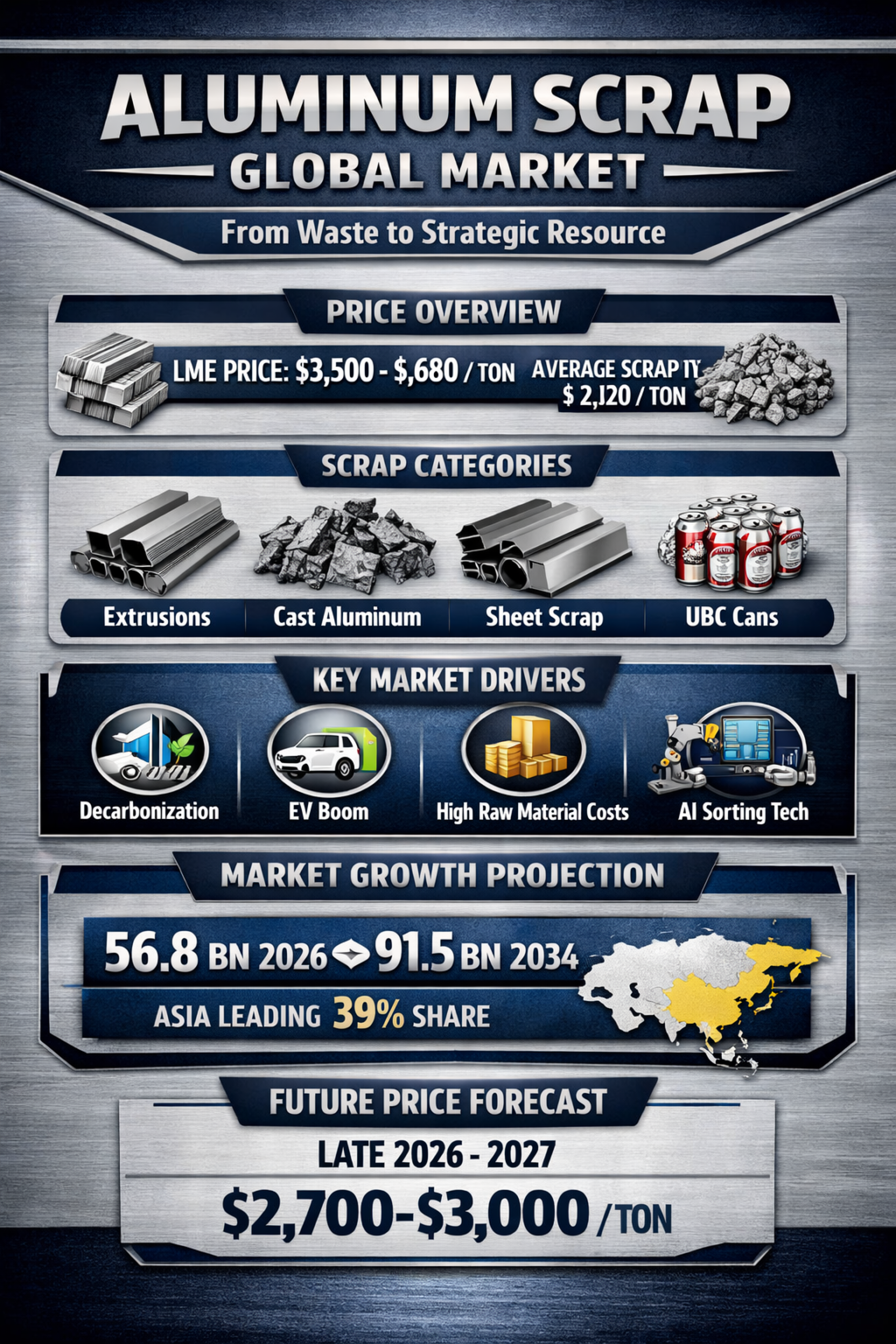
Extrusions (ISRI: Tabor/Tata) Clean window and door frames, the highest value category.
Cast Aluminum (ISRI: Tense) Engine parts, cylinder heads—strong and valuable.
Sheet Aluminum (ISRI: Taint/Tabor) Pots, pans, thin sheets, fenders.
UBC (Used Beverage Cans) Soda and beer cans, easy to recycle with a dedicated market.
Special Grades: Alloy wheels (Troma), bare wire (Talon/Taste), litho plates (Tabloid), mixed/dirty scrap (Talk).
 
Current Prices (May 2026)
Global Market (LME Cash): USD 3,680 – 3,735 / ton ≈ 138 – 145 THB/kg
Average Scrap Price: USD 2,150 – 2,520 / ton ≈ 80 – 98 THB/kg
Thailand Retail Buying Prices

Bare Wire: 80–81 THB/kg
Alloy Wheels: 81 THB/kg
Clean Extrusions: 70–74 THB/kg
UBC Cans: 64–68 THB/kg
 
Market Drivers
Decarbonization Policies Recycling aluminum consumes 95% less energy than primary smelting, helping brands comply with EU CBAM regulations.
EV Transition Surging demand for lightweight materials and recycled components.
High Primary Costs Smelters turn to scrap to reduce expenses.
AI Sorting Technology Advanced systems deliver cleaner scrap, enabling use in high-tech industries.
 
Global Market Outlook
Market value projected to grow from USD 56.77 billion (2026) to USD 91.49 billion (2034).
Asia-Pacific leads with 39% market share, driven by China and India.
Risk: Collection networks lag behind demand, keeping supply tight.
 
Future Price Forecast
Short Term (Q2–Q3 2026): Prices remain bullish at USD 3,500 – 3,900 / ton, influenced by geopolitical tensions and Guinea’s bauxite export controls.
Medium Term (Late 2026–2027): Prices expected to stabilize at USD 2,700 – 3,000 / ton as new supply from Indonesia enters the market.
Long Term: World Bank projects USD 2,700 / ton, still above historical averages (USD 2,419 / ton in 2024).
 
SO OK TRADING
Your trusted partner in the new era of metals FAST | SHARP | RELIABLE www.sooktrading.com Facebook: SO OK TRADING


Related Content
“Wood Pellets: Renewable Energy of the Future — Transforming Global Energy Amid the 2026 USA–Iran War, CBAM, and Net Zero”
Impact of the 2026 Gulf War: As Oil Prices Surge, CBAM Takes Effect, and the World Accelerates Toward Net Zero With fossil fuels becoming a global risk, Wood Pellets (biomass fuel) are emerging as the new answer for industries worldwide. ✅ Oil prices soar to $125 → Businesses turn to renewable fuels ✅ CBAM enforcement begins → Factories must adapt to stay competitive ✅ Net Zero by 2050 → Wood Pellets truly help reduce greenhouse gas emissions ✅ Thailand’s strong potential → Production, exports, and domestic use strengthen energy security
8 Mar 2026
Steel Industry Outlook 2026: Gradual Recovery with Rising Price Potential BY SOOK TRADING
Steel Industry Outlook 2026: Gradual Recovery with Rising Price Potential The year 2026 marks a turning point for the global steel industry. After hitting its lowest point in 2025, the market is entering a “new equilibrium,” with demand gradually recovering and prices showing signs of stable upward movement. Global steel demand is forecast to grow 1.3%, reaching 1,773 million tons. India will be the main driver, with growth of 9% fueled by infrastructure investments in roads, railways, and energy. The United States and Europe are also expected to recover steadily, supported by interest rate cuts, clean energy projects, and the automotive sector—1.8% growth in the US and 3.2% in the EU. China, while still facing a slowdown in real estate, will see demand decline ease to -1%, supported by infrastructure projects and steel exports. Meanwhile, Southeast Asia and the Middle East are expected to contribute to diversified demand growth through infrastructure and energy investments. On the pricing side, steel bars (Rebar) are expected to average 16,000–17,000 THB/ton (450–530 USD/MT). Iron ore costs are projected at 83–95 USD/ton, with new supply from Guinea and Australia helping to stabilize input costs. Although trade barriers in the US and EU may keep domestic prices above global levels, the market is moving toward a more stable balance. In Thailand, steel demand is expected to grow modestly, driven by construction and automotive industries, with a base of 16.2 million tons in 2025. However, cheap Chinese steel could account for up to 50% of the market, putting pressure on local producers. Thai businesses must adapt by developing value-added specialty products, enhancing quality standards, and targeting premium and niche export markets such as ASEAN, the Middle East, and Africa. SO OK Trading: Partnering Thai Steel with Global Markets SO OK Trading supports Thai steel producers with comprehensive solutions: - Market Connectivity: Linking Thai producers with buyers in China and East Asia through an extensive partner network and integrated rail–sea–road logistics. - Market Analysis & Pricing Strategy: Providing insights into steel and iron ore price trends, with index-linked pricing recommendations to reduce volatility. - Stable Contracts & Compliance: Assisting in contract structuring, export documentation, standards, and certifications to ensure reliable trade. - Customer Development: Delivering tailored technical and commercial proposals to meet the needs of Chinese buyers seeking specialty steel. SO OK Trading is more than an exporter—it is a trusted business partner, helping Thai steel enterprises compete with stability and sustainability in the global steel market.
15 Jan 2026
“Thai Steel Outlook 2026: From Pressure to Green Steel Opportunities – SO OK TRADING’s Analysis of the 4 Cost Shocks and H2 Market Outlook”   24 June 2026
“Thai Steel in 4 Cost Shocks: Pivot to Green Steel and H2 2026 Outlook” SO OK TRADING | 24 June 2026 The Thai steel industry is now at a critical turning point — facing pressures from rising energy costs, soaring shipping rates, and fierce competition from cheap imported steel. Yet within this crisis lies a new opportunity: the global transition toward Green Steel, recycled steel that is environmentally friendly and aligned with international standards. In this article, SO OK TRADING takes you through:
24 Jun 2026
This website uses cookies for best user experience, to find out more you can go to our Privacy Policy and Cookies Policy
Powered By MakeWebEasy Logo MakeWebEasy