“Global Transformation in the Low Fertility Era: A Turning Point for the World Economy — TOTAL CHANGE OVER”
Global Demographics & Economy in the Low Fertility Era
SO OK TRADING : 21 July 2026
Global Population Trends
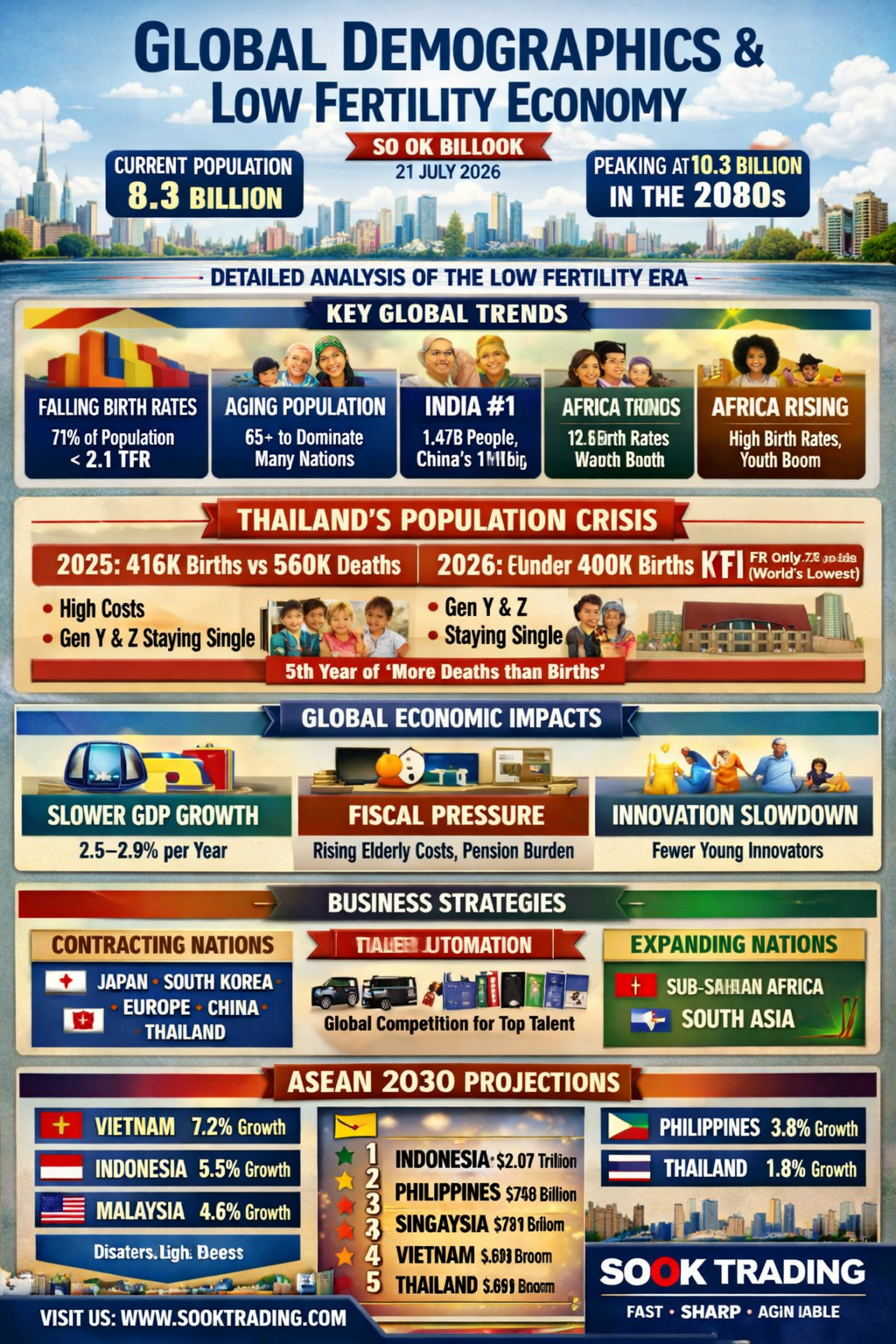
The world’s population now exceeds 8.3 billion. While it continues to grow, the pace is slowing. It is projected to peak at 10.3 billion in the mid‑2080s, before entering decline for the first time in modern history.
Four Key Trends
Falling Birth Rates Worldwide — Over 71% of the global population lives in countries with fertility rates below 2.1. Nations such as Japan, South Korea, and parts of Europe have rates below 1.0, a critical threshold.
Aging Societies — Medical innovation has extended life expectancy, making those aged 65+ the dominant demographic in many countries.
India Becomes #1 — With 1.469 billion people, India has surpassed China (1.407 billion), powered by a vast young workforce.
Africa Rising — The only region with consistently high birth rates, Africa has the largest share of children and youth, positioning it as a future labor hub and emerging market.
Thailand’s Demographic Crisis
Thailand faces its most severe population contraction in 75 years.
2025: 416,574 births vs. 559,684 deaths → “More deaths than births” for the 5th consecutive year
2026: Births expected to fall below 400,000 for the first time
Key Drivers
Economic pressures and high living costs
Gen Y & Gen Z values (late marriage, single lifestyle, avoiding obligations)
Fertility rate at 0.78 — the lowest in the world
Population Projections
2026: 65.8 million
2035: 61.9 million, with 3.4 million fewer workers and over 28% elderly
2044: Below 60 million, school closures, severe labor shortages
Global Economic Impacts
Slower GDP Growth — Reduced labor supply limits global growth to 2.5–2.9%
Fiscal & Pension Strain — Lower tax revenues but rising elderly welfare costs
Innovation Risks — Fewer young researchers and entrepreneurs
Business Adaptations
AI & Automation — Technology replacing human labor, boosting productivity
War for Talent — Nations competing to attract skilled workers via Talent Visas
Silver Economy — Growth in healthcare, wellness tourism, and senior technologies
Demographic Divide in Global Economics
Contracting Nations: Japan, South Korea, China, Europe, Thailand → shrinking domestic markets, reliant on exports and migrant labor
Expanding Nations: Africa, parts of South Asia → rising labor force and new markets
ASEAN Demographics & Economy
Highest Birth Rates: Timor‑Leste (21.9/1,000), Laos (20.8), Cambodia (20.1)
Lowest Birth Rates: Singapore & Thailand (~8/1,000)
ASEAN Economic Outlook 2026
Rising Stars: Vietnam 7.2%, Indonesia 5.2–5.6%, Malaysia 4.6%
Fragile Economies: Philippines 3.8%, Thailand 1.8–2.0%
ASEAN GDP Rankings 2030
Indonesia ($2.07 trillion)
Philippines ($746 billion)
Singapore ($721 billion)
Vietnam ($666 billion)
Thailand ($654 billion)
Three Global Megatrends in the Low Fertility Era
Digital economy doubling in scale
Production relocation under the “China+1” strategy
Transition to clean energy
Conclusion
The world is entering the Low Fertility Era, where economies shift from labor‑driven growth to productivity‑driven growth. Nations and businesses that survive will be those that adapt — moving from labor‑intensive systems to value creation through technology and AI.
SO OK TRADING — Your Business Partner in the Low Fertility Era www.sooktrading.com Facebook: SOOK TRADING