“Copper vs Aluminum: Dual Metal Power Driving Motors & Compressors Toward a Clean Energy Future — SO OK TRADING INSIGHT” : 29 AUG 2026
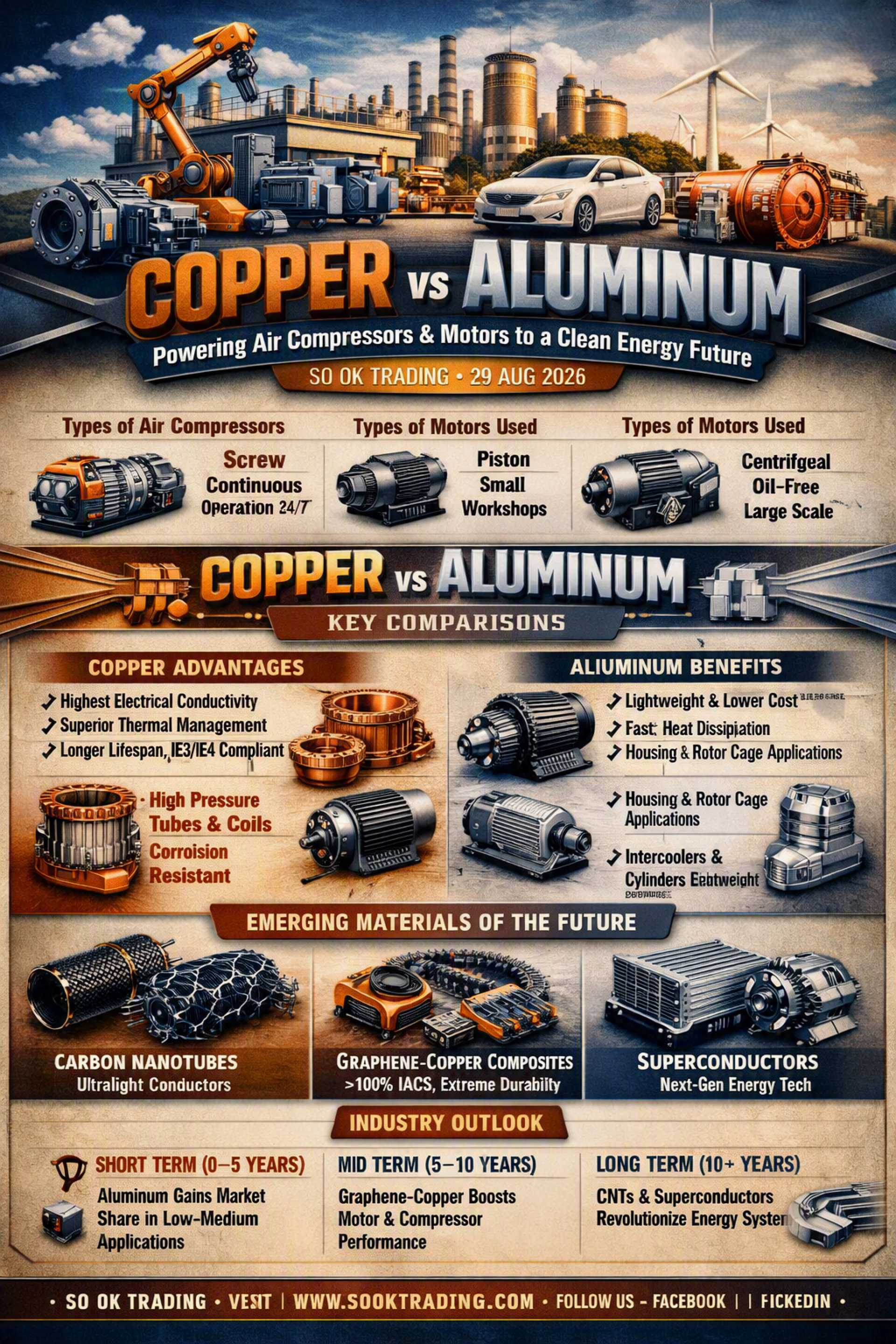
“Copper vs Aluminum: The Core of Motor & Air Compressor Industries Driving Toward a Clean Energy Future” | SO OK TRADING | 29 AUG 2026
Introduction In the modern industrial world, motors and air compressors are the beating heart of global manufacturing systems. From robotic arms in automotive assembly lines, to compressed air in food and pharmaceutical industries, and precision-driven electronics, every process relies on the “power of air” generated by high-performance machinery.
Behind this efficiency lies the choice of conductive and thermal metals. Among them, Copper and Aluminum stand as the two essential materials shaping the pillars of energy, efficiency, and sustainability in the clean energy era.
Copper delivers unmatched precision and stability, while Aluminum offers lightweight versatility and cost efficiency. Together, they play critical roles in motors and compressors — from internal windings to external structures — balancing energy, cost, and durability.
Types of Air Compressors (Copper & Aluminum Applications)
Screw Compressor: Continuous operation, ideal for 24/7 use
Piston Compressor: Common in small factories and automotive workshops
Centrifugal Compressor: Oil-Free, massive airflow, suited for power plants and chemical industries
Types of Motors (Copper & Aluminum Driven)
AC Induction Motor: Reliable, durable, easy maintenance
Inverter/VFD Motor: Variable speed, 30–50% energy savings
Permanent Magnet Motor: High efficiency, compact size, superior cooling
Standards in Thailand
TIS 812-2558: Safety standards for motor compressors
Efficiency Levels IE1–IE4: IE3–IE4 widely adopted to reduce long-term electricity costs
Copper vs Aluminum
In Motors
Copper: Excellent conductivity, reduced heat, long lifespan, essential for IE3–IE4 motors
Aluminum: Lightweight, fast cooling, cost-effective, suitable for housings and rotor cages
In Compressors
Copper: Tubes, coils, bushings → high pressure resistance, corrosion-free
Aluminum: Intercoolers, cylinders → rapid heat dissipation, reduced weight
Current Trend
Factories increasingly invest in pure copper-wound IE3/IE4 motors for long-term energy savings
Aluminum plays a growing role in structural components and cooling systems
Future Materials
Carbon Nanomaterials (CNT, Galvorn): 5–6 times lighter than copper, superior conductivity
Graphene-Copper Composites: Conductivity beyond 100% IACS, 3x corrosion resistance, applied in data centers and EVs
Superconductors & Advanced Semiconductors: Ruthenium, Tungsten, HTS → zero energy loss, next-gen chip and high-voltage transmission applications
Outlook: Future Direction of Copper & Aluminum in Industry
Short Term (0–5 years): Aluminum continues to gain market share in low-to-medium voltage applications such as wiring and air-conditioning coils
Mid Term (5–10 years): Graphene-Copper composites enhance durability and conductivity, complementing copper in high-performance applications
Long Term (10+ years): Carbon Nanotubes and Superconductors emerge as game changers in EVs and high-voltage infrastructure
Core Goal: Energy savings, cost reduction, and alignment with renewable energy and low-carbon economic transition
✨ SO OK TRADING — FAST • SHARP • RELIABLE Your trusted partner in driving Thai industries toward global standards.
Visit us: www.sooktrading.com Facebook: SO OK TRADING