“Recycling 2026: Transforming Waste into the Resources of Tomorrow, Driving the World with the Power of Circular Economy” SO OK TRADING : August 18, 2026
“Recycling 2026 – When Waste Becomes a Global Strategic Resource”
SO OK TRADING : August 18, 2026
Introduction
The year 2026 marks a major turning point for the recycling industry. The world no longer sees it as mere “waste management,” but as the heart of the Circular Economy and a pillar of Resource Security that every nation must compete to develop. Metals, plastics, rare earths, and even waste-to-energy are now elevated into valuable reserves—strategic lifelines for global industries.
Global Overview
Driven by Net Zero targets and the Global Plastics Treaty, recycling worldwide is undergoing a transformation:
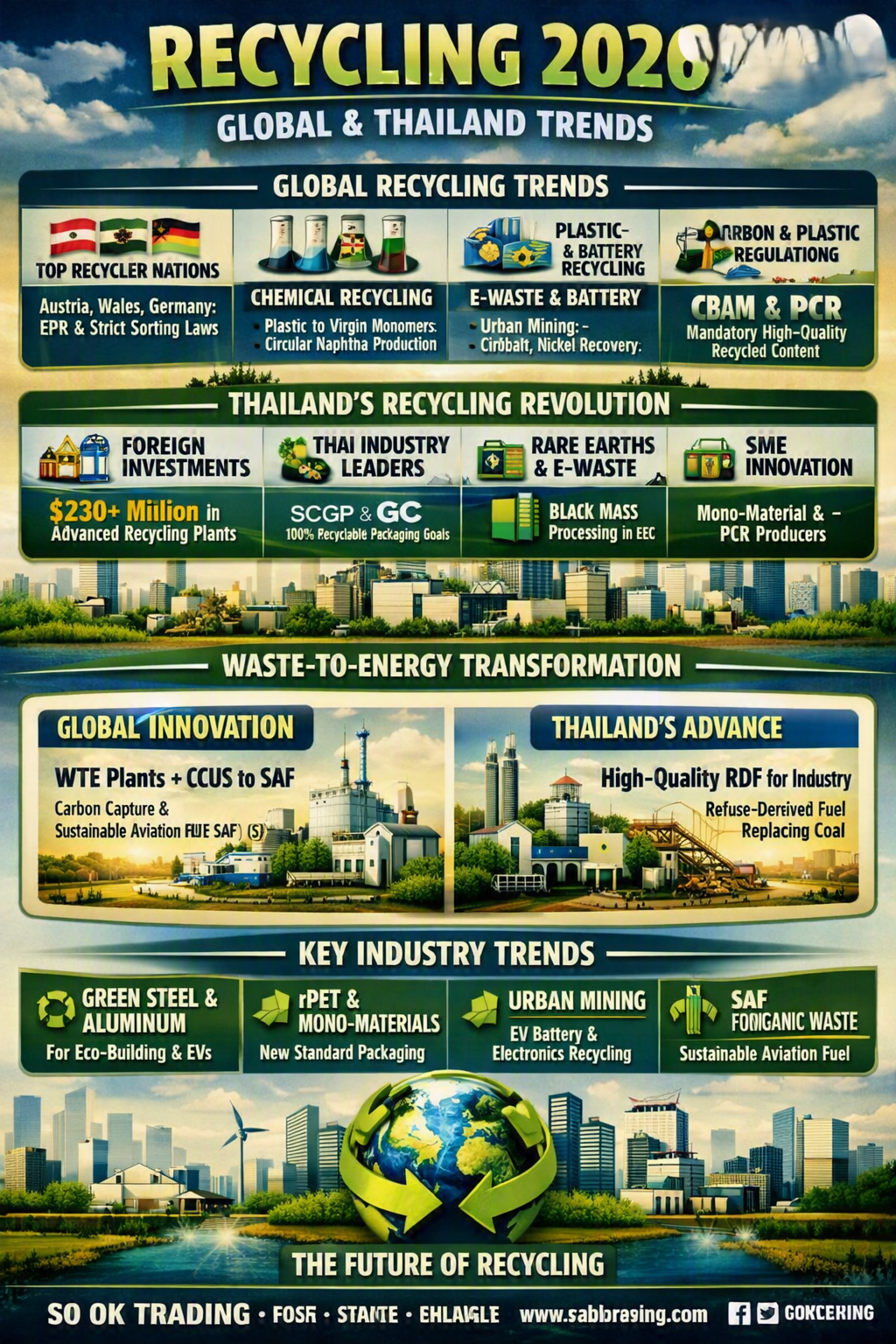
Global Recycling Leaders: Austria, Wales, and Germany, with strict sorting systems and full enforcement of EPR laws.
Chemical Recycling Emerges: Dirty or multilayer plastics are broken down into pure monomers, reprocessed into virgin-quality plastics.
E-Waste and EV Batteries: Urban Mining recovers lithium, cobalt, and nickel for reuse.
CBAM and PCR Regulations: Global brands are compelled to use high-quality recycled plastic resins.
Thailand’s Situation
Although Thailand ranks 27th globally (recycling rate ~21.8%), it is rapidly upgrading toward a “high-value industry”:
Foreign Investment: U.S. firms invest over 8.1 billion THB to establish advanced plastic recycling bases in Thailand.
Domestic Giants Drive Change: SCGP targets 100% recyclable packaging by 2030; GC expands its food-grade rPET facilities.
SME Transformation: From scrap shops to producers of high-quality recycled raw materials such as mono-materials and PCR resins.
Industry Outlook
Metals
Global: Steel shifts to Electric Arc Furnaces and Green Steel; aluminum adopts “Can-to-Can” models; copper becomes the backbone of clean energy.
Thailand: Needs to improve scrap quality; aluminum enjoys high can collection rates; copper investments focus on advanced wire separation.
Plastics
Global: Food-grade rPET becomes mandatory; chemical recycling generates Circular Naphtha.
Thailand: ENVICCO plant meets world-class standards; EPR legislation is imminent.
Rare Earths & E-Waste
Global: Closed-loop recycling of EV batteries and solar panels.
Thailand: Accelerating Black Mass processing supply chains in the EEC.
Waste-to-Energy (WTE)
Global: Next-generation plants use gasification and CCUS, producing SAF (Sustainable Aviation Fuel).
Thailand: Transition from municipal waste incineration to high-quality RDF for cement plants, plus UCO (used cooking oil) converted into biofuels and SAF.
Emerging Trends
Green Steel & Green Aluminum: Applied in green construction and EV industries.
rPET & Mono-material Packaging: Becoming global standards.
Urban Mining: Extracting rare earths from EV batteries and electronics.
SAF from Organic Waste: Transforming aviation into a sustainable energy sector.
The Naphtha Crisis – A Turning Point
The Middle East conflict has driven naphtha prices sky-high, making virgin plastics more expensive than recycled ones—turning recycled resins into the star of the industry.
PET Recycling Upgraded: SSP technology enables rPET to match virgin resin quality.
Chemical Recycling Fully Realized: Mixed plastics converted into Circular Naphtha.
Conclusion
In 2026, recycling is no longer just about “saving the planet.” It is the survival strategy of global and Thai industries in an era of energy crises and geopolitical tensions. Those who invest in advanced technologies and clean sorting systems will emerge as winners in the Circular Economy—transforming “waste” into “strategic resources” that drive the world forward.
SO OK TRADING : Your Business Partner SO OK TRADING : FAST SHARP RELIABLE VISIT US AT : WWW.SOOKTRADING.COM FACEBOOK : SO OK TRADING