“Thailand’s Metal Recycling Revolution — Copper & Aluminum Driving the Green Economy, Positioning Asia’s Circular Hub, and Leading the Global Decarbonization Future”
Copper & Aluminum Recycling Industry in Thailand
The Core of Circular Economy and Global Market Outlook 2026–2032
Article by SO OK TRADING — The True Expert in Thailand’s Non‑Ferrous Business (July 29, 2026)
Introduction
The recycling industry for copper and aluminum is a pillar of the circular economy, as both metals can be infinitely reused without losing their physical properties. Recycling also saves up to 95% of energy compared to producing metals from virgin ore, making this industry not only an economic driver but also a key mechanism for environmental sustainability and carbon reduction.
Supply Chain Structure
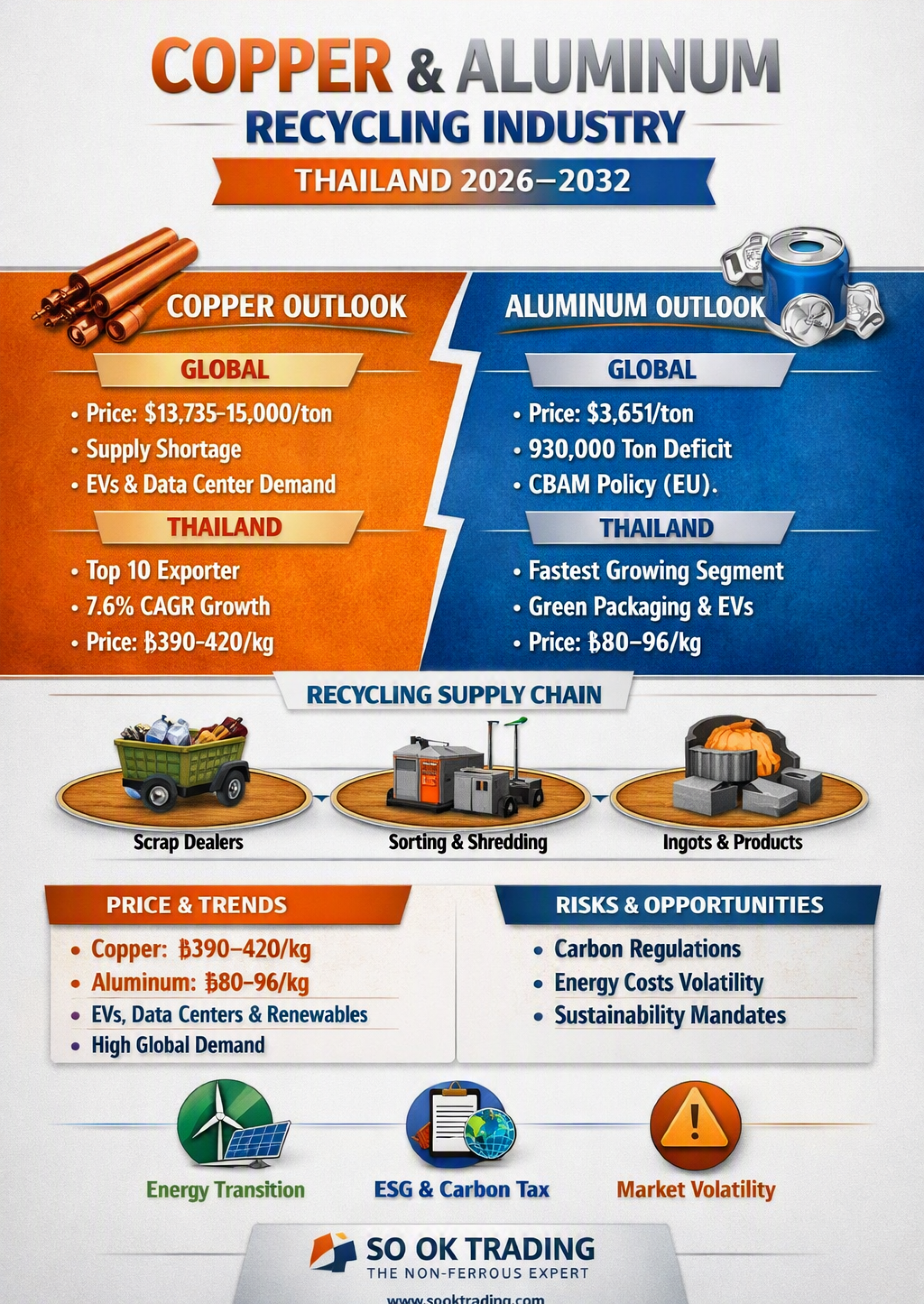
Upstream: Scrap collectors, local junk shops, and industrial auctions for waste materials such as wires, air‑conditioning pipes, and beverage cans. Factories also consolidate copper and aluminum scrap for remelting.
Midstream: Sorting and compression plants (e.g., Wongpanit) that strip wires, separate aluminum grades, and compress scrap for transport.
Downstream: Smelting and processing plants producing ingots, aluminum rolls, and copper wires, supplying industries such as automotive, packaging, and electronics.
Pricing and Product Differentiation
Copper: High value (hundreds of THB/kg), fluctuating with LME market prices. The most expensive grade is “premium stripped copper wire” (~390–420 THB/kg).
Aluminum: Mid‑range value (tens of THB/kg). For example, aluminum cans ~80–82 THB/kg; aluminum profiles ~85–96 THB/kg.
Opportunities and Challenges
Opportunities: Strong demand from Europe and the U.S., where export products must include recycled materials and demonstrate reduced carbon footprints.
Challenges: Contamination during sorting, global price volatility, rising energy costs, and stricter environmental regulations.
Market Outlook 2026–2032
Copper Scrap
Global Outlook: LME prices projected at $13,735–15,000/ton, driven by tight supply and demand from EVs, data centers, and renewable energy.
Thailand Outlook: Domestic copper scrap market expected to grow at 7.6% CAGR. Thailand ranks among the world’s Top 10 exporters, with China as the primary destination. Domestic prices average 390–400 THB/kg.
Aluminum Scrap
Global Outlook: Prices peaked at $3,651/ton in 2026 (highest in four years). Supply shortfall of 930,000 tons due to China’s environmental policies. EU’s CBAM regulation accelerates recycled aluminum demand.
Thailand Outlook: Fastest‑growing segment in the recycling industry, especially in green packaging and lightweight automotive components. Domestic prices range from 80–96 THB/kg.
Driving Forces and Risks
Drivers: Energy transition, ESG mandates, carbon taxes, demand from EVs and data centers.
Risks: High energy costs, strict environmental laws, global market volatility.
Strategic Outlook
Copper: Remains a “strategic metal” for power grids and EVs. Thailand has the potential to become a regional hub for high‑quality copper scrap exports.
Aluminum: Positioned as the “rising star metal,” with rapid growth in eco‑friendly packaging and lightweight automotive industries.
Conclusion
Thailand’s copper and aluminum recycling industry is entering a structural uptrend, supported by global energy transition and environmental policies. Despite market volatility, companies that can deliver value‑added processes, traceability, and closed‑loop recycling will secure long‑term competitiveness and sustainable growth.
SO OK TRADING: Your Trusted Business Partner SO OK TRADING: FAST SHARP RELIABLE Visit us at: www.sooktrading.com Facebook: SO OK TRADING SO OK TRADING — The True Expert in Thailand’s Non‑Ferrous Industry