《全球铅 2026:清洁能源核心的战略金属,颠覆世界市场》:SO OK TRADING:2026年5月30日
最后更新: 30 五月 2026
2517 浏览量
⚡ 全球铅 2026:“全球所需的战略金属:铅价走势”:SO OK TRADING:2026年5月30日
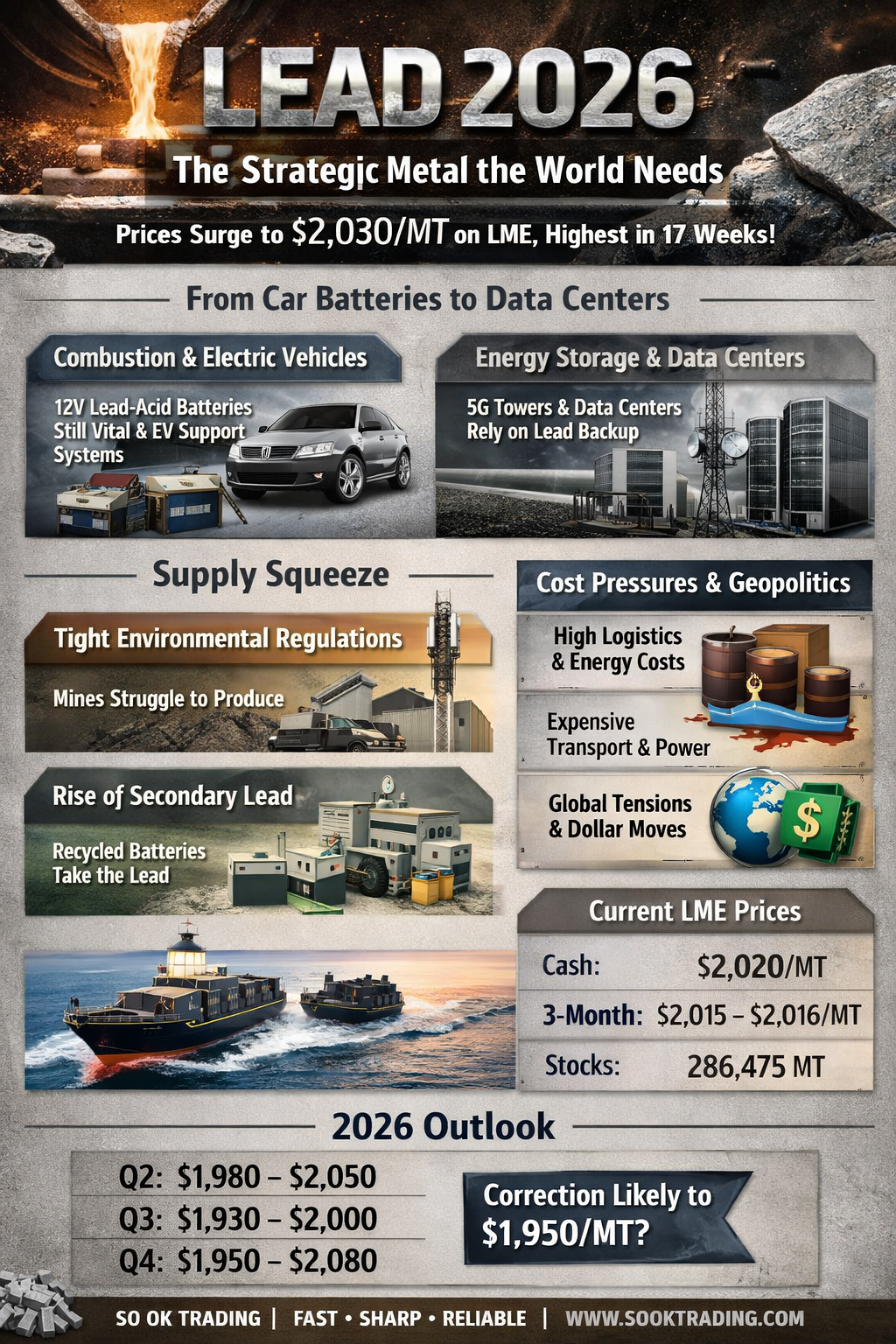
铅(Lead)在清洁能源与电动汽车时代再次发挥关键作用。 如今全球市场正密切关注,因为LME铅价已飙升至 2,030美元/吨,创下17周新高,但随即面临库存过剩与结构性转型的压力。
从汽车电池到数据中心 —— 改变游戏的需求
内燃车与电动车:尽管世界加速进入电动化时代,铅酸电池仍主导内燃车市场。即使电动车使用锂电池,12V系统依然离不开铅。
备用能源与数据中心:5G基站与数据中心的扩张,使铅成为支撑电力系统稳定的“能源金属”。
供应受限 —— 回收成为主角
环境法规严格:原生矿冶炼厂持续受限。
再生铅(Secondary Lead):废旧电池成为主要原料。亚洲与欧洲的冶炼厂全力扩产,市场逐渐依赖回收而非新矿。
物流与能源成本 —— 直接反映在价格上
高昂的运输费用与有限的航线
全球能源价格波动 → 高能耗的冶炼与回收过程立即反映在铅价中
地缘政治与汇率 —— 市场无法忽视的震荡
国际紧张局势 → 大买家选择囤货或抛售
美元强弱 → 直接决定铅价走势
当前LME铅价
现货价(Cash Settlement):2,020美元/吨
三个月期(3M Official):2,015 – 2,016美元/吨
库存:286,475吨(多年最高水平)
2026年展望 —— 价格或回调至1,950美元
LME库存过剩 → 超过286,000吨
进入淡季 → 中国工厂Q2–Q3减产
再生铅增加 → 回收替代原生矿
2026年季度价格预测
Q2:1,980 – 2,050美元
Q3:1,930 – 2,000美元
Q4:1,950 – 2,080美元
⚖️ 支撑价格的因素
高能源成本 → 关键支撑
汽车产业与备用电源需求复苏
用铅企业的策略
大型采购放缓,等待价格落入 1,930 – 1,960美元 区间再行囤货。
总结
2026年,全球铅市场正处于从“有毒金属”向“能源金属”的转折点。然而,库存过剩与锂电替代的压力,使得平均价格仍维持在 1,900 – 2,100美元/吨 区间,整体趋势呈 偏空至中性(Bearish to Neutral)。
SO OK TRADING:您的商业伙伴 SO OK TRADING:FAST | SHARP | RELIABLE
访问我们 → WWW.SOOKTRADING.COM Facebook → SO OK TRADING
铅(Lead)在清洁能源与电动汽车时代再次发挥关键作用。 如今全球市场正密切关注,因为LME铅价已飙升至 2,030美元/吨,创下17周新高,但随即面临库存过剩与结构性转型的压力。
从汽车电池到数据中心 —— 改变游戏的需求
内燃车与电动车:尽管世界加速进入电动化时代,铅酸电池仍主导内燃车市场。即使电动车使用锂电池,12V系统依然离不开铅。
备用能源与数据中心:5G基站与数据中心的扩张,使铅成为支撑电力系统稳定的“能源金属”。
供应受限 —— 回收成为主角
环境法规严格:原生矿冶炼厂持续受限。
再生铅(Secondary Lead):废旧电池成为主要原料。亚洲与欧洲的冶炼厂全力扩产,市场逐渐依赖回收而非新矿。
物流与能源成本 —— 直接反映在价格上
高昂的运输费用与有限的航线
全球能源价格波动 → 高能耗的冶炼与回收过程立即反映在铅价中
地缘政治与汇率 —— 市场无法忽视的震荡
国际紧张局势 → 大买家选择囤货或抛售
美元强弱 → 直接决定铅价走势
当前LME铅价
现货价(Cash Settlement):2,020美元/吨
三个月期(3M Official):2,015 – 2,016美元/吨
库存:286,475吨(多年最高水平)
2026年展望 —— 价格或回调至1,950美元
LME库存过剩 → 超过286,000吨
进入淡季 → 中国工厂Q2–Q3减产
再生铅增加 → 回收替代原生矿
2026年季度价格预测
Q2:1,980 – 2,050美元
Q3:1,930 – 2,000美元
Q4:1,950 – 2,080美元
⚖️ 支撑价格的因素
高能源成本 → 关键支撑
汽车产业与备用电源需求复苏
用铅企业的策略
大型采购放缓,等待价格落入 1,930 – 1,960美元 区间再行囤货。
总结
2026年,全球铅市场正处于从“有毒金属”向“能源金属”的转折点。然而,库存过剩与锂电替代的压力,使得平均价格仍维持在 1,900 – 2,100美元/吨 区间,整体趋势呈 偏空至中性(Bearish to Neutral)。
SO OK TRADING:您的商业伙伴 SO OK TRADING:FAST | SHARP | RELIABLE
访问我们 → WWW.SOOKTRADING.COM Facebook → SO OK TRADING



相关文章

铝卷2026:迈向可持续与创新新时代
SO OK TRADING | 2026年10月4日
在2026年,铝卷产业(Aluminum Coil) 正迎来全球性的重大转折。随着技术革新、循环再生以及可持续发展的推进,全球主要制造商纷纷加快布局,以满足在电动汽车(EV)、现代建筑以及环保包装领域日益增长的需求。
从 Alcoa、Hindalco、Norsk Hydro、Rusal 等国际巨头,到 Aluminum Dynamics、EGA、Speira 以及中国的新兴制造商——各家公司都在通过 人工智能(AI)、自动化系统以及再生铝材的利用,打造轻量、坚固并且低碳排放的新型材料。
泰国依然是东盟地区的重要生产基地,闭环回收(Closed-Loop Recycling) 项目能够在短短60天内将废旧铝罐再生为新罐,节省高达95%的能源。
铝包装产业已成为新时代增长的核心,从饮料罐到食品包装,广泛采用 3004、3104、5182、5052 等特殊合金,既保证了强度,又确保了使用安全。
在全球迈向可持续发展的进程中,SO OK TRADING 始终坚守作为值得信赖的商业伙伴,持续为客户提供高质量的解决方案与深度洞察。
SO OK TRADING — FAST • SHARP • RELIABLE
4 10月 2026

在 2026年9月7日至11日 这一周,全球经济依然处于“炙热而脆弱”的状态。中东战争持续,能源价格飙升,地缘政治的不确定性冲击全球供应链。然而,另一方面,人工智能(AI) 却成为关键驱动力,使世界经济依然保持令人惊叹的增长势头。
国际货币基金组织(IMF)报告指出,尽管能源价格高企与公共债务不断攀升,2026年全球GDP仍有望实现 3.0% 的增长。全球企业正逐步迈入“AI驱动型经济”时代,投资与生产的新引擎正在形成。
在本文中,SO OK TRADING 汇总了美国、中国、欧洲及中东的经济动态,并深入分析能源市场、金属市场以及全球金融趋势,帮助您清晰洞察“正在转型的世界经济”。
✨ 获取完整分析请访问
SO OK TRADING : FAST | SHARP | RELIABLE
11 9月 2026
he Thai baht in Q1 2026 is expected to strengthen against the US dollar, driven primarily by a weaker dollar globally, a seasonal tourism boost, and expectations of US Federal Reserve rate cuts. This strength is occurring despite a weak domestic economic outlook and the Bank of Thailand's (BoT) likely continued easing of its policy rate.
Exchange Rate Drivers and Forecast
External Factors: The primary driver for the strengthening baht is external, mainly the broad weakness of the US dollar as global markets price in expected Fed rate cuts. The baht is also correlated with global gold prices, which have been climbing.
Tourism High Season: The period extending into Q1 2026 is the high season for tourism, which typically brings in foreign currency and supports the baht's value.
Policy Divergence: The BoT is expected to continue its easing cycle, potentially cutting the policy rate further to 1.00% by Q1 2026 to stimulate the sluggish domestic economy. This divergence from a potentially less aggressive US Fed in Q1 could support the baht in the short term, though some analysts warn the currency could weaken later in 2026.
Forecasts: Projections for 2026 generally place the baht in a range of 30.80–33.00 per US dollar. Some models estimate it could trade around 31.06 by the end of Q1. A persistently strong baht below 31 per US$ is seen as a significant risk to the Thai export and tourism sectors.
Key Economic Context
Weak Growth: Thailand's economy is expected to slow down to a 5-year low growth rate of around 1.6-1.8% in 2026, pressured by US tariffs, global trade tensions, and high household debt. The central bank chief expects an improvement in Q1 2026 after a weak second half of 2025.
Political Uncertainty: A general election expected in February 2026 could also introduce volatility, though some historical trends suggest the baht may strengthen following the formation of a new government.
Low Inflation: Headline inflation is projected to remain subdued or even negative, providing the central bank with justification for further rate cuts to stimulate demand.
In summary, Q1 2026 is characterized by a strong and volatile baht driven by external factors, contrasting sharply with a weak domestic economy and accommodative monetary policy.
1 1月 2026
