Share

“RDF-3 & SRF: Fuels Driving Net Zero” : “Circular Economy in Action: Waste Fuels for the Future : SO OK TRADING Presents: Smart Waste Fuels for a Sustainable World
Last updated: 31 Jan 2026
355 Views

RDF-3 and SRF: Waste Fuels Transforming Energy and Environment ⚡

As the world accelerates toward a Circular Economy and clean energy transition, RDF-3 (Fluff RDF) and SRF (Solid Recovered Fuel) are emerging as key solutions for waste management and carbon reduction in industry and power generation.


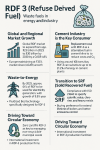
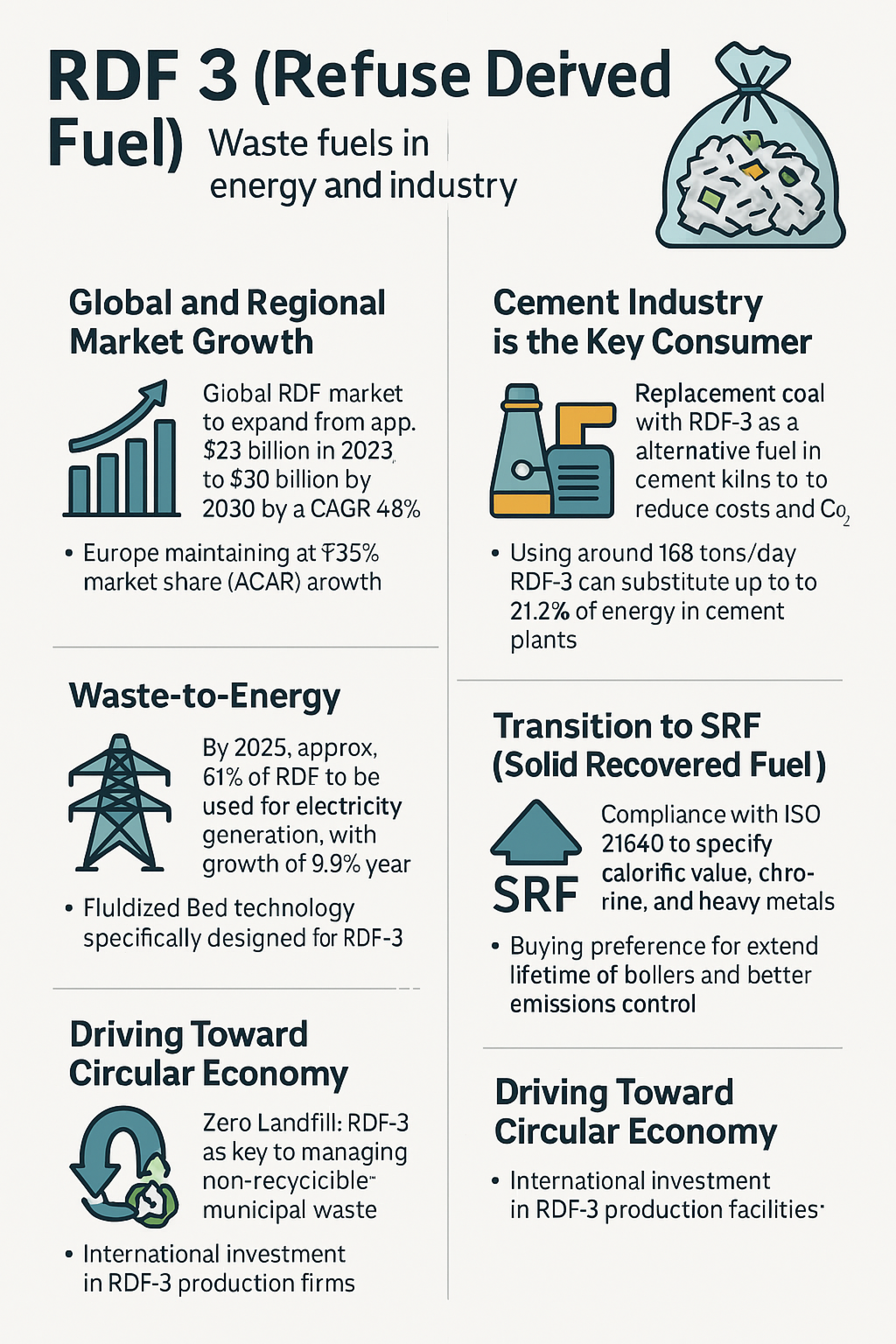
1. Global and Regional Market Growth

The global RDF market is projected to grow from USD 22 billion (2024) to USD 30 billion (2030), with a CAGR of 4.6–8%.
Europe leads with a 35% market share due to strict landfill regulations.
Asia-Pacific is the fastest-growing region (24%), driven by rapid expansion of waste-to-energy plants in China, Indonesia, and Thailand.
 

2. Cement Industry: The Largest Consumer

RDF-3 is widely used in cement kilns as a coal substitute, reducing costs and CO₂ emissions.
Using about 168 tons/day of RDF-3 can replace up to 21.2% of energy demand and improve combustion efficiency.
 

3. Waste-to-Energy

By 2025, 61% of RDF is expected to be used for electricity generation, growing at 9.9% annually.
Fluidized Bed technology is increasingly adopted, designed specifically for RDF-3 to ensure complete combustion and lower emissions.
 

4. Transition to SRF: Premium Waste Fuel

SRF complies with ISO 21640, ensuring calorific value, chlorine, and heavy metal control.
Buyers prefer SRF for longer boiler lifespan and better emission control compared to RDF-3.
Production involves advanced processes such as optical sorting and chemical composition control.
 

5. Carbon Credits and Plastic Credits

RDF-3 reduces methane emissions from landfills, enabling claims for Carbon Credits.
Global brands support RDF for Plastic Credits, turning non-recyclable plastics into energy instead of polluting oceans.
 

6. Digital Twin and AI: Next-Generation RDF Plants

AI Sorting with hyperspectral cameras ensures consistent calorific value.
Predictive Maintenance reduces operating costs by forecasting blade wear.
 

Thailand Outlook (2026)

RDF market value expected to reach THB 14.5 billion, up 15.1% year-on-year.
Power sector (64%) shows the highest growth at 16.8%.
Industrial sector (36%), especially cement, increasingly adopts RDF/SRF as coal substitutes.
Government’s AEDP 2024 plan targets 36% renewable energy share by 2037.
RDF/SRF producers can join T-VER to sell Carbon Credits for additional revenue.
 

RDF-3 Pricing in Thailand (2025–2026)

RDF-3 (3,000–3,500 kcal/kg): THB 900–1,100/ton
SRF (4,000–5,000+ kcal/kg): THB 1,300–1,600/ton
Key factors: calorific value, moisture (<20–30%), chlorine/heavy metals, and imported coal prices.
Transport costs are critical → economically viable within 200–300 km radius.
 

Conclusion: The Turning Point for RDF-3 and SRF

2026 marks the year when RDF/SRF become the new standard for alternative fuels in Thailand. Investments in MBT plants and carbon credit programs will strengthen the ecosystem, supporting both the Circular Economy and Net Zero goals.


Introducing SO OK TRADING: RDF-3 and SRF Specialists in Thailand

SO OK TRADING is a leading supplier of RDF-3 and SRF in Thailand, committed to creating new value from waste and driving the future of clean energy.

www.sooktrading.com

Our Strengths

Expertise in RDF-3 and SRF supply
High-quality fuels, ISO 21640 compliant
Ideal for cement kilns and power plants
Supporting Net Zero and Circular Economy initiatives
Products

RDF-3 (3,000–3,500 kcal/kg)
SRF (4,000–5,000+ kcal/kg)
Low moisture, strict impurity control
Why Choose Us

International-standard reliability
End-to-end management from sorting to delivery
Long-term sustainable partnerships


Related Content
เกร็ดความรู้ การใช้เชื้อเพลิงชีวภาพในภาคอุตสาหกรรม  By SO OK
เกร็ดความรู้ เชื้อเพลิงชีวภาพ ในภาคอุตสาหกรรม การใช้เชื้อเพลิงชีวภาพในภาคอุตสาหกรรมช่วยลดต้นทุนและมลภาวะ โดยนำวัตถุดิบทางการเกษตร (เช่น ฟางข้าว ซังข้าวโพด) ของเสียจากโรงงาน (เช่น น้ำเสีย) และพืชพลังงาน (เช่น สาหร่าย) มาผลิตเป็นพลังงานชีวมวล (เม็ดเชื้อเพลิง) ก๊าซชีวภาพ (Biogas) ไบโอดีเซล และเอทานอล เพื่อใช้ทดแทนเชื้อเพลิงฟอสซิลในหม้อไอน้ำ โรงไฟฟ้า และยานยนต์ ซึ่งสนับสนุนเศรษฐกิจ BCG ลดการพึ่งพาพลังงานภายนอก และสร้างความมั่นคงด้านพลังงาน. ประโยชน์หลัก: ลดต้นทุนและพึ่งพาเชื้อเพลิงฟอสซิล: แทนที่ถ่านหิน น้ำมันเตา ด้วยพลังงานหมุนเวียน. ลดมลพิษ: ลดฝุ่น PM 2.5 กลิ่น และก๊าซเรือนกระจก. เพิ่มมูลค่าเกษตรกรรม: สร้างรายได้จากผลผลิตทางการเกษตรเหลือใช้ (Zero Burn). สร้างความมั่นคงทางพลังงาน: เพิ่มสัดส่วนการใช้พลังงานหมุนเวียนในประเทศ. รูปแบบการใช้งานในอุตสาหกรรม: เชื้อเพลิงชีวมวล (Biomass Fuel): นำฟางข้าว ซังข้าวโพด กากอ้อย มาอัดเป็นเม็ด (Energy Pellet) ใช้เป็นเชื้อเพลิงในหม้อเผาของโรงงาน (เช่น โรงงานปูนซีเมนต์). ก๊าซชีวภาพ (Biogas): เกิดจากการย่อยสลายสารอินทรีย์ในน้ำเสีย หรือของเสียจากโรงงานและฟาร์มสัตว์ นำมาใช้ผลิตไฟฟ้าหรือทดแทนแก๊ส LPG ได้. ไบโอดีเซล (Biodiesel) และเอทานอล (Ethanol): ผลิตจากพืชน้ำมัน (ปาล์ม) และพืชหัว (มันสำปะหลัง อ้อย) ใช้ผสมในน้ำมันดีเซลและเบนซิน (แก๊สโซฮอล์). พลังงานจากสาหร่าย (Algae Biofuel): สาหร่ายเติบโตเร็ว ดูดซับคาร์บอนได้ดี นำมาผลิตเป็นไบโอดีเซลและเชื้อเพลิงอื่นๆ. ตัวอย่างอุตสาหกรรมที่ใช้: อุตสาหกรรมปูนซีเมนต์/ก่อสร้าง: ใช้ชีวมวล (ฟางข้าว) แทนถ่านหิน. อุตสาหกรรมอาหาร: ใช้ก๊าซชีวภาพจากน้ำเสียเป็นพลังงาน. อุตสาหกรรมเคมีภัณฑ์และวัสดุชีวภาพ (Bio-based Industry): ใช้พืชผลทางการเกษตรเป็นวัตถุดิบหลักในการผลิตสารเคมี, PLA (Polylactic Acid). การพัฒนาอุตสาหกรรมเชื้อเพลิงชีวภาพเป็นส่วนสำคัญของโมเดลเศรษฐกิจ BCG (Bio-Circular-Green Economy) ของไทย เพื่อขับเคลื่อนสู่เป้าหมาย Net Zero และเพิ่มศักยภาพการแข่งขันของประเทศ. การพัฒนาเพื่อการ เชื้อเพลิงชีวภาพ มีหลากหลายประเภท ทั้งไม้สับ ไม้อัดแท่ง ไม้อัดแท่งสีดำ กะลาปาล์ม กะลามะพร้าว และเศษวัสดุทางการเกษตร ช่วยลดมลพิษ สนับสนุนเศรษฐกิจหมุนเวียน.
7 Dec 2025
The Future of Biofuels and Biomass Energy — Pathways to Replace Coal (Article by SO OK TRADING)
BIOFUELS & BIOMASS: CLEAN ENERGY FOR CARBON CREDIT & CBM By SO OK TRADING As the world accelerates toward Net Zero, biofuels and biomass are no longer just alternatives — they’re becoming the new standard. From SAF in East Asia to RDF in ASEAN, clean energy is reshaping global trade, carbon strategies, and industrial fuel choices. This infographic breaks down: ✅ Global market growth (USD 257.61B by 2034) ✅ Regional trends across USA, EU, and Asia ✅ East Asia’s SAF & marine fuel revolution ✅ Biomass fuel comparison: Wood Pellets, Chips, RDF ✅ Market prices & business opportunities for producers Whether you're exporting premium pellets, supplying local chips, or scaling RDF for heavy industry — the future is green, and the momentum is real.
28 Feb 2026
Carbon Credit คืออะไร ใช้งานอย่างไร และ ส่งผลต่อภาพธุรกิจอย่างไร ?
คาร์บอนเครดิตคือ สิทธิที่เกิดจากการลดปริมาณก๊าซเรือนกระจก หรือจากการกักเก็บก๊าซเรือนกระจก ซึ่งสามารถวัดปริมาณได้ในหน่วยตันคาร์บอนไดออกไซด์เทียบเท่า (\(tCO_{2}e\)) สิทธินี้สามารถซื้อขายได้ในตลาดคาร์บอนเพื่อใช้ชดเชยการปล่อยก๊าซเรือนกระจก การเกิดคาร์บอนเครดิต เกิดขึ้นจากโครงการที่ช่วยลดหรือกักเก็บก๊าซเรือนกระจก เช่น: โครงการพลังงานสะอาด: การเปลี่ยนมาใช้พลังงานหมุนเวียน เช่น พลังงานแสงอาทิตย์หรือพลังงานลมโครงการปลูกป่า: การเพิ่มพื้นที่ป่าเพื่อดูดซับคาร์บอนไดออกไซด์โครงการจัดการของเสีย: การนำขยะมาผลิตเป็นพลังงานการผลิตแบบ Low-Carbon: การปรับปรุงกระบวนการผลิตในภาคอุตสาหกรรมให้มีประสิทธิภาพมากขึ้น การซื้อขายคาร์บอนเครดิต การซื้อ: องค์กรที่ปล่อยก๊าซเรือนกระจกเกินกว่าที่กำหนดจะซื้อคาร์บอนเครดิตเพื่อชดเชยส่วนที่เกินการขาย: องค์กรที่ดำเนินโครงการแล้วสามารถลดหรือกักเก็บก๊าซเรือนกระจกได้ จะได้คาร์บอนเครดิตไปขายตลาดคาร์บอน: มี 2 ประเภทหลัก ได้แก่ตลาดภาคบังคับ (Mandatory Carbon Market): ดำเนินการตามกฎหมาย เช่น โดยรัฐบาลหรือสหประชาชาติตลาดภาคสมัครใจ (Voluntary Carbon Market): ดำเนินการโดยองค์กรเอกชน เช่น องค์การบริหารก๊าซเรือนกระจก (อบก.) ที่ดูแลโครงการ T-VER ในประเทศไทย
30 Nov 2025
This website uses cookies for best user experience, to find out more you can go to our Privacy Policy and Cookies Policy
Compare product
0/4
Remove all
Compare
Powered By MakeWebEasy Logo MakeWebEasy