SO OK TRADING'S INSIGHT | When Aluminum Becomes a Global Strategic Resource: The New Game of Carbon, Clean Energy, and Economic Geopolitics in 2026 | 28 NOV 2026
SO OK TRADING'S INSIGHT
Global Aluminum Industry 2026: Driving the Green Economy, Energy Transition, and Strategic Competition Worldwide
28 NOV 2026
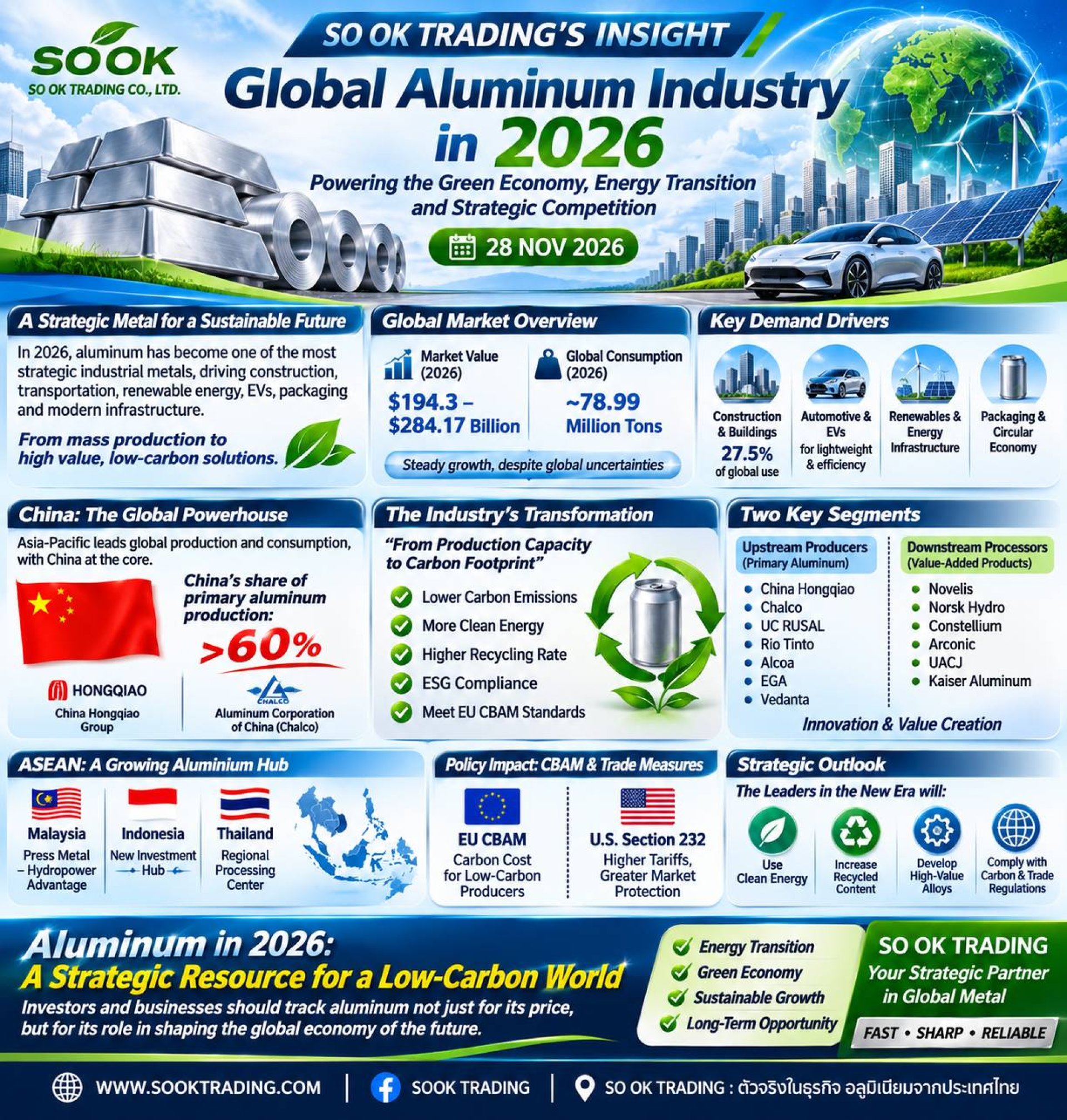
In 2026, aluminum has emerged as one of the world's most strategically important industrial metals. Its growing significance stems from its indispensable role across construction, transportation, renewable energy, electric vehicles (EVs), packaging, and modern technological infrastructure.
Against the backdrop of global decarbonization efforts, the expansion of the circular economy, and increasing resource security concerns among major economies, the aluminum industry is undergoing a profound transformation. Competition is shifting away from production volume alone toward energy efficiency, sustainability, and value creation throughout the supply chain.
Global Aluminum Market Overview in 2026
According to leading market research institutions, the global aluminum market continues to expand despite ongoing uncertainties related to geopolitics, energy costs, and international trade policies.
The global aluminum market in 2026 is estimated to be valued between US$194.3 billion and US$284.17 billion, depending on the methodology and scope of individual research firms. Global aluminum consumption is projected to reach approximately 78.99 million metric tons.
Looking ahead, the market is expected to maintain strong long-term growth, supported by investments in green infrastructure, rising EV production, and the continued expansion of aluminum recycling industries worldwide.
Key Drivers of Global Demand
1. Construction and Building Sector
The construction sector remains the largest consumer of aluminum globally, accounting for approximately 27.5% of total demand.
Thanks to its lightweight properties, strength, corrosion resistance, and recyclability, aluminum continues to be a preferred material for modern buildings, energy-efficient structures, and large-scale infrastructure projects.
2. Automotive and Electric Vehicles (EVs)
The transition toward electric mobility is significantly increasing aluminum demand.
Automakers are pursuing lightweight vehicle designs to improve energy efficiency and driving range. As a result, aluminum is increasingly used in vehicle bodies, chassis systems, battery enclosures, and thermal management applications.
3. Renewable Energy and Energy Infrastructure
The rapid deployment of solar power, wind energy, and energy storage systems is creating additional demand for aluminum worldwide.
This trend is particularly evident across China, India, the Middle East, and Southeast Asia.
4. Packaging and the Circular Economy
Aluminum cans continue to gain popularity globally due to their superior recyclability and alignment with corporate ESG initiatives.
As sustainability becomes a central business priority, aluminum packaging is increasingly viewed as a key component of circular economy strategies.
China Remains the Center of the Global Aluminum Industry
The Asia-Pacific region continues to dominate global aluminum production and consumption, with China serving as the industry's primary hub.
Leading Chinese producers include:
China Hongqiao Group
Aluminum Corporation of China (Chalco)
Together, these companies have helped China maintain more than 60% of global primary aluminum production capacity.
However, tighter environmental regulations and domestic production caps are encouraging Chinese producers to expand investments into energy-competitive regions such as Indonesia and other Southeast Asian countries.
A Structural Shift: From Production Capacity to Carbon Footprint
One of the most significant transformations within the global aluminum industry is the changing definition of competitiveness.
Today, buyers, investors, and policymakers are increasingly focused on:
Carbon emissions from production processes
Clean energy utilization
Recycling capabilities
ESG compliance
Readiness for the EU Carbon Border Adjustment Mechanism (CBAM)
As a result, companies with strong recycling capabilities and low-carbon operations such as Novelis, Norsk Hydro, and Constellium are receiving greater attention from global customers, particularly in the automotive and packaging sectors.
Competitive Structure of the Global Aluminum Industry
The industry can generally be divided into two major segments:
1. Upstream Producers
This segment includes bauxite mining, alumina refining, and primary aluminum smelting.
Major players include:
China Hongqiao Group
Chalco
UC RUSAL
Rio Tinto Aluminium
Alcoa Corporation
Emirates Global Aluminium (EGA)
Vedanta Aluminium
The strength of upstream producers lies in scale and resource access. However, their profitability remains closely linked to fluctuations in global aluminum prices on the London Metal Exchange (LME).
2. Downstream Processors
This segment focuses on higher-value-added activities such as rolling, extrusion, and advanced alloy production.
Key companies include:
Novelis
Norsk Hydro
Constellium
Arconic
UACJ Corporation
Kaiser Aluminum
Strategically, downstream companies often enjoy more stable margins due to their reliance on processing expertise, technological innovation, and specialized applications rather than commodity price movements.
ASEAN: The Next Growth Hub for Aluminum
ASEAN is becoming an increasingly important region within the global aluminum supply chain.
Malaysia
Press Metal Aluminium is the largest aluminum producer in Southeast Asia. By utilizing hydropower from Sarawak, the company benefits from both lower production costs and a reduced carbon footprint.
Indonesia
Indonesia is rapidly emerging as a new global investment destination for aluminum production.
Government policies restricting raw bauxite exports have encouraged significant investment from Chinese and international producers, positioning the country as a major future production hub.
Thailand: ASEAN's Processing Center
Although Thailand does not operate primary aluminum smelters, the country plays a critical role as one of ASEAN's leading downstream processing centers.
Companies such as UACJ Thailand, TOSTEM Thai, and VARO are deeply integrated into regional automotive, packaging, and electrical appliance supply chains, reinforcing Thailand's position within the aluminum value chain.
The Impact of CBAM and U.S. Trade Policies
The year 2026 marks a major turning point for the global aluminum industry as environmental regulations and trade policies increasingly influence investment decisions.
European Union (EU CBAM)
The implementation of the EU Carbon Border Adjustment Mechanism is creating clear advantages for low-carbon aluminum producers.
Key beneficiaries include:
Norsk Hydro
Rio Tinto
Press Metal
Conversely, producers heavily dependent on coal-fired power generation face rising export costs and declining competitiveness in European markets.
United States
U.S. aluminum import tariffs under Section 232 continue to benefit domestic producers such as Alcoa and Century Aluminum by strengthening protection for local manufacturing.
As a result, many Asian exporters are redirecting their focus toward ASEAN, the Middle East, and India.
Strategic Outlook
The global aluminum industry is entering a new era in which success will no longer be determined solely by production capacity or access to raw materials.
Future market leaders will be companies capable of combining four critical strengths:
Clean energy-based production
Higher recycled-content utilization
Development of advanced, value-added aluminum products
Compliance with evolving carbon and international trade regulations
Under these conditions, aluminum is evolving from a conventional industrial metal into a strategic resource that will play a central role in the global transition toward a low-carbon economy, the expansion of electric mobility, and long-term industrial competitiveness.
For investors and business leaders, monitoring the aluminum industry is no longer merely about tracking commodity prices. It is about understanding one of the most important megatrends that will shape the future structure of the global economy. ■
SO OK TRADING: Your Business Partner
SO OK TRADING : FAST • SHARP • RELIABLE
VISIT US AT: WWW.SOOKTRADING.COM
FACEBOOK: SO OK TRADING
SO OK TRADING: A Trusted Aluminum Industry Partner from Thailand
Connecting Global Markets. Creating Long-Term Value