GLOBAL ALUMINUM CAN STOCK INDUSTRY 2026 Alloy Specifications | Manufacturing Applications | Global Supply Chain : SO OK TRADING 'S INSIGHT
SO OK TRADING – INDUSTRIAL INSIGHT
GLOBAL ALUMINUM CAN STOCK INDUSTRY 2026
Alloy Specifications | Manufacturing Applications | Global Supply Chain
1. Overview of the Aluminum Can Stock Industry
Aluminum can stock is a critical material in the global packaging industry, particularly for beverage cans, food cans, and easy-open-end packaging.
Its key advantages include lightweight properties, excellent formability, corrosion resistance, recyclability, and strong compatibility with high-speed manufacturing processes.
The main aluminum alloy series used in can manufacturing include 3xxx and 5xxx series alloys, each designed to meet specific mechanical and forming requirements.
2. Key Aluminum Alloys and Their Applications
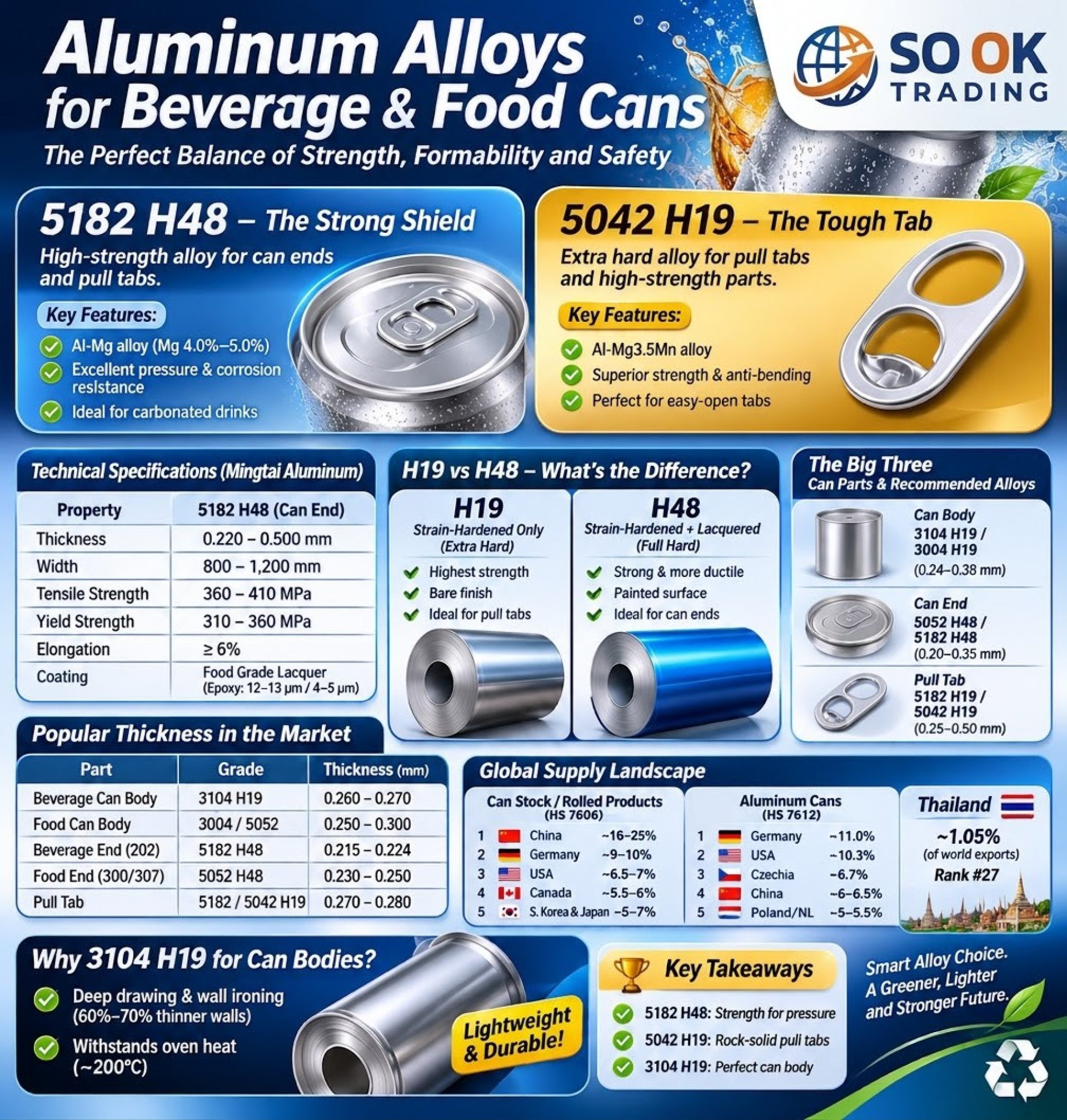
3104 H19 – Beverage Can Body Stock (CBS)
* Alloy system: Aluminum-Manganese-Magnesium (Al-Mn-Mg)
* Main application: Beverage can bodies
* Manufacturing process: Draw and Wall Ironing (DWI)
* Typical thickness: 0.240–0.320 mm
* Typical tensile strength: 270–310 MPa
3104 H19 is widely used for beverage can bodies due to its excellent strength-to-weight ratio, formability, and ability to withstand high-speed can-making operations.
5182 H48 – Beverage Can End Stock (CES)
* Alloy system: Aluminum-Magnesium (Al-Mg)
* Magnesium content: Approximately 4.0–5.0%
* Main application: Beverage can ends and easy-open ends
* Typical thickness: 0.208–0.235 mm
* Typical tensile strength: 360–410 MPa
5182 is valued for its high strength and excellent performance in end forming, scoring, and rivet formation. It is particularly suitable for beverage can ends designed to withstand internal pressure.
5042 H19 – Pull Tab Stock
* Alloy system: Aluminum-Magnesium-Manganese (Al-Mg-Mn)
* Magnesium content: Approximately 3.0–4.0%
* Main application: Easy-open pull tabs
* Typical thickness: 0.220–0.560 mm
* Typical tensile strength: Approximately 324–334 MPa, depending on specifications
5042 offers a combination of strength, formability, and resistance to deformation, making it suitable for pull-tab applications requiring reliable opening performance.
5052 H48 – Food Can End Stock
* Alloy system: Aluminum-Magnesium (Al-Mg)
* Magnesium content: Approximately 2.2–2.8%
* Main application: Food can ends and closures
* Typical thickness: 0.220–0.280 mm
5052 provides good corrosion resistance, strength, and formability, making it suitable for food packaging applications.
3. Typical Aluminum Can Stock Specifications
Application Alloy / Temper Typical Thickness
Beverage Can Body 3104 H19 0.245–0.285 mm
Beverage Can End 5182 H48 0.208–0.235 mm
Pull Tab 5042 / 5182 0.250–0.300 mm
Food Can Body 3004 / 3104 0.240–0.320 mm
Food Can End 5052 / 5182 0.220–0.280 mm
Note: Actual specifications may vary depending on the mill, customer requirements, manufacturing process, and final application.
4. Understanding Aluminum Temper Designations
H19 – Extra Hard Temper
H19 is a strain-hardened temper achieved through cold working. It provides high strength and hardness, making it suitable for applications requiring dimensional stability and resistance to deformation.
H48 – Strain-Hardened and Coated Temper
H48 generally refers to a strain-hardened aluminum product that has been coated or painted and subsequently stoved. Final mechanical properties depend on the alloy, coating system, heat treatment, and mill-specific specifications.
5. Surface Treatment and Coating Technologies
Aluminum can stock commonly requires specialized coating systems to ensure product safety, corrosion resistance, and compatibility with food and beverage contents.
Common coating technologies include:
* Epoxy coatings
* Polyester coatings
* BPA-NI (Bisphenol A Non-Intent) coating systems
Key quality requirements include:
* Chemical composition and material certification
* Mechanical properties and tensile strength
* Thickness and width tolerances
* Surface quality and cleanliness
* Coating adhesion and performance
* Compliance with applicable food-contact regulations
Relevant technical references may include EN 541, EN 573-3, and applicable Aluminum Association standards. Final compliance must be assessed against the regulations of the destination market and the customer’s product requirements.
6. Global Supply Chain and Major Producing Regions
The global aluminum can stock supply chain is supported by major aluminum producers and rolling mills across several regions.
Key producing regions include:
* China
* Germany
* United States
* Canada
* South Korea
* Japan
India and the Middle East are also expanding their roles in the global aluminum industry, offering additional sourcing opportunities and supply-chain alternatives.
For Thailand and the ASEAN market, sourcing strategies increasingly focus on China, South Korea, and Japan, while India and the Middle East may provide further diversification opportunities.
7. International Trade and HS Code References
Aluminum products used in packaging are generally classified under several international Harmonized System (HS) categories.
* HS 7606: Aluminum plates, sheets, and strip, of a thickness exceeding 0.2 mm.
* HS 7612: Aluminum casks, drums, cans, boxes, and similar containers.
These are broad customs classifications and are not exclusive to aluminum can stock or beverage-can materials. The correct tariff classification should be verified based on the product’s physical characteristics, specifications, and applicable customs regulations.
8. Strategic Outlook: 2026–2030
The aluminum packaging industry is expected to continue evolving in response to sustainability targets, manufacturing efficiency, and changing consumer demand.
Five major trends are expected to shape the market:
1. Lightweighting
Manufacturers continue to optimize material thickness and reduce aluminum consumption while maintaining product strength and performance.
2. Sustainable Aluminum
Recyclability, recycled content, and lower-carbon aluminum are becoming increasingly important across global packaging supply chains.
3. Advanced Coating Technologies
New coating solutions are being developed to improve corrosion resistance, product safety, and compatibility with evolving food-contact requirements.
4. Supply Chain Diversification
Packaging manufacturers are seeking more resilient sourcing strategies by developing alternative suppliers and reducing dependence on a limited number of producing regions.
5. Precision Manufacturing
High-speed production lines require increasingly consistent material quality, tighter dimensional tolerances, and reliable mechanical properties.
9. SO OK TRADING – Your Strategic Partner in Aluminum Packaging
SO OK TRADING CO., LTD. is a Thailand-based international trading company connecting global aluminum manufacturers with packaging industries in Thailand and the wider ASEAN region.
We focus on aluminum packaging materials, including:
* 3104 Aluminum Coil – Beverage Can Body Stock
* 5182 Aluminum Coil – Beverage Can End Stock
* 5042 Aluminum Coil – Pull Tab Stock
* 5052 Aluminum Coil – Food Can End Stock
Our approach is built around material knowledge, reliable sourcing, supply-chain coordination, and long-term business partnerships.
We aim to connect qualified global manufacturers with regional packaging producers through a professional, responsive, and market-oriented trading platform.
⸻
SO OK TRADING CO., LTD.
FAST • SHARP • RELIABLE
Website: www.sooktrading.com
Facebook: SO OK TRADING
Email: SOOKTRADING@SOOKTRADING.COM
Email: SOOKTRADING@OUTLOOK.COM
WeChat / WhatsApp: +66 95 556 4255
A Professional Partner in the Aluminum Packaging Industry – Proudly Based in Thailand.