SO OK TRADING'S INSIGHT | Central Asia 2035: The Emerging Critical Minerals Hub Reshaping the Global Economic Balance 25 NOV 2026
SO OK TRADING'S INSIGHT
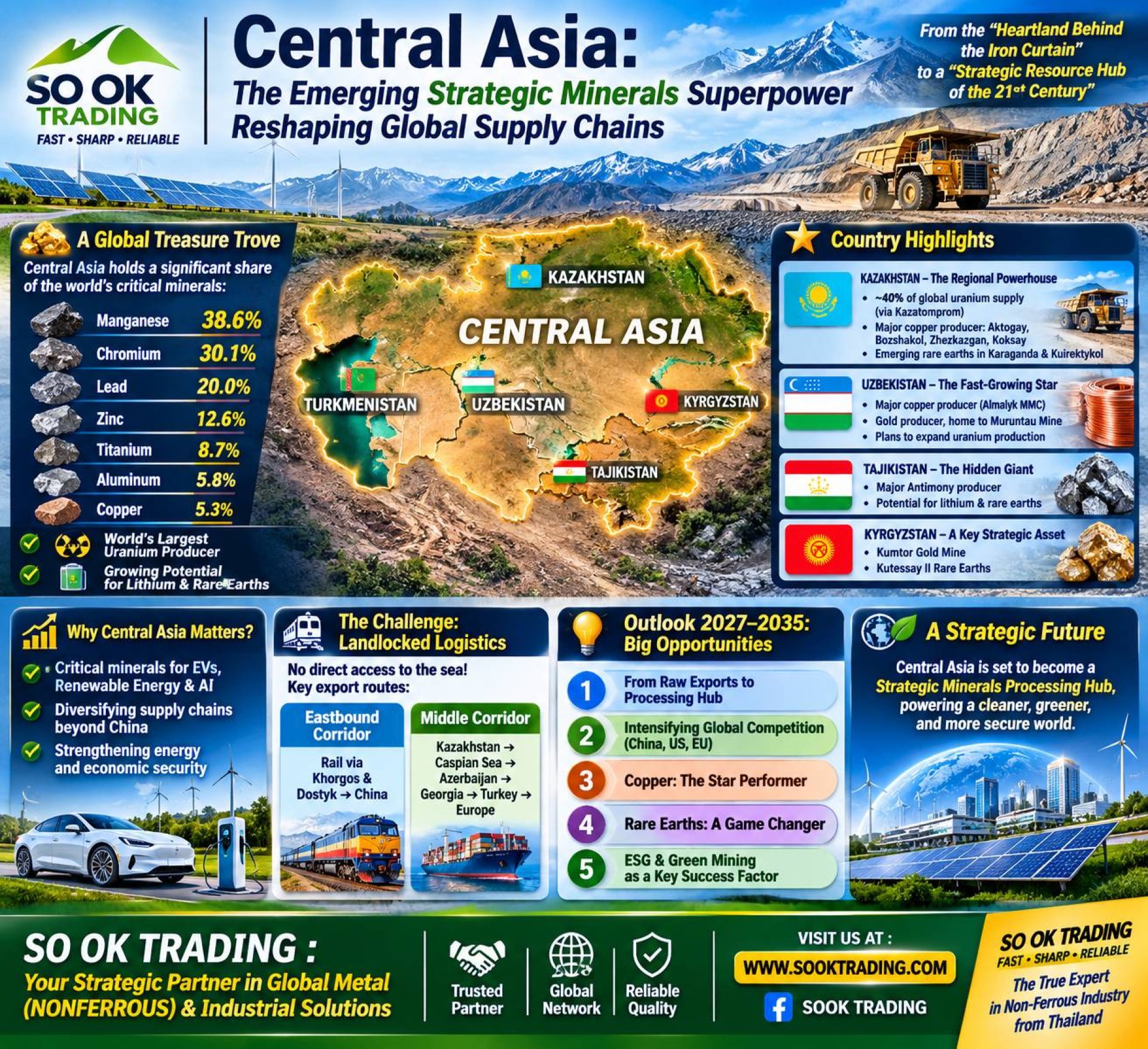
Central Asia: The Emerging Strategic Minerals Superpower Reshaping Global Supply Chains
From the “Former Soviet Frontier” to the “Resource Hub of the 21st Century”
For decades, Central Asia was largely viewed through a geopolitical lens, serving as a strategic crossroads between Russia, China, the Middle East, and Europe. Today, however, the region is rapidly emerging as one of the world's most important strategic territories for an entirely different reason: its vast reserves of Critical Minerals that are essential for the industries of the future.
The rapid expansion of electric vehicles (EVs), renewable energy, energy storage systems, semiconductors, AI data centers, and defense technologies is driving unprecedented demand for strategic minerals worldwide.
Against this backdrop, Central Asia, comprising Kazakhstan, Uzbekistan, Kyrgyzstan, Tajikistan, and Turkmenistan, is becoming a crucial pillar of global resource security and a key alternative source for diversifying critical mineral supply chains.
The Underground Treasure the World Is Watching
Central Asia's growing strategic importance stems from its extraordinary mineral wealth.
The region collectively holds a significant share of global reserves for several critical minerals, including:
Manganese: 38.6% of global reserves
Chromium: 30.1%
Lead: 20%
Zinc: 12.6%
Titanium: 8.7%
Aluminum: 5.8%
Copper: 5.3%
Beyond these impressive figures, Central Asia is also the world's largest uranium-producing region and is increasingly recognized as a promising source of lithium and rare earth elements (REEs).
These resources are no longer viewed as simple commodities. They have become strategic assets that increasingly influence economic competitiveness, national security, energy independence, and technological leadership.
Kazakhstan: The Core of Central Asia's Mining Industry
Kazakhstan stands at the center of the region's mining sector and is widely regarded as one of the most resource-rich nations in the world.
Uranium
Kazakhstan produces approximately 40% of global uranium supply through its national champion, Kazatomprom.
As countries worldwide revisit nuclear energy as part of their Net Zero strategies, uranium demand is expected to remain robust, strengthening Kazakhstan's strategic position in the global energy transition.
Copper
Kazakhstan is also a major global copper producer, supported by world-class mining operations such as:
Aktogay
Bozshakol
Zhezkazgan
Koksay
Much of Kazakhstan's copper production is exported to China, Turkey, and Europe, benefiting directly from rising demand driven by EV manufacturing, renewable energy infrastructure, and AI data centers.
Rare Earth Elements
One of the most closely watched developments in recent years has been the discovery of substantial rare earth deposits in the Karaganda and Kuirektykol areas.
If commercial development progresses successfully, Kazakhstan could emerge as one of the world's most important rare earth suppliers outside China.
Uzbekistan: The Fastest-Rising Mining Powerhouse
If Kazakhstan represents the region's established mining leader, Uzbekistan is rapidly becoming its fastest-growing mining economy.
The Uzbek government has aggressively pursued economic reforms and foreign investment, particularly in the mining and metallurgical sectors.
Copper
Almalyk MMC is investing billions of dollars to significantly expand copper production capacity.
Its primary objective is to increase cathode copper output to meet rapidly growing demand from green energy industries worldwide.
Gold
Uzbekistan is a major global gold producer and home to the Muruntau Gold Mine, one of the largest open-pit gold mines in the world.
Uranium
State-owned Navoiyuran has ambitious plans to substantially increase uranium production by 2030, reflecting confidence in the long-term growth outlook for nuclear energy.
The Hidden Giants: Tajikistan and Kyrgyzstan
Although smaller in economic size, both countries possess strategically important mineral assets.
Tajikistan
Tajikistan is one of the world's significant producers of antimony, a critical material used in:
Battery technologies
Flame retardants
Defense applications
Certain semiconductor technologies
The country also possesses considerable potential in lithium and rare earth development, attracting growing international interest.
Kyrgyzstan
Kyrgyzstan is home to the renowned Kumtor Gold Mine and the strategically important Kutessay II rare earth deposit.
Many analysts believe Kutessay II could become a valuable alternative supply source for Western economies seeking to reduce dependence on Chinese rare earth supply chains.
Lithium and Rare Earths: The Next Strategic Frontier
Perhaps the most compelling opportunity in Central Asia lies not in its established resources, but in the next generation of strategic minerals currently under development.
Rare Earth Elements (REEs)
Rare earth elements are indispensable for:
Electric Vehicles (EVs)
AI Infrastructure
Robotics
Semiconductor Manufacturing
Smart Grids
Wind Turbines
China currently dominates more than 80% of global rare earth processing capacity.
As a result, the United States and the European Union are actively strengthening partnerships with Kazakhstan and Uzbekistan to secure alternative supply chains.
Lithium
Lithium remains the cornerstone of modern EV battery technology.
Although Central Asia's lithium industry is still in its early stages, new discoveries are attracting investment from:
Germany
South Korea
China
United States
Competition for access to the region's lithium resources is expected to intensify throughout the late 2020s.
The Biggest Bottleneck: Logistics
Despite its immense resource base, Central Asia faces a major structural challenge.
Every country in the region is landlocked, creating significant logistical constraints for mineral exports.
Eastbound Corridor
The primary export route connects Central Asia to China through rail networks crossing Khorgos and Dostyk.
Today, this remains the dominant export channel for the region's mineral shipments.
Middle Corridor
This strategic route links:
Kazakhstan → Caspian Sea → Azerbaijan → Georgia → Turkey → Europe
Although transportation costs are higher, the Middle Corridor is receiving strong support from the United States and Europe as a means of reducing geopolitical supply chain risks.
OUTLOOK 2027–2035
The Future of Central Asia's Mining Industry
1. From Raw Material Exporter to Processing Hub
Historically, Central Asian countries focused on exporting raw mineral resources.
However, governments across the region are increasingly implementing policies that require foreign investors to pair resource development with:
Technology transfer, downstream investment, and local processing capabilities.
This shift could transform Central Asia into a major value-added metals production hub.
2. Intensifying Competition Between China, the U.S., and Europe
Central Asia is rapidly becoming a new arena for global resource competition.
China maintains significant advantages in infrastructure, financing, and mineral processing capacity.
Meanwhile, the United States and Europe are accelerating investments to diversify critical supply chains.
Competition for copper, uranium, lithium, and rare earth assets is likely to become one of the defining economic themes of the next decade.
3. Copper Could Become the Region's Star Commodity
From an industrial perspective, copper may be the single biggest beneficiary of future global growth trends.
Demand is being driven by:
Electric Vehicles
Renewable Energy
AI Data Centers
Grid Modernization
Kazakhstan and Uzbekistan are particularly well-positioned to capitalize on this growing demand.
4. Rare Earths Could Be a Game Changer
If rare earth projects in Kazakhstan and Kyrgyzstan progress successfully, Central Asia could become one of the most important rare earth supply regions outside China.
Such a development would significantly reshape global technology supply chains.
5. ESG and Green Mining Will Become Critical Success Factors
Western investors increasingly prioritize:
Carbon Footprint Reduction
Water Management
Traceability
Responsible Mining Practices
Countries that advance ESG standards most effectively will likely attract greater long-term capital inflows.
Executive Summary
Central Asia is rapidly emerging as one of the world's most strategically important mineral regions, supported by substantial reserves of uranium, copper, chromium, manganese, aluminum, lithium, and rare earth elements.
Driven by the global energy transition and expanding demand from advanced technologies, Kazakhstan and Uzbekistan are becoming the focal points of mining and metallurgical investment across the region. At the same time, global efforts to diversify supply chains beyond China are creating unprecedented strategic opportunities for Central Asia.
Between 2027 and 2035, the region is expected to evolve from a traditional raw-material exporter into a Strategic Minerals Processing Hub, playing a critical role in clean energy, electric vehicles, AI infrastructure, and long-term global resource security.
SO OK TRADING
Your Trusted Business Partner
FAST • SHARP • RELIABLE
www.sooktrading.com
Facebook: SO OK TRADING
SO OK TRADING
Thailand's Trusted Partner in Non-Ferrous Metals
Key Sources
OECD (2026), Critical Minerals in Central Asia
World Nuclear Association, Uranium and Nuclear Power in Kazakhstan (2026)
World Nuclear Association, Uranium Production by Country (2026)
U.S. Geological Survey (USGS), Kazakhstan Minerals Information (2026)
International Trade Administration (U.S. Department of Commerce), Kazakhstan Critical Minerals & Mining Sector (2026)
Ministry of Industry and Construction of Kazakhstan, Kuirektykol Rare Earth Discovery (2025–2026)
Navoi Mining & Metallurgical Company (NMMC), Muruntau Mine Data (2026)