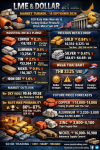
“Global Metal Market Under Pressure: Fed’s Hawkish Tone & Strong Dollar Shake LME and Thai Baht – SO OK TRADING | 14 SEP 2026”

“LME Slumps – Strong Dollar Pressures Metal Market and Thai Baht | SO OK TRADING | 14 SEP 2026”
Introduction
On September 14, 2026, the London Metal Exchange (LME) faced significant macroeconomic pressure. Commodity and industrial metal prices fell across the board after recently hitting record highs. The main drivers were concerns over U.S. inflation and expectations of further Federal Reserve (Fed) rate hikes, which strengthened the U.S. dollar and triggered widespread profit-taking. Global investors shifted into a more cautious stance.
Metal Market Overview (14 SEP 2026)
Copper: Down 0.3% to $14,193/ton, after previously surging past $14,700.
Aluminum: Slightly lower at $3,254/ton, still more than 20% higher year-on-year.
Tin: Dropped sharply to $53,364/ton due to profit-taking.
Lead: Down 0.7% to $1,879/ton.
Nickel: Down 0.83% to $16,387/ton.
Zinc: Down 0.7% to $3,830/ton.
Iron Ore: Fell for the fourth consecutive day to $97/ton.
Precious Metals
Gold: Spot down 0.84% to $4,314–4,325/oz. Thai gold prices fell by 200 THB, with selling prices at 68,050 THB.
Silver: Spot down 0.41% to $64.01–64.69/oz.
Thai Baht and Impacts
The Thai baht weakened to 33.25 per U.S. dollar, pressured by three key factors:
Dollar strength following higher-than-expected U.S. inflation data.
Rising energy prices amid Middle East tensions.
Foreign fund outflows from Thai equities and bonds.
Business Impacts:
Importers face higher costs despite lower LME prices due to baht depreciation.
Domestic gold prices fell less than global prices, cushioned by the weaker baht.
Exporters benefit from converting U.S. dollar revenues back into baht.
Market Outlook
The U.S. Dollar Index (DXY) rose to 99.46–99.58, with key resistance at 100.00. A breakout would further pressure the baht. Markets estimate an 80–87% probability that the Fed will raise rates by 0.25% to 3.75–4.00% at the September 15–16 meeting.
In the short term, commodities remain in a consolidation phase. However, tight supply fundamentals continue to provide support, especially for copper and aluminum, which may rebound later in the year driven by demand from AI, EV, and China’s infrastructure projects.
Future Price Trends (Non-Ferrous + Precious Metals)
Copper: Trading range $14,000–14,200/ton, with potential to retest $14,800 by year-end due to reduced mine supply and EV/AI demand.
Aluminum: Support at $3,200–3,250/ton, resistance at $3,700–3,800/ton, supported by geopolitical risks and Chinese policy.
Zinc: Support at $3,800/ton, resistance above $4,100/ton. Backwardation reflects tight physical supply.
Nickel: Expected to fluctuate between $16,000–16,900/ton, driven by Indonesia’s supply control and EV battery demand.
Recommendations for Businesses
Use price corrections to gradually enter forward contracts or hedging strategies.
Monitor key support levels for metals and baht resistance at 33.35–33.50/USD.
Strengthen risk management against volatility in both currency and commodity prices.
Conclusion
This report provides a comprehensive analysis of the metal markets, currency trends, and Fed policy outlook, along with future price directions. It serves as a valuable reference for businesses and investors in making strategic decisions and managing risks effectively.
SO OK TRADING – Your Trusted Business Partner FAST • SHARP • RELIABLE Visit: www.sooktrading.com | Facebook: SO OK TRADING