SO OK TRADING'S INSIGHT | APEC Shenzhen 2026: From Trade War to the AI Economy - A Turning Point for the New Global Economic Order | 21 NOV 2026
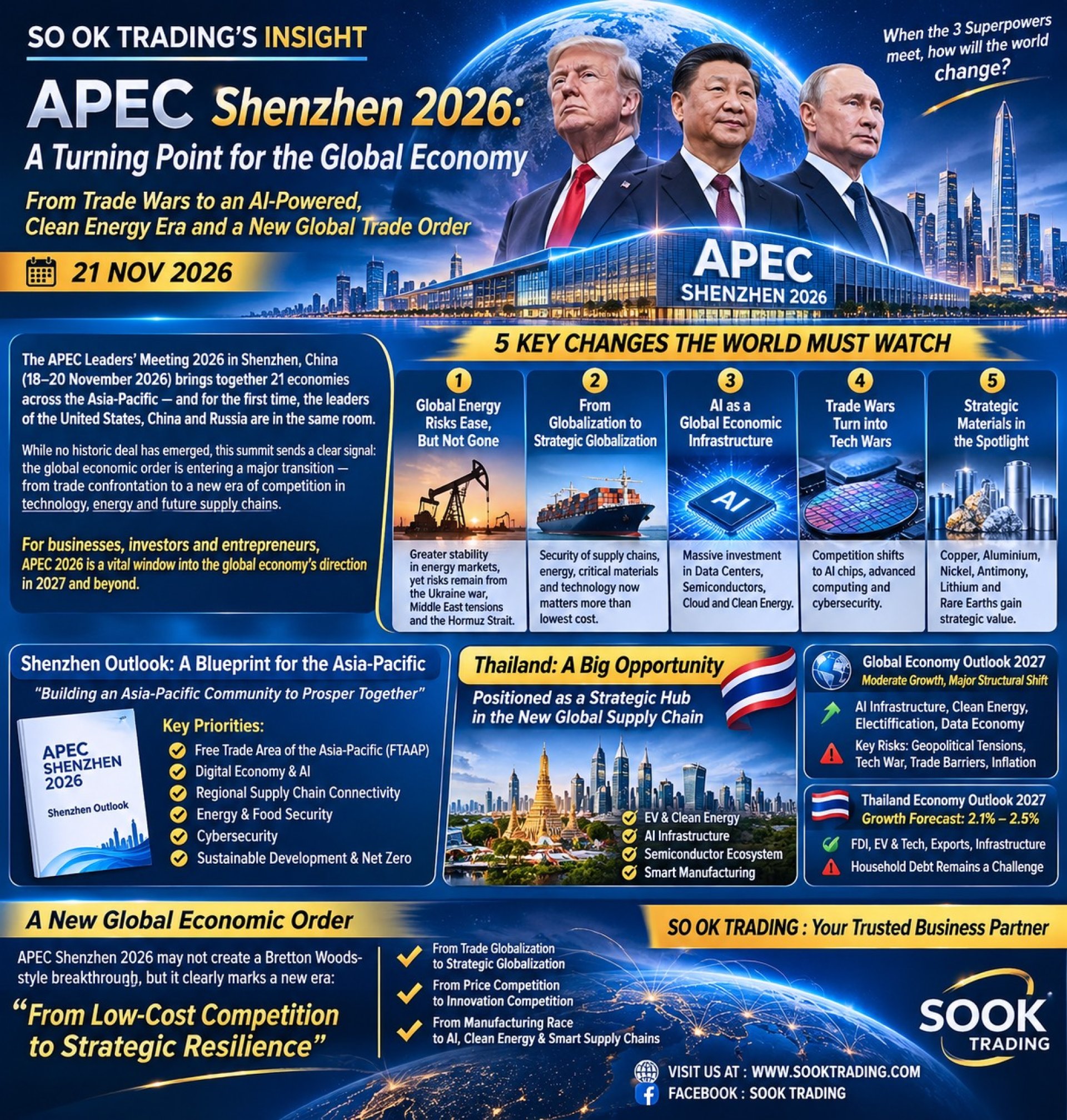
Shenzhen Outlook: A New Economic Blueprint for the Asia-Pacific
Under the Vision of
“Building an Asia-Pacific Community to Prosper Together”
APEC leaders adopted the 2026 APEC Leaders’ Shenzhen Outlook, a landmark framework that is expected to shape the future direction of economic cooperation across the Asia-Pacific region.
Key priorities include:
✅ Advancing the Free Trade Area of the Asia-Pacific (FTAAP)
✅ Accelerating the development of the Digital Economy and Artificial Intelligence (AI)
✅ Strengthening regional Supply Chain Connectivity
✅ Enhancing Energy and Food Security
✅ Improving Cybersecurity and Digital Governance
✅ Promoting Sustainable Development and Decarbonization
The Shenzhen Outlook highlights a clear reality: AI, digital transformation, and clean energy are becoming the core pillars of regional economic policy for the decade ahead.
Thailand: A Strategic Opportunity Amid Global Transformation
For Thailand, the most significant outcome of APEC Shenzhen 2026 may not be short-term trade gains, but the opportunity to emerge as a new regional supply-chain hub.
The effort to connect China's Greater Bay Area (GBA) with Thailand's Eastern Economic Corridor (EEC), alongside high-level discussions with leading companies such as BYD and Tencent, demonstrates that Thailand is increasingly viewed as a strategic destination for next-generation investment.
Particularly in sectors such as:
Electric Vehicles (EV)
AI Infrastructure
Semiconductor Ecosystems
Smart Manufacturing
Clean Energy
At the same time, Thailand continues to expand market access through Free Trade Agreements (FTAs) and regional digital economy initiatives, positioning itself for the next phase of global economic integration.
Global Economic Outlook 2027: The Era of AI and Clean Energy
The global economy is expected to maintain moderate growth in 2027, but the structure of that growth is undergoing a profound transformation.
The new engines of global expansion are increasingly centered on:
AI Infrastructure
Clean Energy
Electrification
Data Economy
Advanced Manufacturing
However, several major risks remain:
Geopolitical tensions
Technology competition
Trade protectionism
Energy-driven inflation
Slowing growth in China
These factors will continue to shape market sentiment and investment decisions over the coming years.
Thailand Economic Outlook 2027: Growth Amid Challenges
Thailand's economy is expected to grow between 2.1% and 2.5% in 2027.
The primary growth drivers include:
Foreign Direct Investment (FDI)
EV and Technology Industries
Electronics Exports
Public Infrastructure Investment
Nevertheless, elevated household debt remains a significant constraint on domestic consumption.
As a result, Thailand's recovery is likely to continue exhibiting a K-Shaped Recovery, where sectors connected to exports, technology, and global investment outperform businesses that rely primarily on domestic purchasing power.
In this environment, companies integrated into international supply chains and future industries are expected to enjoy stronger growth opportunities than those focused solely on local demand.
The World Is Entering a New Economic Order
APEC Shenzhen 2026 may not have produced a historic agreement on the scale of the Bretton Woods System or the creation of the World Trade Organization (WTO).
However, it has clearly demonstrated that the global economy is entering a new era.
The world is shifting:
From an economy driven by low-cost production to one powered by energy security, advanced technology, and strategic resources.
From Trade Globalization to Strategic Globalization.
From competition in manufacturing capacity to competition in AI, clean energy, and intelligent supply chains.
For Thailand, this transformation represents more than an opportunity to attract investment. It is a chance to elevate its role as a regional hub for manufacturing, technology, logistics, and clean energy across the Asia-Pacific.
Strategic Conclusion
The winners of the post-APEC Shenzhen 2026 era may not be the countries or companies with the lowest production costs.
Instead, they will be those capable of successfully integrating:
Energy
Technology
Critical Resources
Resilient Supply Chains
into a sustainable competitive advantage.
As the next chapter of the global economy begins, success will increasingly depend not on scale alone, but on the ability to anticipate change, manage complexity, and connect strategic assets across industries and borders.
The future belongs to those who can transform disruption into opportunity and convert global change into long-term competitive strength.
SO OK TRADING | Your Trusted Business Partner
SO OK TRADING | FAST • SHARP • RELIABLE
Visit Us: www.sooktrading.com
Facebook: SO OK TRADING
Together, We Grow. Together, We Succeed.