SO OK TRADING'S INSIGHT | 34 Baht per Dollar: When the Thai Baht Reflects a Shift in the Global Financial Order | 19 NOV 2026
SO OK TRADING'S INSIGHT
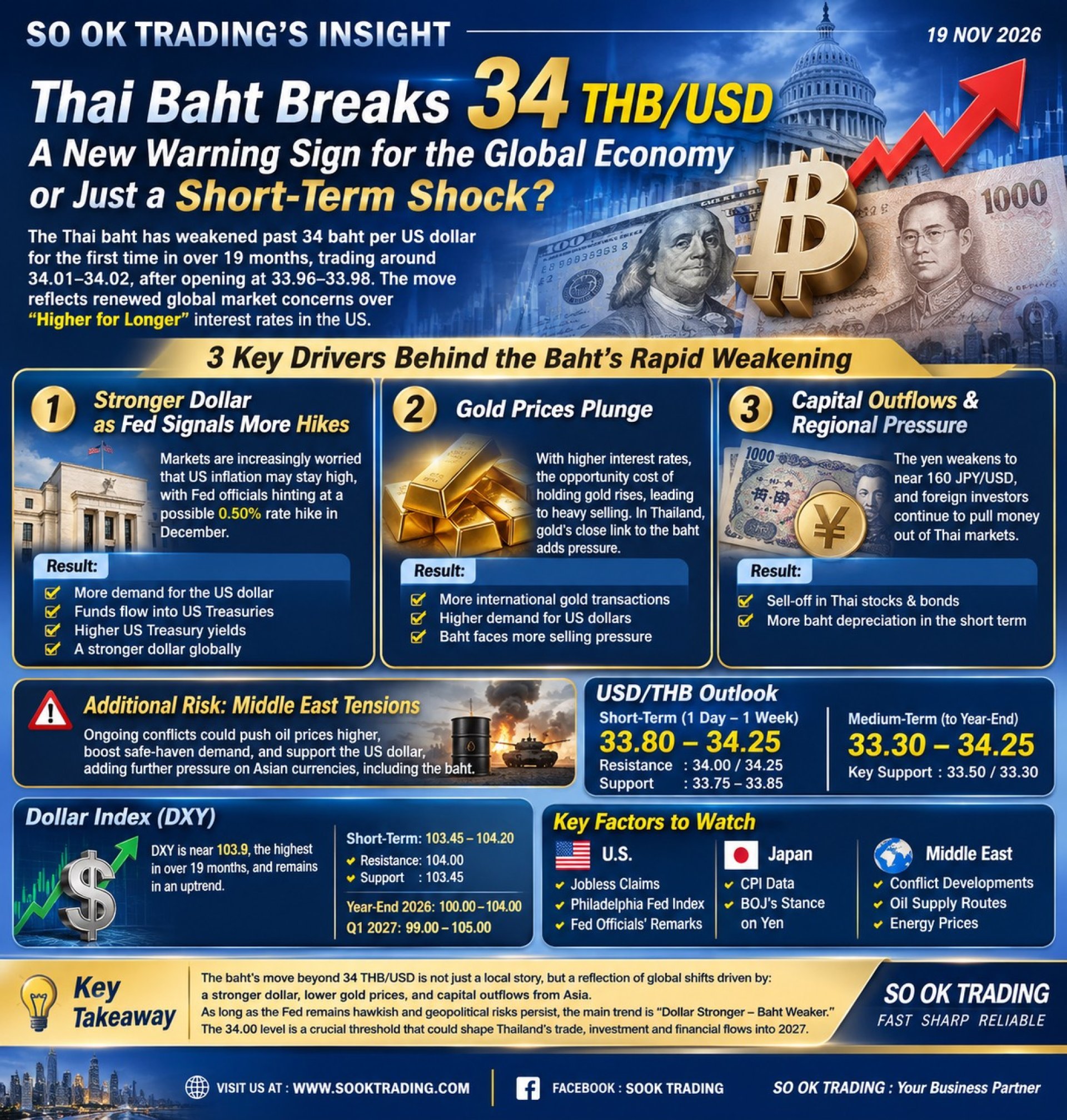
34 Baht per Dollar: A New Warning Signal for the Global Economy or Just a Short-Term Market Ripple?
19 NOV 2026
The Thai Baht has weakened beyond the 34 Baht per U.S. Dollar threshold for the first time in more than 19 months, recently trading around 34.01–34.02 per Dollar after opening the session near 33.96–33.98. The move reflects renewed pressure from global financial markets as investors once again embrace the U.S. "Higher for Longer" interest-rate narrative.
What makes this development particularly noteworthy is that the depreciation has not been driven by a single factor. Instead, it is the consequence of three powerful forces converging within just one week, creating significant turbulence across Asian financial markets.
Three Key Drivers Behind the Thai Baht's Rapid Weakness
1. A Stronger U.S. Dollar as the Fed Signals a More Aggressive Stance
Markets have become increasingly concerned that U.S. inflation may remain higher than expected. As a result, several Federal Reserve officials have signaled that a 0.50% interest rate increase may need to be considered at the December policy meeting.
The implications are clear:
Investors are increasing their holdings of U.S. Dollars.
Capital is flowing into U.S. Treasury markets.
U.S. Treasury yields continue to rise.
The Dollar is strengthening globally.
As the Dollar gains strength, emerging-market currencies, including the Thai Baht, naturally come under pressure.
2. A Sharp Decline in Global Gold Prices
Another major factor is the recent correction in gold prices.
As interest-rate expectations rise, the opportunity cost of holding gold increases. Investors consequently reduce their exposure to gold and reallocate capital toward higher-yielding assets.
For Thailand, gold prices are closely linked to currency movements.
When gold prices decline:
International gold transactions increase.
Demand for U.S. Dollars rises.
Additional selling pressure emerges on the Thai Baht.
As a result, the Baht tends to weaken further.
3. Capital Outflows and Regional Currency Pressure
Beyond U.S.-specific factors, Asia as a whole is experiencing mounting pressure.
Japanese Yen Approaches 160 per Dollar
The Japanese Yen has continued to weaken and is approaching the psychologically important level of 160 Yen per U.S. Dollar.
This depreciation has intensified pressure across regional Asian currencies, including the Thai Baht.
Foreign Investors Continue to Exit Thai Markets
International investors remain net sellers of:
Thai equities
Thai government bonds
At the same time, capital is increasingly being redirected toward Dollar-denominated assets and U.S. financial markets that offer more attractive returns.
These outflows have further reinforced the short-term depreciation trend in the Baht.
Additional Risk Factor: Rising Tensions in the Middle East
Geopolitical tensions in the Middle East remain an important source of market risk.
Should the conflict escalate or become more prolonged:
✅ Oil prices could rise further.
✅ Demand for safe-haven assets could increase.
✅ The U.S. Dollar could receive additional support.
Such developments would likely place even greater pressure on Asian currencies, including the Thai Baht.
USD/THB Outlook
Short-Term Outlook (1 Day - 1 Week)
Expected Range: 33.80 - 34.25
Key Levels to Watch
Major Resistance: 34.00
If USD/THB holds firmly above 34.00, the next upside target could be 34.25.
Initial Support: 33.75 - 33.85
Medium-Term Outlook (Through Year-End)
Projected Range: 33.30 - 34.25
Key Support Levels:
33.50
33.30
Conditions That Could Support a Baht Recovery
✅ Rebound in global gold prices
✅ A weaker U.S. Dollar
✅ Signals from the Bank of Japan (BOJ) to support the Yen
✅ Return of foreign capital to Asian markets
U.S. Dollar Index (DXY) Outlook
The Dollar Index is currently trading around 103.9, its highest level in more than 19 months.
The broader trend remains bullish.
Short-Term Range
103.45 - 104.20
Resistance: 104.00
A decisive break above this level could open the door to further gains.
Support: 103.45
A move below this level may trigger profit-taking and a temporary correction.
Medium-Term Outlook
End of 2026
100 - 104
Q1 2027
99 - 105
Although upward momentum has started to moderate, the primary trend remains bullish as long as DXY stays above key support levels.
Key Events to Watch
United States
Initial Jobless Claims
Philadelphia Fed Manufacturing Index
Speeches from Federal Reserve Officials
These releases will influence market expectations regarding whether the Fed will deliver a 0.25% or 0.50% rate hike at its upcoming meeting.
Japan
CPI Inflation Data
Bank of Japan Policy Signals
A more hawkish stance from the BOJ could support the Yen and help ease pressure on Asian currencies.
Middle East
Geopolitical developments
Risks to global oil shipping routes
Energy price movements
These factors have a direct impact on risk sentiment, oil markets, and demand for safe-haven assets.
What This Means for Investors and Businesses
The Thai Baht's move beyond 34 per Dollar is not simply the result of domestic economic conditions. Instead, it reflects a broader transformation taking place across global financial markets, driven by three major forces:
A stronger U.S. Dollar supported by higher-for-longer interest rates
Declining global gold prices
Capital outflows from Asia alongside continued Yen weakness
As long as the Federal Reserve maintains its inflation-fighting stance and geopolitical risks remain elevated, the dominant market theme is likely to remain:
"Stronger Dollar, Weaker Baht"
The 34 Baht per Dollar level is therefore more than just a psychological threshold. It could become a critical marker influencing trade competitiveness, import and export costs, capital flows, and investment decisions across Asia through late 2026 and early 2027.
SO OK TRADING'S INSIGHT
In a world where interest rates, geopolitics, and global capital flows are more interconnected than ever, the Thai Baht is no longer merely a reflection of Thailand's economy.
It is increasingly becoming a real-time indicator of the evolving balance of global financial power.
SO OK TRADING
Your Trusted Business Partner
FAST • SHARP • RELIABLE
VISIT US AT: www.sooktrading.com
FACEBOOK: SO OK TRADING