SO OK TRADING'S INSIGHT | Aluminium Market Outlook From a US$270+ Aluminium Price Drop to a Major Transformation of the Global Industry As the Era of "Supply Shortage Premium" Gives Way to the Rise of "Green & Strategic Materials P
SO OK TRADING'S INSIGHT | Aluminium Market Outlook
From Supply Shortage to a New Market Balance
As Aluminium Prices Transition from a "Short Squeeze" Rally to a New Era of Fundamentals-Driven Valuation
Aluminium Market Situation as of 19 November 2026 and Price Outlook
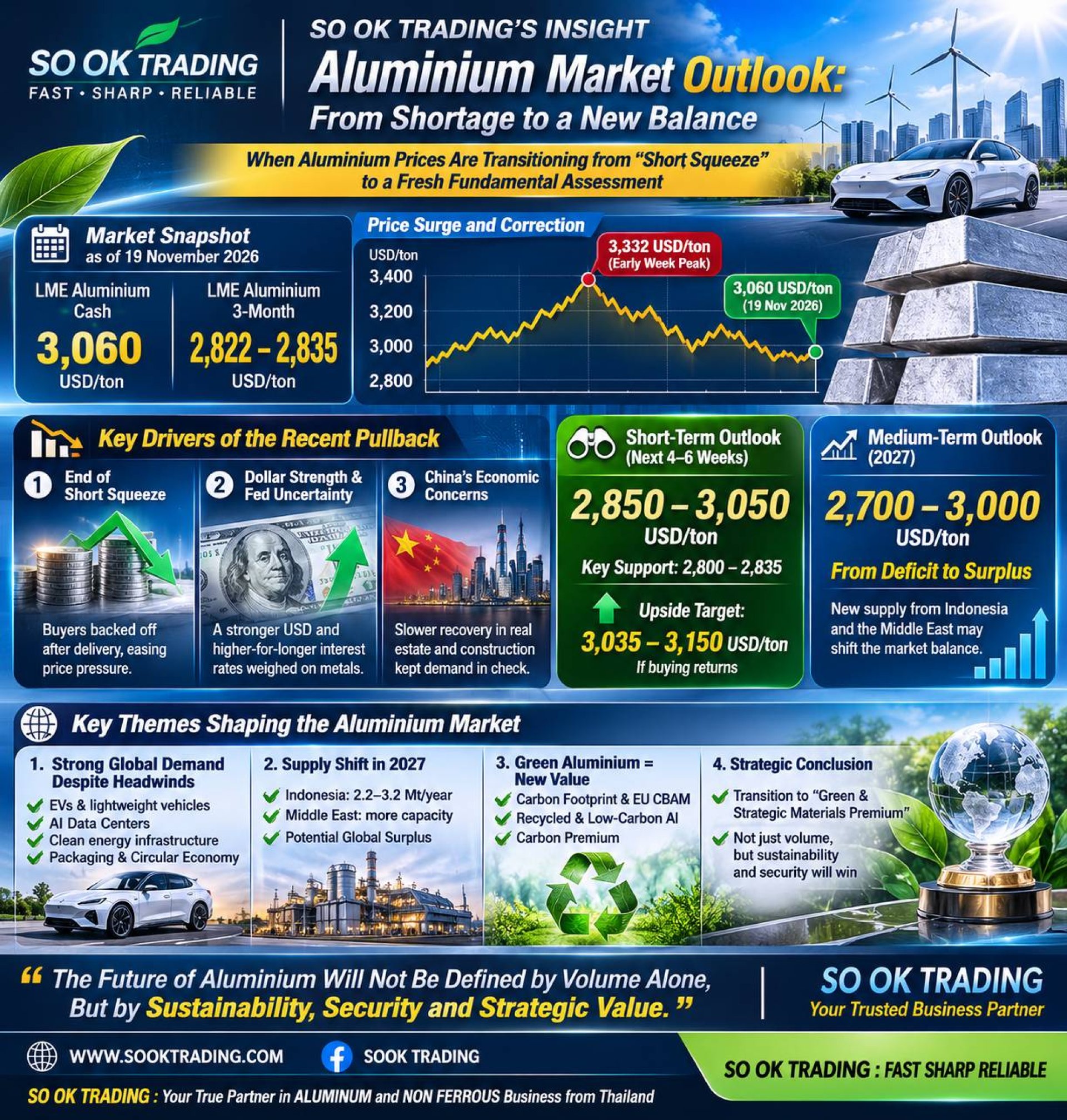
As of 19 November 2026, the global aluminium market stands at a critical turning point following one of its most volatile periods of the year. Earlier this week, LME Aluminium Cash surged above US$3,332 per metric ton, driven by physical metal shortages and an intense Short Squeeze. However, prices have since retreated sharply to approximately US$3,060 per metric ton, while LME Aluminium 3-Month contracts have eased to a trading range of US$2,822-2,835 per metric ton.
This correction does not necessarily signal a significant deterioration in global demand. Rather, it reflects the unwinding of short-term speculative positions following the November contract expiry, combined with the impact of a stronger U.S. dollar, uncertainty surrounding the Federal Reserve's interest rate path, and concerns about the pace of China's economic recovery.
Despite the recent pullback, the broader outlook for the global aluminium industry remains supported by powerful long-term growth drivers. These include the expansion of electric vehicles (EVs), clean energy infrastructure, AI data centers, next-generation power grids, and the accelerating transition toward Green Aluminium, which is increasingly becoming a key determinant of value in the industry.
The Market Is Moving from Supply Scarcity Back to Fundamental Valuation
At the beginning of the week, the global aluminium market experienced extreme tightness as inventories in LME warehouses fell to their lowest levels in decades. This forced a large number of short-position holders to rush into the market to cover their positions.
The resulting buying pressure pushed spot aluminium prices sharply higher and created an unusually steep Backwardation, where immediate delivery prices traded significantly above forward prices. This reflected a severe shortage of readily available metal in the physical market.
However, once the November delivery period passed, the short-covering frenzy quickly subsided. Aluminium prices subsequently fell by more than US$270 per ton within just a few days, bringing market attention back to industry fundamentals.
Three Key Factors Behind the Price Correction
1. The End of the Short Squeeze
The most significant factor was the unwinding of the Short Squeeze.
As short sellers were no longer forced to buy back positions aggressively, the exceptional buying pressure that had driven prices to extreme levels disappeared, allowing the market to return to a more balanced state.
2. Dollar Strength and U.S. Interest Rate Uncertainty
Stronger-than-expected U.S. economic data revived concerns that the Federal Reserve may keep interest rates elevated for longer than previously anticipated.
As a result, the U.S. dollar strengthened, increasing the cost of dollar-denominated commodities for international buyers and attracting capital back into financial assets.
The impact was not limited to aluminium. Industrial metals including copper, nickel, and zinc also faced significant selling pressure.
3. Concerns Over China's Economic Recovery
China remains the world's largest aluminium consumer, but key sectors such as real estate, construction, and private investment continue to recover more slowly than expected.
This has raised an important question for investors:
Can China's traditional demand sectors regain their role as the primary growth engine for global aluminium consumption in the coming year?
Short-Term Price Outlook: Building a Base Before the Next Move
Although the recent decline appears severe, market structure has not yet shifted into a fully bearish trend.
The US$2,800-2,835 per ton zone has emerged as a critical support level and represents the recent post-Short Squeeze low.
If prices remain above this level, the market could establish a base and trade within a range of US$2,850-3,050 per ton over the next four to six weeks.
Key market drivers will include:
Federal Reserve policy decisions
U.S. dollar movements
China's economic performance
LME inventory levels
Should buying interest return meaningfully, the next recovery target is expected to be between US$3,035 and US$3,150 per ton.
A successful breakout above this range could pave the way for a renewed uptrend toward US$3,200-3,400 per ton.
Outlook 2027: From Deficit to Surplus
While the aluminium market remains relatively tight in late 2026, the outlook for 2027 may look significantly different.
Current price support continues to come from low inventory levels, logistical challenges, and geopolitical uncertainties. However, a growing number of market analysts expect the global aluminium market to transition from a Deficit to a Surplus position during 2027.
Importantly, this shift is not expected to be driven by weaker demand but rather by new waves of supply entering the market.
The most significant additions are expected to come from Indonesia and the Middle East.
If major projects proceed as planned, the increase in global production capacity could alter the balance of the market and potentially push average aluminium prices into a range of US$2,700-3,000 per ton in 2027.
In other words, the market may be moving away from an era where prices are driven primarily by metal scarcity toward one where operational efficiency and competitiveness play a more decisive role.
Indonesia and the Middle East: The New Supply Powerhouses
One of the most closely watched developments is the rise of Indonesia as a major aluminium production hub.
Over the past several years, substantial Chinese investment has flowed into Indonesian smelters and upstream aluminium projects. As a result, the country's aluminium production capacity is projected to expand to approximately 2.2-3.2 million metric tons per year by 2027.
At the same time, large-scale smelters in the Middle East are expected to return to full operating capacity as regional geopolitical conditions stabilize.
Together, these developments could significantly reshape global supply dynamics and increase the likelihood of a surplus market.
Global Demand Remains Stronger Than Many Expect
Although China's property sector remains weak, new sources of aluminium demand continue to grow rapidly.
The electric vehicle industry remains a major driver of consumption, with aluminium playing a crucial role in lightweight vehicle structures, Gigacasting technologies, and battery enclosures.
Meanwhile, the expansion of AI data centers and energy infrastructure is driving demand for aluminium in transmission networks, substations, and renewable energy installations.
The packaging industry is also increasing its use of aluminium as companies pursue Circular Economy initiatives and Net Zero commitments, replacing traditional materials with more recyclable alternatives.
Green Aluminium: The New Source of Value
In the past, competitiveness was largely determined by production scale and cost.
Today, however, Carbon Footprint is becoming an increasingly important measure of value.
Under regulatory frameworks such as the EU Carbon Border Adjustment Mechanism (CBAM), buyers in Europe and North America are placing greater emphasis on environmental performance when selecting suppliers.
Demand continues to grow for:
Recycled Aluminium
Low-Carbon Aluminium
Renewable-Powered Aluminium
This trend is creating what many industry participants refer to as a "Carbon Premium" - an additional value placed on low-emission aluminium products.
Over the coming decade, this premium could become a defining competitive advantage for producers worldwide.
Strategic Conclusion
In the short term, the aluminium market still has room to recover following the post-Short Squeeze correction. A price range of US$2,950-3,150 per ton remains achievable, particularly if inventories stay low and geopolitical risks persist.
However, the longer-term landscape is changing rapidly.
New supply from Indonesia and the Middle East is expected to play a larger role in shaping global markets, while sustainability and carbon performance will increasingly influence value creation.
Ultimately, the global aluminium industry is moving away from the era of "Supply Shortage Premium" and entering the age of "Green & Strategic Materials Premium."
The winners of the next decade may not be those who produce the most aluminium.
Rather, they will be the companies that produce aluminium most sustainably, with the lowest carbon footprint and the strongest alignment with the evolving needs of global supply chains.
SO OK TRADING'S INSIGHT | 19 November 2026
"The Future of Aluminium Will Not Be Defined by Volume Alone, But by Sustainability, Security and Strategic Value."
SO OK TRADING
Your Trusted Business Partner
FAST • SHARP • RELIABLE
www.sooktrading.com
Facebook: SOOK TRADING
SO OK TRADING
Thailand's Real Expert in Aluminium and Non-Ferrous Metals
Your Strategic Partner in the Global Aluminium and Non-Ferrous Metals Supply Chain