SO OK TRADING'S INSIGHT | Indonesia: The Rising Star of the Global Aluminum Industry How ASEAN's Aluminum Ingots Are Transforming the Future of Global Supply Chains 17 NOV 2026
SO OK TRADING'S INSIGHT | Indonesia: The Rising Star of the Global Aluminum Industry
How ASEAN's Aluminum Ingots Are Transforming the Global Supply Landscape
16 NOV 2026
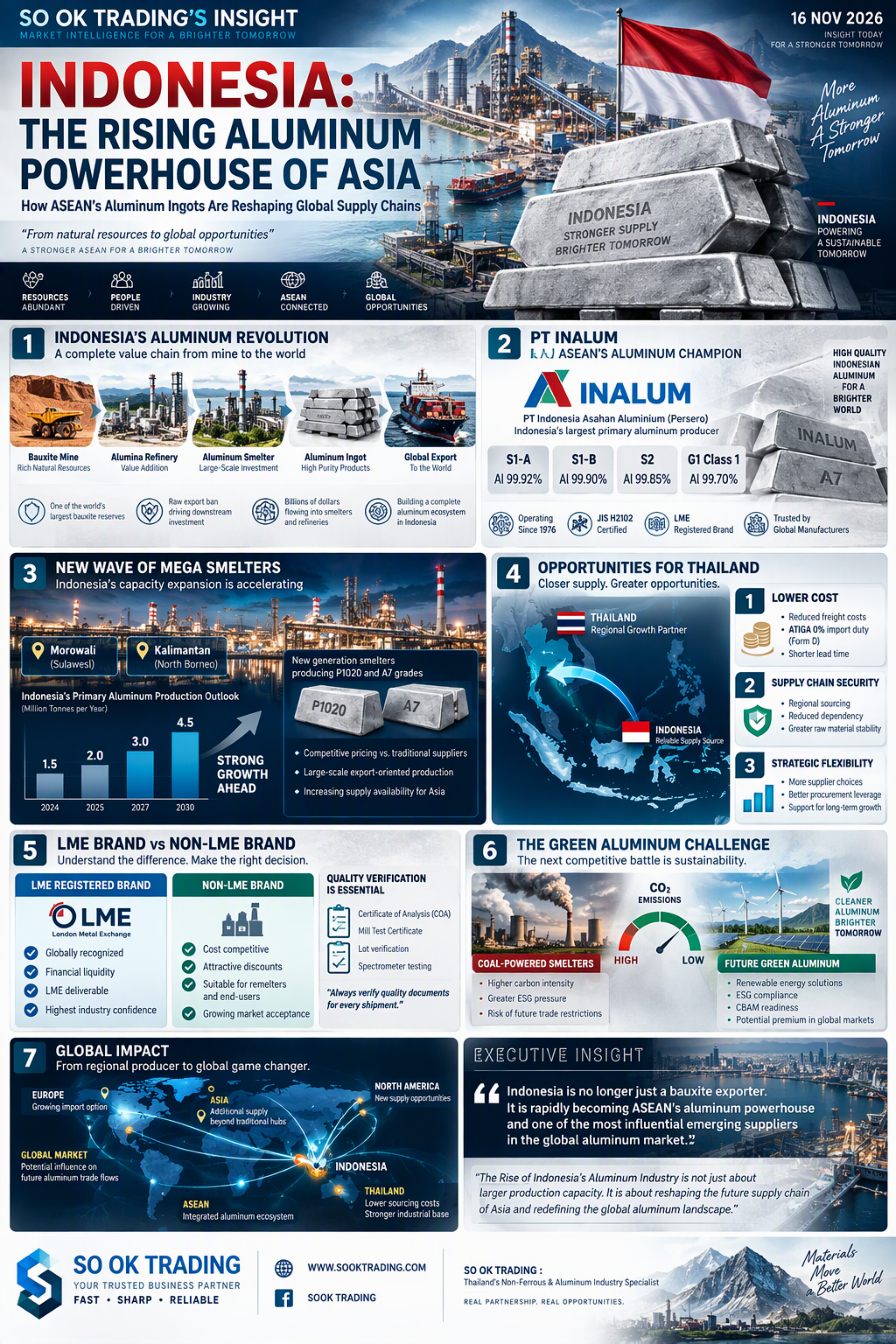
For decades, the global aluminum market has been dominated by major producers such as China, Russia, India, Australia, and the Middle East. Today, however, Indonesia is rapidly emerging as one of the industry's most closely watched players.
Backed by vast bauxite reserves, a strategic ban on raw mineral exports, and billions of dollars in foreign investment from China, Japan, and sovereign wealth funds, Indonesia is building a fully integrated aluminum value chain. From bauxite mining and alumina refining to aluminum smelting and downstream manufacturing, the country is positioning itself as a major force in the global aluminum industry.
This transformation could mark the beginning of a new era, elevating ASEAN into one of the world's most important aluminum production hubs.
PT INALUM: The Pioneer of Indonesia's Aluminum Industry
At the heart of Indonesia's aluminum sector stands PT Indonesia Asahan Aluminium (INALUM), the country's largest aluminum producer.
Operating since 1976, INALUM has established itself as a globally recognized producer of primary aluminum ingots. Its products offer purity levels ranging from 99.70% to 99.92% and comply with Japan's JIS H2102 industrial standards.
Key product grades include:
• S1-A: Al 99.92%
• S1-B: Al 99.90%
• S2: Al 99.85%
• G1 Class 1: Al 99.70%
With decades of experience supplying the Japanese automotive sector and global manufacturers, INALUM has become one of ASEAN's benchmark aluminum brands. It is also currently the only Indonesian aluminum producer with LME Registered Brand status.
A New Wave of Mega Smelters
Beyond INALUM, Indonesia is witnessing significant investment in large-scale aluminum smelting facilities.
Major projects in Morowali and Kalimantan are rapidly expanding the country's production capacity and attracting global industrial investment.
These next-generation smelters are producing P1020 and A7 grade aluminum with purity levels exceeding 99.70%, making them ideal feedstock for alloy manufacturing and downstream processing industries.
Although many of these brands are not yet registered with the London Metal Exchange (LME), they are gaining strong interest throughout Asia thanks to their competitive pricing and large-volume production capabilities.
From Bauxite Exporter to Asia's Aluminum Powerhouse
Indonesia's success in developing its nickel industry is now being replicated in aluminum.
The government has embraced a downstream industrialization strategy aimed at creating greater domestic value from natural resources. By restricting raw material exports and encouraging investment in refining and processing facilities, Indonesia is rapidly strengthening its industrial foundation.
As a result, the country's primary aluminum production capacity is poised for significant expansion, potentially reaching several million tonnes annually within the coming years.
Indonesia is no longer merely a new producer. It is becoming a true game changer with the potential to reshape global aluminum supply and demand dynamics.
Opportunities for Thailand
For Thai manufacturers and industrial users, Indonesia's aluminum expansion presents both opportunities and challenges.
1. Closer Supply, Lower Costs
Importing aluminum from Indonesia reduces transportation distances, shortens lead times, and lowers logistics risks compared with sourcing from the Middle East, Europe, or Australia.
Importers may also benefit from tariff exemptions under the ASEAN Trade in Goods Agreement (ATIGA) through Form D certification.
2. Enhanced Supply Chain Resilience
The emergence of a major regional supplier allows Thai manufacturers to diversify procurement sources and reduce dependency on a limited number of exporting countries.
3. Rising Competition for the Recycling Industry
Increased availability of competitively priced primary aluminum could place pressure on secondary aluminum producers throughout ASEAN by narrowing traditional pricing spreads.
As a result, secondary alloy manufacturers may need to further improve operational efficiency and cost competitiveness.
LME Brand vs Non-LME Brand: What Buyers Should Know
Commercially, Indonesian aluminum products generally fall into two key categories.
LME Registered Brands
Advantages:
• Officially approved by the London Metal Exchange
• Greater financial liquidity
• Eligible for LME warehouse delivery
• Strong international market recognition
Non-LME Brands
Advantages:
• More competitive pricing
• Attractive discounts relative to LME reference prices
• Suitable for remelters and downstream manufacturers
• Growing acceptance across industrial markets
Regardless of origin, buyers should require a Certificate of Analysis (COA), Mill Test Certificate, and regular chemical composition verification to ensure material quality and consistency.
Green Aluminum: The Next Major Challenge
While Indonesia's aluminum industry has tremendous growth potential, sustainability is becoming an increasingly important consideration.
Many newly constructed smelters continue to rely heavily on coal-fired power generation, resulting in higher carbon emissions compared with producers in Australia, Canada, and Scandinavia.
At the same time, demand for low-carbon aluminum is accelerating worldwide. Environmental regulations in Europe and North America are expected to become increasingly stringent, making carbon intensity a critical competitive factor for future aluminum exports.
Conclusion
Indonesia is rapidly transforming from a bauxite-exporting nation into ASEAN's integrated aluminum production hub.
Its ambitious capacity expansion is expected to influence supply chains across Thailand, ASEAN, Asia, and the global market. The impact will extend beyond production volumes to include pricing dynamics, investment flows, competitive positioning, and the future direction of the aluminum industry.
In the years ahead, Indonesian Aluminum Ingots may become one of the most important factors shaping the competitiveness of aluminum manufacturing and industrial development across the region.
SO OK TRADING'S INSIGHT
"The Rise of Indonesia's Aluminum Industry is not just about larger production capacity. It is about reshaping the future supply chain of Asia and redefining the global aluminum landscape."
SO OK TRADING | YOUR TRUSTED BUSINESS PARTNER
FAST • SHARP • RELIABLE
VISIT US AT: WWW.SOOKTRADING.COM
FACEBOOK: SOOK TRADING
SO OK TRADING
Thailand's Non-Ferrous Metals & Aluminum Industry Specialist