The Global Aluminum Industry 2026: Products, Applications, Alloy Series and Future Market Trends
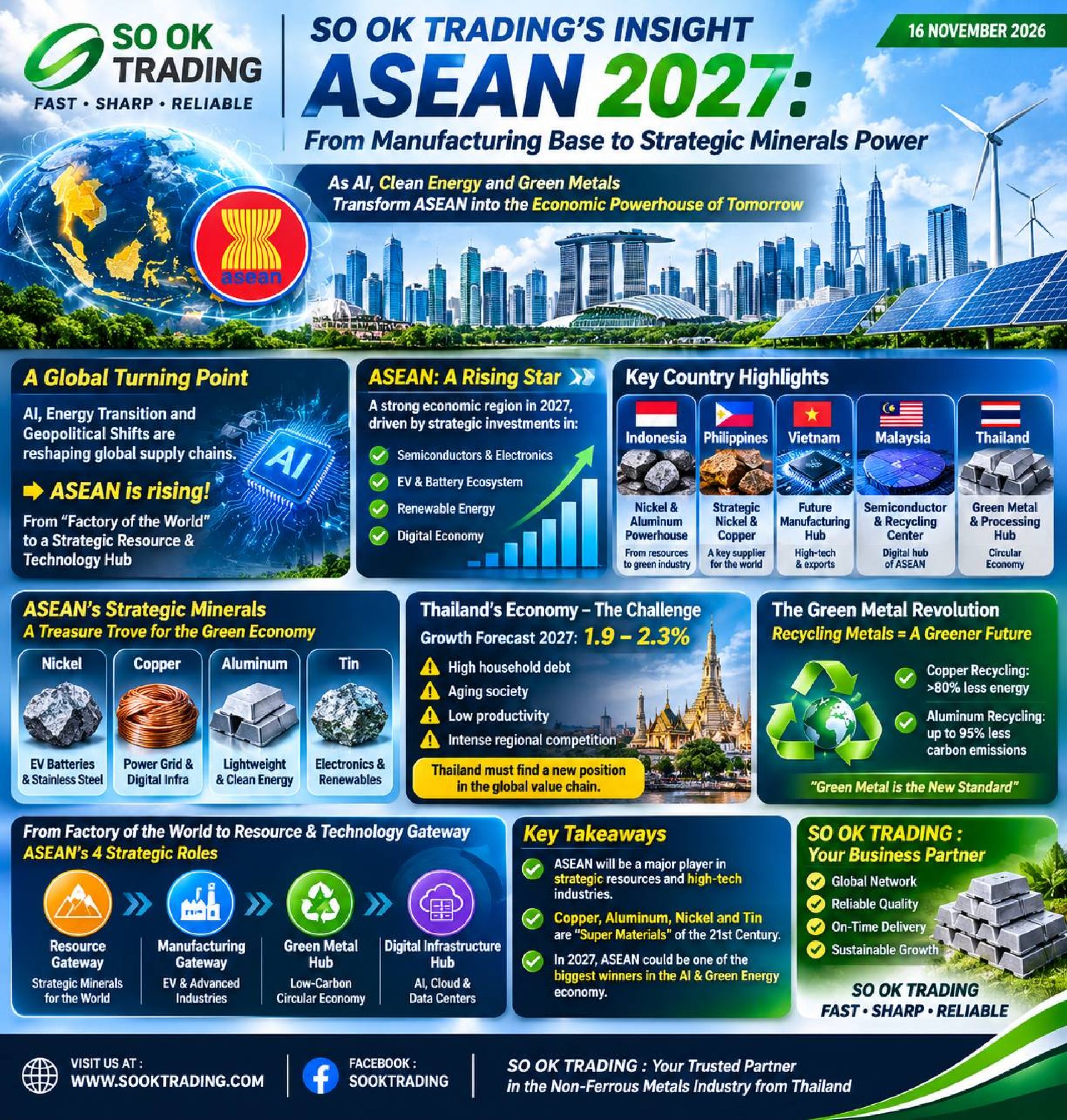
SO OK TRADING'S INSIGHT | ASEAN 2027: From the Factory of the World to a Strategic Resource Superpower as AI, Clean Energy, and Green Metals Transform ASEAN into the Economic Hub of the Future
16 NOVEMBER 2026
Amid the rapid advancement of artificial intelligence (AI), the global energy transition, and the strategic restructuring of supply chains, ASEAN is evolving from a low-cost manufacturing base into one of the world's most important hubs for strategic resources and industrial development.
Backed by abundant critical mineral resources, a growing non-ferrous metals industry, and an expanding role in the supply chains of electric vehicles (EVs), batteries, data centers, semiconductors, and renewable energy, ASEAN is emerging as a key driver of 21st-century economic growth.
At the same time, Thailand faces a critical challenge: accelerating its economic transformation to maintain competitiveness in a rapidly changing global landscape.
A Turning Point for the Global Economy and a New Opportunity for ASEAN
The year 2027 is shaping up to be another pivotal year for the global economy.
Advances in AI, large-scale investment in digital infrastructure, the acceleration of the energy transition, and increasing geopolitical tensions are reshaping global supply chains once again.
While global economic growth is expected to moderate, ASEAN continues to stand out as one of the world's most promising regions. The region offers a unique combination of a large consumer market, modern manufacturing capabilities, and access to resources that are essential for the industries of the future.
Once known primarily as the "Factory of the World," ASEAN is now evolving into a Strategic Resource & Technology Hub poised to play a much larger role in the global economy.
ASEAN Remains a Rising Star of the Global Economy
ASEAN's economic outlook for 2027 remains stronger than that of many other regions around the world.
Growth is being driven by investments in strategic industries, including:
Semiconductors
AI Data Centers
Electric Vehicles (EVs)
Renewable Energy
Advanced Electronics
Digital Infrastructure
Vietnam continues to benefit from strong growth in technology exports, semiconductor manufacturing, and multinational relocation strategies under the China+1 model.
Indonesia is leveraging its large domestic market alongside its downstream mineral processing policy to transform its economic structure and create greater value from natural resources.
Malaysia is rapidly establishing itself as a regional hub for data centers, semiconductor manufacturing, and digital technologies.
These trends highlight a significant shift: ASEAN is no longer competing primarily on low labor costs. Instead, it is increasingly competing through strategic resources, technology, energy infrastructure, and integration into next-generation global supply chains.
Thailand's Economy: Growing, But Not Fast Enough
While neighboring countries continue to grow at a robust pace, Thailand's GDP growth in 2027 is projected to be approximately 1.9% to 2.3%, significantly below the ASEAN average.
Although electronics exports, AI-related investment, and manufacturing continue to support economic activity, several structural challenges remain:
High household debt
An aging population
Productivity constraints
A shortage of high-growth emerging industries
Intensifying competition from neighboring economies
Thailand's recovery also reflects a clear K-shaped pattern, where technology-driven sectors, exporters, and large corporations continue to perform well, while many SMEs and traditional industries struggle under increasing competitive pressure.
The most important question for Thailand over the next decade is not simply how fast it can grow, but how it can reposition itself within the global value chain.
AI Is Reshaping the Global Industrial Landscape
Artificial Intelligence has become one of the most powerful investment themes worldwide.
Its impact extends far beyond software and digital services. AI is driving unprecedented levels of investment in:
Data Centers
Power Grids
Energy Storage Systems
Semiconductors
Cooling Systems
Digital Infrastructure
All of these sectors require substantial quantities of critical raw materials, including:
Copper
Aluminum
Nickel
Tin
As a result, the world is entering an era in which critical minerals are becoming strategic assets comparable to oil in previous generations.
ASEAN Is Emerging as a Global Critical Minerals Powerhouse
Perhaps even more significant than ASEAN's economic growth is its increasing control over resources that are fundamental to future industries.
Indonesia: The New Global Powerhouse for Nickel and Aluminum
Indonesia sits at the heart of the global EV battery supply chain.
As the world's leading nickel producer, the country continues to expand domestic nickel, aluminum, and copper smelting capacity through its downstream industrial development strategy.
Its objective is no longer simply to export raw materials, but to create value-added products ranging from battery materials and cathodes to electric vehicles.
Indonesia is transforming itself from a resource exporter into a global green industrial powerhouse.
The Philippines: A Strategic Source of Nickel and Copper
The Philippines possesses substantial nickel and copper resources.
As global demand for copper rises alongside the expansion of AI infrastructure, power networks, and data centers, the country is becoming increasingly important within global supply chains.
In the future, the Philippines may further develop downstream processing and refining capabilities, creating higher-value industrial opportunities.
Vietnam: The Manufacturing Platform of the Future
Although Vietnam is not a major mineral producer, it has established itself as one of Southeast Asia's most dynamic manufacturing economies.
The country is benefiting from strong foreign direct investment and expanding production in semiconductors, solar panels, electronics, and renewable energy equipment.
Vietnam is rapidly becoming a high-value manufacturing hub within the region.
Malaysia: ASEAN's Semiconductor and Circular Economy Hub
Malaysia is strengthening its position as one of Asia's leading semiconductor and metal recycling centers.
The rapid growth of data centers and semiconductor manufacturing has also made the country a major consumer of copper and aluminum.
Its role in advanced manufacturing and circular economy initiatives is expected to become increasingly important.
Thailand: A Hub for Advanced Processing and Green Metals
Although Thailand lacks large-scale mineral reserves, it possesses significant downstream industrial capabilities.
These include:
Aluminum Alloy Casting
Copper Processing
Electrical Cable Manufacturing
Automotive Components
Metal Recycling
If Thailand successfully advances Green Metal standards and Circular Economy initiatives, it could become one of ASEAN's most important high-quality recycled metal hubs.
Copper and Aluminum: The Two Metals Defining the 21st Century
As AI, clean energy, and electric vehicles continue to expand, the strategic importance of copper and aluminum is increasing rapidly.
Copper has become essential for:
Power Transmission Networks
AI Data Centers
Electric Vehicles
Renewable Energy Systems
Digital Infrastructure
Global copper markets face growing supply challenges as demand expands faster than new mining capacity can be developed.
Aluminum, meanwhile, continues to benefit from EV manufacturing and clean energy investments. However, additional production capacity from Indonesia and the Middle East may create periods of market oversupply.
Nevertheless, both metals remain indispensable to the future global economy.
The New Era of Metal Recycling
One of the industries expected to benefit most from these trends is metal recycling.
What was once considered a traditional scrap business is now evolving into a Strategic Green Material Industry.
Global EV manufacturers, semiconductor companies, and technology firms are increasingly seeking low-carbon raw materials.
Copper recycling can reduce energy consumption by more than 80%, while aluminum recycling can reduce greenhouse gas emissions by up to 95% compared with primary production.
As a result, Green Metals are rapidly becoming the new standard for industrial supply chains worldwide.
From Factory of the World to Resource & Technology Gateway
What is taking place in ASEAN is more than economic growth. It is a transformation of the region's strategic role within the global economy.
ASEAN is positioning itself across four key dimensions:
Resource Gateway
Providing access to critical minerals and strategic resources.
Manufacturing Gateway
Serving as a production base for EVs, clean energy technologies, and advanced electronics.
Green Metal Hub
Leading the development of low-carbon metals and circular economy ecosystems.
Digital Infrastructure Hub
Supporting AI, cloud computing, data centers, and future digital networks.
Executive Summary
The year 2027 may ultimately be remembered as the beginning of a new era in which ASEAN is no longer simply a manufacturing center, but a region that plays a defining role in shaping the future of resources and global supply chains.
In a world increasingly driven by AI, clean energy, electric vehicles, and low-carbon development, critical minerals such as nickel, copper, aluminum, and tin are becoming the Super Materials of the 21st Century.
While many nations are competing to secure access to these strategic resources, ASEAN possesses a unique combination of:
✅ Critical Mineral Resources
✅ Manufacturing Capabilities
✅ Large Consumer Markets
This combination positions ASEAN as one of the most important potential winners of the AI, Green Energy, and Critical Minerals era over the coming decade.
SO OK TRADING
Your Trusted Business Partner
FAST • SHARP • RELIABLE
www.sooktrading.com
Facebook: SOOKTRADING
Thailand's Leading Non-Ferrous Metals Specialist