SO OK TRADING'S INSIGHT Global Aluminum Market Outlook 2026–2027 From Supply Squeeze to the Green Metal Era The Future of Aluminum in the Age of EV, AI and Net Zero
SO OK TRADING'S INSIGHT
Aluminum Market Outlook 2026–2027
The Global Aluminum Industry Is Reaching a Major Turning Point
The aluminum industry is entering a transformative period, shifting from an era of supply shortages toward a new landscape defined by technological innovation, sustainability, and low-carbon competitiveness.
At first glance, aluminum prices remaining above USD 3,000 per metric ton may suggest that the market is still fundamentally strong. However, beneath the surface, the industry is experiencing one of the most significant structural changes seen in decades.
What is happening today is no longer just about metal prices. It is the result of a convergence of global economic trends, geopolitical developments, energy transition policies, electric vehicle adoption, AI infrastructure expansion, and increasingly stringent carbon regulations.
In other words, aluminum is evolving from a conventional industrial commodity into a strategic metal for the future global economy.
Late 2026: A Tight Market, but Signs of Change Are Emerging
As of mid-November 2026, aluminum prices remain at elevated levels:
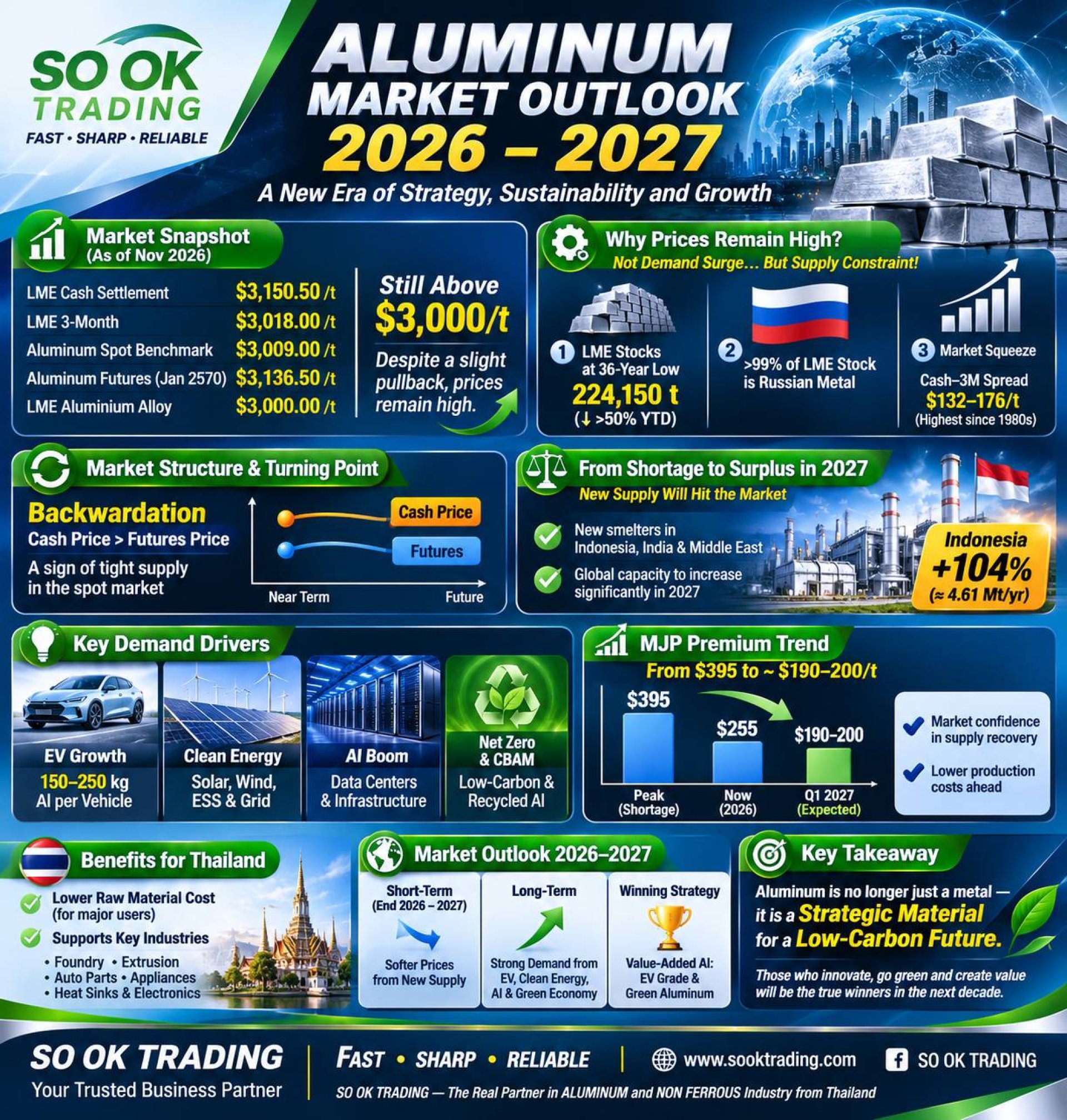
• LME Cash Settlement: approximately USD 3,150.50/MT
• LME 3-Month: approximately USD 3,018.00/MT
• Aluminum Spot Benchmark: approximately USD 3,009.00/MT
• Aluminum Futures (January 2027): approximately USD 3,136.50/MT
• LME Aluminium Alloy: approximately USD 3,000.00/MT
Despite modest weakness caused by a stronger U.S. dollar, prices remain significantly above historical averages.
Market Structure Matters More Than Price
One of the most important features of today's aluminum market is its structure.
The LME aluminum market is currently in Backwardation, meaning that spot prices are higher than forward prices.
This situation typically occurs when physical material is scarce and buyers requiring immediate delivery are willing to pay a premium over those purchasing for future delivery.
The message from the market is clear:
The market is not short of demand.
The market is short of deliverable metal.
Why Are Aluminum Prices Still So High?
Under normal circumstances, commodity prices rise because global demand accelerates alongside economic growth.
The current situation is different.
The primary driver is not exceptionally strong demand, but rather restricted supply.
Simply put:
Aluminum consumption has not exploded,
but immediately available supply has become significantly tighter.
Three key factors explain the current environment.
1. LME Inventories Have Fallen to a 36-Year Low
Aluminum inventories within the London Metal Exchange system have fallen to approximately 224,150 metric tons.
This represents a decline of more than 50% since the beginning of the year and marks the lowest inventory level since 1990.
With inventories falling so sharply, buyers requiring physical metal have been forced to compete aggressively for available supply.
2. Most Remaining Stocks Are Russian-Origin Metal
Although inventories still exist on paper, more than 99% of available LME stocks are reported to be Russian-origin aluminum.
Because many Western consumers and manufacturers remain cautious toward Russian material, the amount of metal that is commercially acceptable to a broad range of buyers is significantly smaller than official inventory data suggests.
3. Market Squeeze Conditions Have Emerged
Another key factor is the unusually large long positions held by major market participants.
Certain traders hold futures positions that exceed the amount of readily deliverable aluminum available in the market.
As a result, competition for physical delivery has intensified.
The spread between Cash and 3-Month contracts widened to approximately USD 132–176 per metric ton, reaching levels not seen since the late 1980s.
Why Could the Market Shift to Surplus in 2027?
This is arguably the most important question facing the aluminum industry today.
The factors responsible for today's shortages are gradually being addressed across several major producing regions.
Over the past few years, elevated prices have encouraged substantial investment in new smelting capacity.
Significant projects have been developed in:
• Indonesia
• India
• The Middle East
As these facilities reach full production during 2027, additional metal supply will begin entering the market in meaningful volumes.
The result could be a transition from today's supply-constrained environment toward a more balanced market.
Indonesia: The Rising Powerhouse of the Aluminum Industry
Among global aluminum markets, Indonesia has become one of the most closely watched countries.
Historically, Indonesia primarily exported bauxite and raw materials.
Today, the government is actively promoting downstream industrial development, aiming to transform the country from a raw material exporter into a producer of high-value-added metals.
By 2027, Indonesia's primary aluminum production capacity is expected to reach approximately:
4.61 Million MT per Year
representing growth of more than:
104% Year-over-Year
This expansion is expected to reshape aluminum supply chains throughout Asia, particularly in:
• China
• Japan
• South Korea
• Thailand
• Vietnam
What Is the Decline in MJP Premium Telling Us?
While many market participants focus on LME prices, actual buyers know that premiums are equally important.
Premiums represent the additional cost paid above LME prices to secure physical delivery.
At the peak of supply tightness:
• MJP Premium reached approximately USD 395/MT
Today:
• MJP Premium has fallen to around USD 255/MT
Market expectations suggest:
• Q1 2027 MJP Premium may decline further to USD 190–200/MT
This signals:
✅ Improving supply availability
✅ Reduced market tightness
✅ Lower import costs across Asia
In short, the premium market is beginning to price in a more balanced supply environment.
What Does This Mean for Thailand?
Thailand is one of Southeast Asia's major aluminum-processing hubs but is not a significant producer of primary aluminum.
As aluminum prices and premiums gradually soften, a wide range of downstream manufacturers could benefit.
Key beneficiaries include:
• Aluminum foundries
• Extrusion plants
• Wheel manufacturers
• Automotive suppliers
• Appliance manufacturers
• Electronics and heat sink producers
• Fabrication companies
Lower raw material costs could improve both profitability and international competitiveness.
However, businesses holding large inventories may face pressure from declining inventory values.
Scrap Aluminum and ADC12 Markets Remain Stable
Although primary aluminum prices have been highly volatile, scrap aluminum and ADC12 markets have remained relatively stable.
This balance reflects two opposing forces:
• High scrap collection and procurement costs
• Moderately soft demand from foundries
As a result, prices have traded within relatively narrow ranges.
Electric Vehicles Are Becoming a Major Growth Engine
Traditionally, construction has been the largest consumer of aluminum worldwide.
That trend is changing.
An average electric vehicle contains approximately:
150–250 kilograms of aluminum
Applications include:
• Battery enclosures
• Structural components
• Thermal management systems
• Giga-casting applications
As global EV adoption continues to grow, demand for aluminum is expected to increase accordingly.
Renewable Energy Is Creating Massive New Demand
Every new investment in:
• Solar farms
• Energy storage systems (ESS)
• EV charging infrastructure
• Transmission networks
requires significant quantities of aluminum.
A typical utility-scale solar project uses approximately:
19–21 tons of aluminum per megawatt
The global journey toward Net Zero is therefore directly linked to growing aluminum demand.
AI Infrastructure: A Demand Driver That Many Still Underestimate
Many people associate AI primarily with software.
In reality, AI requires massive physical infrastructure.
Modern AI data centers need:
• Heat sinks
• Liquid cooling plates
• Thermal management systems
• Server racks
• Precision structural components
Many of these products rely heavily on aluminum.
In practical terms:
Every dollar invested in AI infrastructure creates additional aluminum demand somewhere in the supply chain.
The Next Competitive Battlefield: Carbon
Looking ahead, aluminum value may increasingly be determined not solely by LME prices, but by carbon intensity.
The key question of the future may no longer be:
"How much does this aluminum cost?"
but instead:
"How much carbon was emitted to produce it?"
Driven by CBAM regulations, ESG requirements, and Net Zero commitments, demand is expected to accelerate for:
• Low-Carbon Aluminum
• Recycled Aluminum
• Green Aluminum
Producers using renewable energy and higher recycled content will likely gain a substantial competitive advantage.
Meanwhile, producers relying heavily on coal-fired power may face higher costs and increasing regulatory hurdles.
Conclusion: A New Era for the Aluminum Industry
The global aluminum market of 2026–2027 is no longer simply a story about rising or falling prices.
It represents a transition from a market driven by physical shortages to one increasingly defined by technology, sustainability, and value creation.
While prices may soften in the short term as new supply enters the market from Indonesia and the Middle East, long-term demand remains supported by powerful structural trends including:
Electric Vehicles
☀ Renewable Energy
AI Data Centers
Energy Storage Systems
♻ Circular Economy Initiatives
Low-Carbon Industrial Development
The winners of the next decade may not be the companies producing the largest volumes of aluminum.
Rather, they will be the companies capable of delivering higher-value solutions through specialty alloys, EV-grade materials, and low-carbon aluminum products.
That is the direction in which the global aluminum industry is moving, and it is rapidly becoming one of the foundations of the modern industrial economy.
SO OK TRADING
Your Business Partner
FAST • SHARP • RELIABLE
www.sooktrading.com
Facebook: SO OK TRADING
Thailand's Trusted Partner in Aluminum & Non-Ferrous Metals