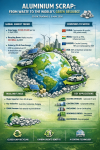
Aluminum Recycling the Circle and How it work
ALUMINUM RECYCLING BUSINESS : HOW IT WORK .....!!!
Aluminium scrap and its possibilities for recycling were introduced in the 1970s when there were signs of problems in secondary alloys resulting from various impurities generated by recycling aluminium. As early as 1979, the Financial Times discussed issues associated with domestic contaminants in aluminium recycling processes. The connection between aluminium and solar photovoltaic energy had already been studied in 1982, primarily using aluminium in the thermal processes involved.
In modern times, aluminium is one of the most recycled and recyclable materials. A recycled aluminium beverage can, car door, or window frame can often be recycled directly back into itself, and this process can last literally for a lifetime.
In six continents out of seven, the metal aluminium stands out to be an essential material. The European Union seeks to build a more sustainable and resource-efficient economy, and aluminium is a solution to many societal and economic challenges.
The aluminium recycling industry is part of the larger European aluminium industry, generating several billion euros in revenue annually and employing more than one million people directly or indirectly. Due to its many properties, aluminium is crucial to Europe's circular economy ambitions.
Since aluminium's essential properties don't change even after multiple recycling cycles, it is infinitely recyclable. In addition, recycling requires low energy levels compared with its manufacture, making it an "energy bank".
Increasing aluminium recycling
Although aluminium recycling rates in most industrial markets exceed 90%, we can do more - especially regarding aluminium beverage cans. Today, the United States collects more than twice as much aluminium as it did in the 1980s for recycling.
According to the Aluminium Association, scrap recycling and aluminium production are increasingly crucial to U.S. aluminium production. More than 80% of American output today is for recycled (or secondary) aluminium, even though primary aluminium production is still a crucial component of the country's aluminium supply chain. In the 1980s, recycled materials comprised 20% to 30% of total production. The United States produces more recycled aluminium than any other nation outside China.
More aluminium is recycled, which uses less energy and has a reduced carbon footprint. For instance, in the market for aluminium beverage cans, each percentage increase in the end-of-life recycling rate lowers the carbon intensity of the production of aluminium beverage cans by 1.02 kg CO2 equivalent per 1,000 cans. For the decarbonization of the entire business to continue, aluminium recovery and recycling must increase. Aluminium recovery and recycling must rise if the entire industry is to continue to be decarbonized.
The Benefits of Aluminum Cans
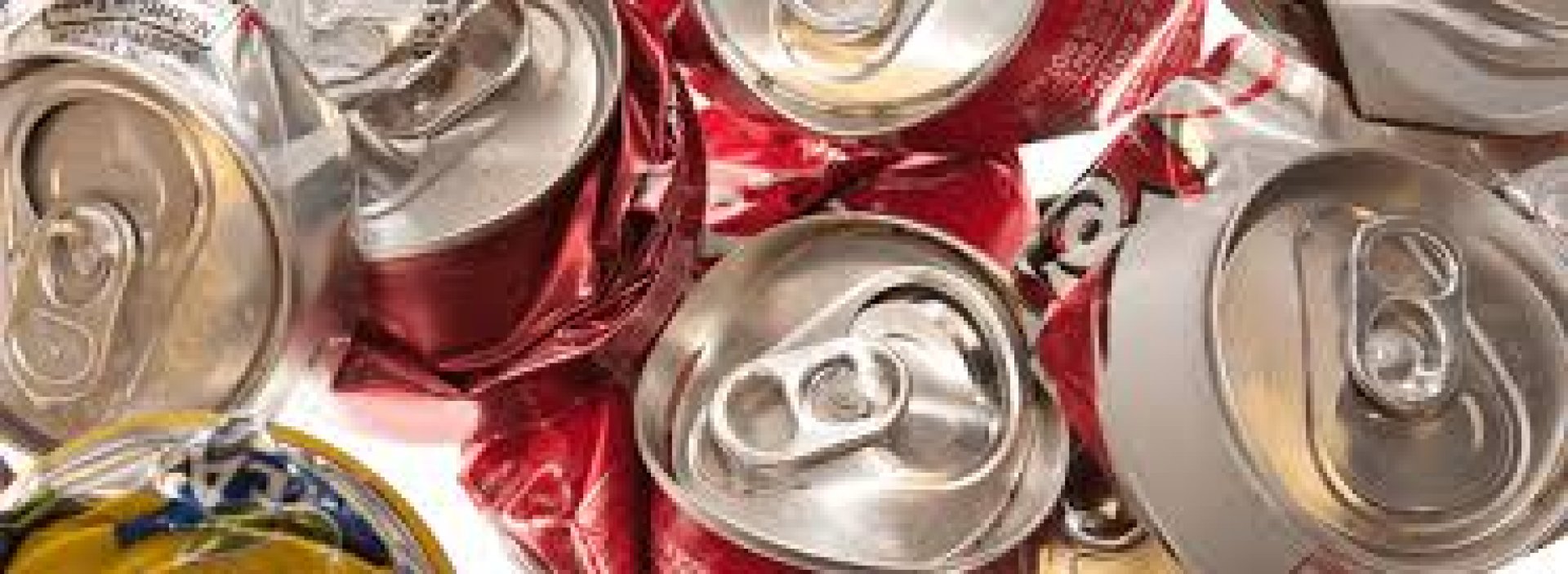
In almost every way, aluminium beverage cans are the most environmentally friendly beverage packaging. Compared to other package types, aluminium can have a better recycling rate and contain more recycled material.
Compared to glass or plastic bottles, aluminium cans are significantly more valuable, allowing companies to package and ship more beverages with less waste. They are also lightweight, stackable, and strong, which allows brands to effectively subsidise the recycling of less valuable materials in the trash by using them as packaging and transportation containers for more beverages. Most significantly, an actual "closed loop" recycling method involves recycling aluminium cans repeatedly. Usually, glass and plastic are "down-cycled" into landfill liners and carpet fibre.
Recycling aluminium can drive manufacturing growth
New opportunities for the reuse of polymer-laminated aluminium products, such as food and coffee packaging, are provided by a recycling breakthrough at the University of New South Wales (UNSW), Sydney.
The UNSW Sustainable Materials Research and Technology (SMaRT) Centre's research has discovered a method that could kickstart a new 'green aluminium' manufacturing revolution as well as industry efforts to advance Australian manufacturing and increase sustainability.
The new technique for recovering aluminium from complex, multilayered packaging is based on micro-recycling science pioneered by the SMaRT Centre's Director, Professor Veena Sahajwalla.
Innovations in aluminium recycling boosted by crystallisation research
A novel method of recycling aluminium has been boosted by research revealing the microscopic changes that occur when molten alloys cool. Dr. Biao Cai of the University of Birmingham's School of Metallurgy and Materials used high-speed X-ray imaging to record the formation of micro-crystals as alloys cool and solidify in a magnetic field.
Dr Andrew Kao of the University of Greenwich created a mathematical model to predict whether micro-crystals would form and what shape they would take. The model predicted that helical'screw-like crystals would form in solid magnetic stirring, and the high-speed X-ray confirmed this.
These beautiful crystals, which are ten times thinner than a human hair and only a few micrometres across, have ramifications for large-scale industrial processes. Biao explains, These microscopic crystals ultimately determine the physical properties of the alloy. Adjusting their shape, structure and direction of growth will enable us to perfect processes for both manufacturing and recycling of metals and alloys.
Biao has already developed a method to enhance aluminium recycling by eliminating iron. Aluminium can become brittle when exposed to iron, a damaging element that restricts its use in high-end applications like aviation. While other methods for removing iron from recycled materials are either expensive or ineffective, Biao's straightforward, low-cost solution combines magnets and a temperature gradient to do it.
The invention has a patent and is funded by the Midlands Innovation Commercialization of Research Accelerator, which provided Biao with funding to construct a substantial prototype.
The first business in the world to benefit from the sophisticated new sensor-based sorting solution is Alutrade, the largest independent aluminium recycling company and extrusion specialist in the UK. Alutrade has achieved 99 per cent pure aluminium for secondary aluminium production thanks to the new X-TRACTTM, TOMRA's most sophisticated x-ray metals sorting device. At Alutrade's Oldbury recycling facility in Birmingham, which processes 42,000 tonnes of waste yearly, the new X-TRACTTM machine was installed in March 2021.
Metal extrusions from various post-consumer construction debris, including windows, doors, and aluminium cans, make up the plant's infeed material.
Economic benefits and circular economy driving the popularity of aluminium
Aluminium scrap in recycled form can result in significant cost savings for producers who use re-melting furnaces to process scrap; this reduces the reliance on pure metal supplied by traditional primary smelters and increases production flexibility.
Indefinitely recycling aluminium without losing its properties makes it an excellent circular material. Moving forward, economies should make scrap handling more accessible and efficient, from end-of-life scrap to reusing scrap during the manufacturing stage (in-house scrap). Aluminium can aid in the achievement of circular economy goals. Countries tailor policies to increase recycling rates, reduce the burden on natural resources such as bauxite, and use 5 per cent less energy, ensuring CO2 reduction.
Recycling accounts for approximately 20 per cent of total primary aluminium production globally. Primary aluminium contributes 80 per cent, which is expected to decrease over the next 5-10 years as recycling replaces primary aluminium due to its numerous commercial benefits and companies' carbon-free targets.
Secondary aluminium billets account for nearly 70 per cent of demand in the APAC region, with 2 million tonnes reported in 2020. It is common for the building and construction industry to exchange primary and secondary billets. This has shifted significantly in recent years in favour of re-melting products.