“Future of Thai Industries 2025–2027: Green Transformation Towards Circular Economy with Rare Earth, EV, and Clean Energy”
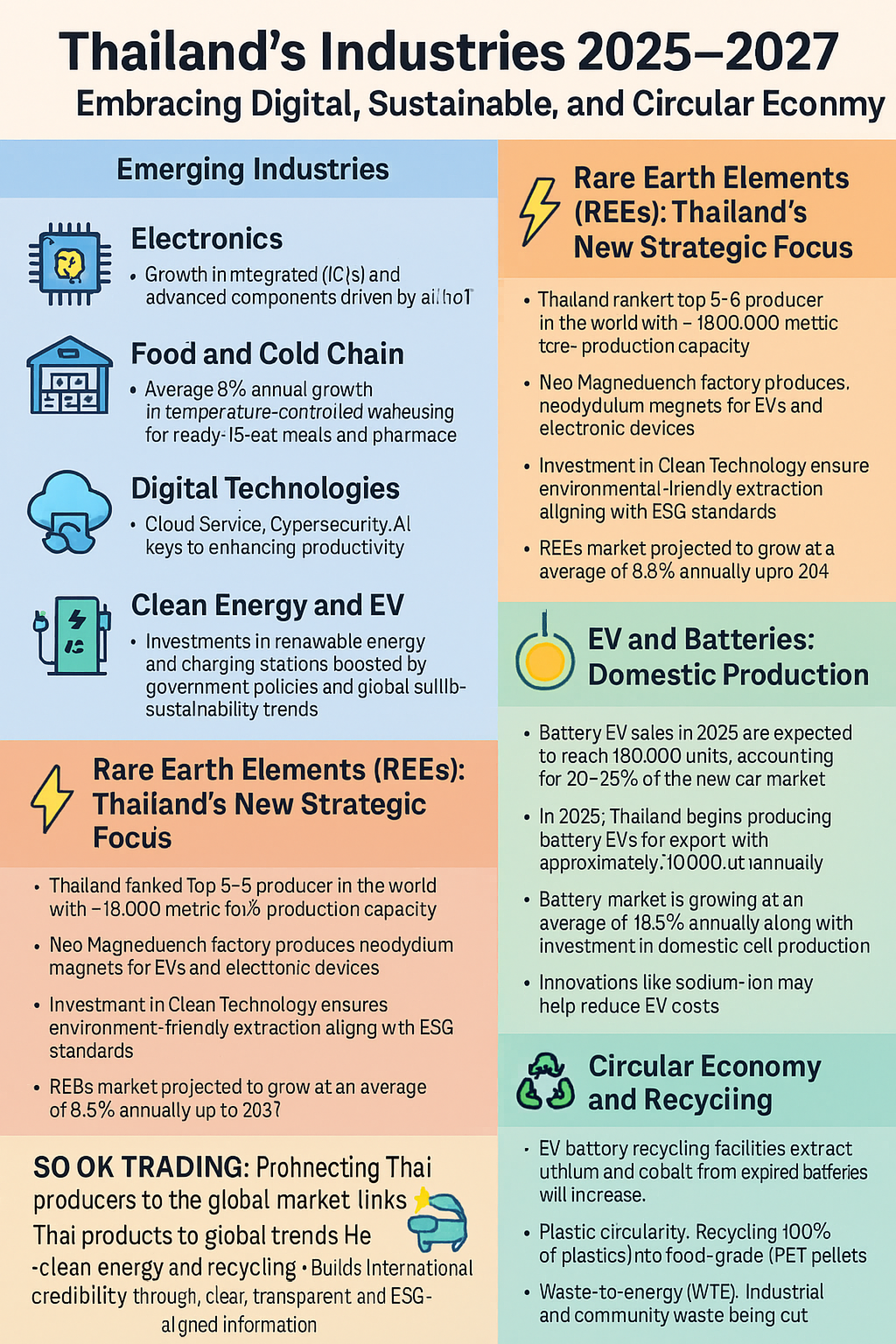
Thailand’s Industries 2025–2027: Embracing Digitalization, Sustainability, and the Circular Economy
In 2025–2026, Thailand’s economy will undergo a major transformation — driven by technology, sustainability, and adaptation to new global trade rules. Several rising industries and challenges are worth close attention.
Emerging Industries
Electronics: Demand for integrated circuits (ICs) and advanced components continues to grow, fueled by AI and IoT expansion.
Food & Cold Chain: Temperature-controlled warehousing is expected to grow by 8% annually, supporting ready-to-eat meals and pharmaceuticals.
Digital Technologies: Cloud services, cybersecurity, and AI are becoming central to productivity.
Clean Energy & EVs: Investments in charging stations and renewable energy are expanding, supported by government policies and global sustainability trends.
⚡ Rare Earth Elements (REEs): Thailand’s New Strategic Role
Ranked among the world’s Top 5–6 producers, with ~13,000 metric tons annually.
Neo Magnequench factory produces neodymium magnets for EVs and electronics.
Clean technology investments ensure ESG-compliant, environmentally friendly extraction.
Thailand’s REE market is projected to grow at 8.3% CAGR through 2031.
☀️ Clean Energy: From “Alternative” to “Mainstream”
Solar PV: Strongest growth in both solar farms and rooftop installations (CAGR ~10%).
Floating Solar: Expanding across major dams nationwide.
BESS & Green Hydrogen: Building foundations for stable power supply and future transport.
PDP 2024: Targets 51% renewable energy share by 2037.
EVs & Batteries: Domestic Production Era
BEV sales in 2025 expected to reach 150,000 units (20–25% of new car market).
By 2026, Thailand will begin producing ~20,000 BEVs annually for export.
Battery market growing at 13.8% CAGR, with investments in local cell production.
Sodium-ion battery innovations may help reduce EV costs.
♻️ Circular Economy & Recycling
EV Battery Recycling: Facilities extracting lithium and cobalt from expired batteries will expand.
Plastic Circularity: 100% recycling into food-grade rPET pellets.
Waste-to-Energy (WTE): Industrial and community waste converted into electricity.
EPR Laws: Producers held accountable for product waste.
Digital Tracking: Blockchain and digital product passports to verify recycled material sources.
✨ Big Picture
Between 2025–2027, Thai industries will fully embrace Green Transformation and Circular Economy. This is not just a “trend” but a new global trade rule. Companies that adapt quickly will lead in EVs, clean energy, and recycling on the world stage.
SO OK TRADING: Bridging Thailand to Global Markets
Amid this transformation, SO OK TRADING acts as a bridge connecting Thai producers with international markets.
Showcasing premium Thai products worldwide.
Aligning Thai exports with global trends such as clean energy, circular economy, and recycling.
Building trust through transparent, ESG-compliant communication.
SO OK TRADING is more than an export company — it is a partner for Thai farmers, manufacturers, and entrepreneurs to confidently step into the global market.
Learn more at www.sooktrading.com