SO OK TRADING’s INSIGHT: Crude Oil Breaks $100 — Oil Shock 2026 Global Energy Crisis Shakes the Economy
SO OK TRADING’s Insight
Global Oil Surges Past $100: An Energy Crisis Shaking the World Economy November 2, 2026
Crude oil prices have soared above $100 per barrel, becoming a symbol of the “global energy crisis.” This reflects both geopolitical fragility and economic pressure across all sectors—from upstream oil producers to downstream consumers and petrochemical industries.
Middle East: The Flashpoint Shaking Global Markets
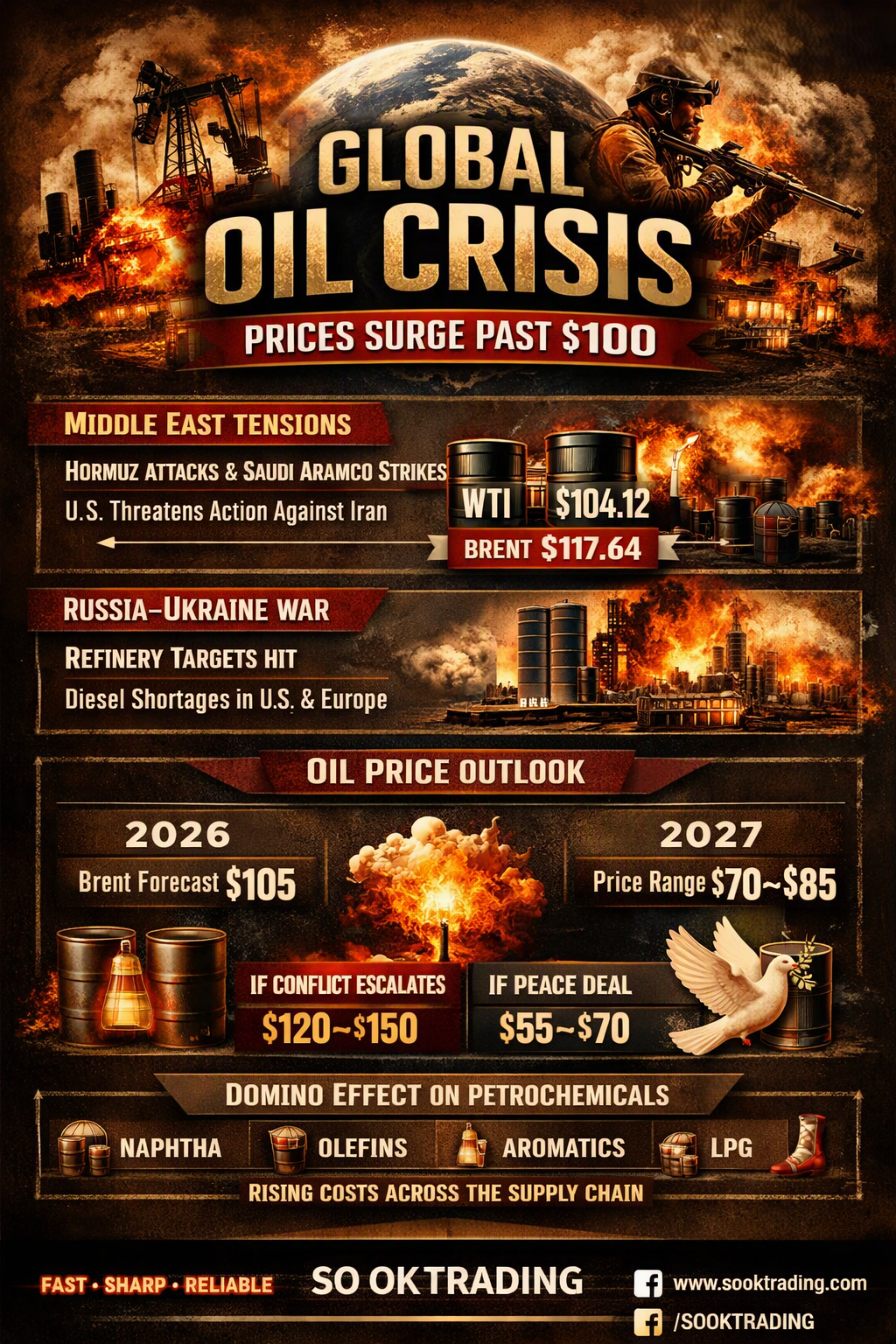
Attacks on oil tankers in the Strait of Hormuz and Saudi Aramco refineries by Houthi forces have put the world’s most critical energy transport route at risk of disruption. Meanwhile, the U.S. has signaled possible military action against Iran after the midterm elections, further amplifying market uncertainty.
The result: WTI crude spiked to $104.12, while Brent surged to $117.64. Investors call this premium the “War Premium,” directly reflecting the war risk priced into oil.
⚔️ Russia–Ukraine: A War Undermining Refined Oil Supply
While the Middle East crisis impacts “crude oil and transport routes,” the Russia–Ukraine war strikes at “refineries and refined products.” Ukraine’s drone attacks on Russia’s Kstovo and Ryazan refineries wiped out over 30% of capacity, forcing Russia to temporarily halt diesel and gasoline exports.
Consequently, diesel prices in the U.S. and Europe hit record highs, pressuring Western governments to consider easing some sanctions to mitigate the energy crisis.
Oil Price Outlook: From Surge to Correction
Late 2026: Prices remain elevated. EIA and Goldman Sachs forecast Brent averaging $105 per barrel.
2027: As tensions ease, oversupply and the EV transition may push prices down to $70–85 per barrel.
Two Risk Scenarios
If war escalates: prices could surge to $120–$150.
If peace talks succeed: prices could plunge to $55–$70.
Domino Effect: Impact on Petrochemical Industry
High oil prices trigger cascading effects across midstream and downstream industries:
Naphtha: Moves 1:1 with crude, driving cost crises for petrochemical plants in Asia and Europe.
Olefins (Ethylene, Propylene, PE, PP): Margins shrink below breakeven, forcing producers to cut output to preserve cash flow.
Aromatics (Benzene, Paraxylene, PET): Prices rise with costs but are capped by limited new capacity.
LPG: Seasonal and oil-linked increases hit household and transport costs directly.
Comparative Overview: Global Oil Market
Middle East: Directly impacts crude and transport routes → Brent/WTI stay above $100.
Russia–Ukraine: Hits refineries and refined products → Diesel and gasoline prices soar abnormally.
Conclusion
Global oil prices in 2026–2027 are dominated by two forces: war risk premiums and oversupply. If 2026 is a year of volatility with prices holding above $100, then 2027 may be a year of correction, with prices settling in the $65–88 range.
Geopolitics and the structure of the global energy market not only shape oil prices but inevitably ripple through the entire industrial chain, from upstream to downstream.
SO OK TRADING: Your Business Partner SO OK TRADING: FAST SHARP RELIABLE
VISIT US AT : WWW.SOOKTRADING.COM FACEBOOK : SOOK TRADING