SO OK TRADING’s INSIGHT: Global Silicon Metal Market 2026–2033 — Turning Point Toward Clean Energy and Smart Technology | October 29, 2026
Global Silicon Metal Market 2026–2033
Price Trends and Driving Factors : SO OK TRADING : October 29, 2026
Introduction
Silicon metal is being elevated from a basic raw material to a “strategic material” powering the green economy and digital technologies. Its applications span electric vehicles (EVs), solar photovoltaics (Solar PV), semiconductors, and specialty chemicals. By late 2026, the market remains steady, but pressures and supports from both demand and supply sides are creating a “critical turning point” for Q4/2026, Q1/2027, and the decade ahead.
Price Situation and Market Conditions (October 2026)
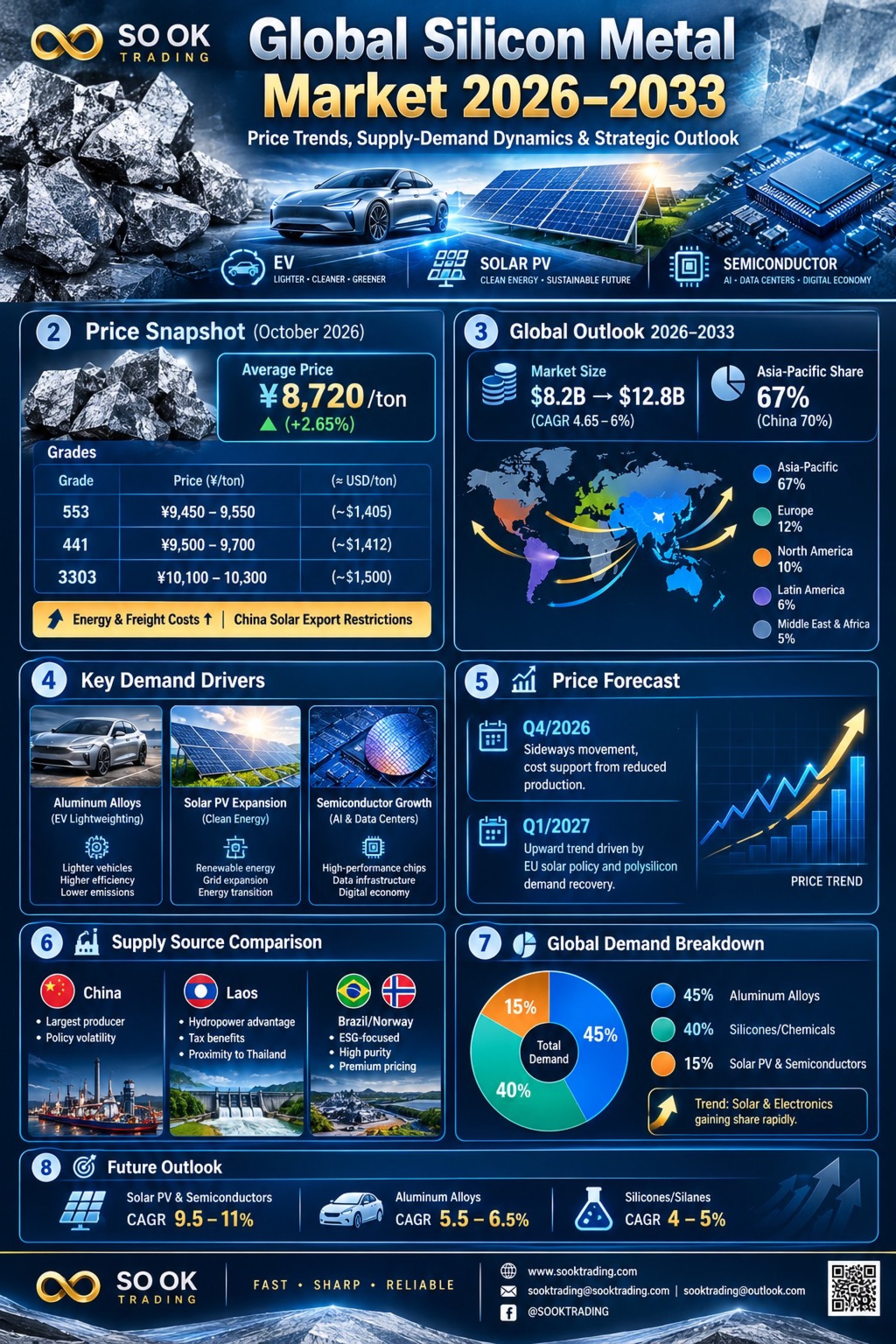
Average market price: 8,720 RMB/ton (+2.65%)
Key grades:
553: 9,450–9,550 RMB/ton (~1,405 USD)
441: 9,500–9,700 RMB/ton (~1,412 USD)
3303: 10,100–10,300 RMB/ton (~1,500 USD)
Price drivers: Rising energy and transport costs in Sichuan–Yunnan, declining inventories. China’s new policy (mid-October 2026) restricting exports of 12 solar technologies impacts the global solar supply chain.
Long-Term Outlook (2026–2033)
Global market value (2026): USD 8.2 billion
Forecast (2033–2034): USD 12.2–12.8 billion (CAGR ~4.65–6.0%)
Asia-Pacific accounts for over 67% of global share, with China producing ~70%. India and ASEAN are expanding rapidly.
⚙️ Application Drivers
Aluminum alloys (39–43%): Strengthening and lightweighting, crucial for EVs
Solar PV: Fastest growth (CAGR ~7%)
Silicones and semiconductors: Steady demand for high-grade silicon
Supply and Demand Factors
Supply Side
Smelters in Yunnan–Sichuan cut output due to power shortages (winter curtailments)
China dominates with over two-thirds of global capacity, especially Xinjiang and Gansu
Demand Side
Europe lifted anti-dumping duties on Chinese solar glass (Oct 22, 2026) → Lower PV costs, boosting polysilicon demand
EVs and silicones: Aluminum-silicon alloy demand remains firm, but general silicones slow down
Price Forecast Q4/2026 & Q1/2027
Q4/2026: Sideways movement within a narrow range. Supported by Chinese output cuts but pressured by weak downstream recovery.
Q1/2027: Likely upward trend, driven by European clean energy policies and polysilicon market recovery.
Comparison of Global Sources of Silicon Metal
China
Strengths: Largest production capacity, covers all grades
Limitations: Trade barriers risk, coal cost volatility
Best for: Buyers needing large volumes and flexibility
Laos
Strengths: Low-cost hydropower, easy transport, tariff advantages
Limitations: Small production, focused on aluminum grades
Best for: Thai buyers seeking cost and tax savings
Brazil/Norway (Global Premium/ESG)
Strengths: 100% clean energy, high quality, ideal for Europe’s CBAM compliance
Limitations: High premium prices, long shipping times
Best for: Exporters to Europe/USA
Global Demand Structure
40–45%: Aluminum alloys (EV)
35–40%: Chemicals and silicones (cosmetics, construction, medical)
15–20%: Solar PV and semiconductors
Trend: Solar/Electronics share rising, aluminum growing with EV adoption.
Future Outlook
Solar PV & Semiconductors: CAGR ~9.5–11.0% → Highest growth
Aluminum alloys: CAGR ~5.5–6.5% → Driven by EV demand
Silicones/Silanes: CAGR ~4.0–5.0% → Stable growth in construction and medical industries
✨ Conclusion
The silicon metal market is entering a critical transition. Clean energy, EVs, and semiconductors will be the main drivers in the coming decade.
SO OK TRADING : Your Business Partner SO OK TRADING : FAST SHARP RELIABLE
VISIT US AT : WWW.SOOKTRADING.COM FACEBOOK : SOOK TRADING E-MAIL : SOOKTRADING@SOOKTRADING.COM, SOOKTRADING@OUTLOOK.COM
SO OK TRADING : The True Expert in Non-Ferrous Metals from Thailand