“Steel Price War 2026: Asia Falls, the West Rises — Thai Buyers Gain the Edge While Producers Battle with New Strategies, Exploring Global Trends and Green Steel Opportunities”
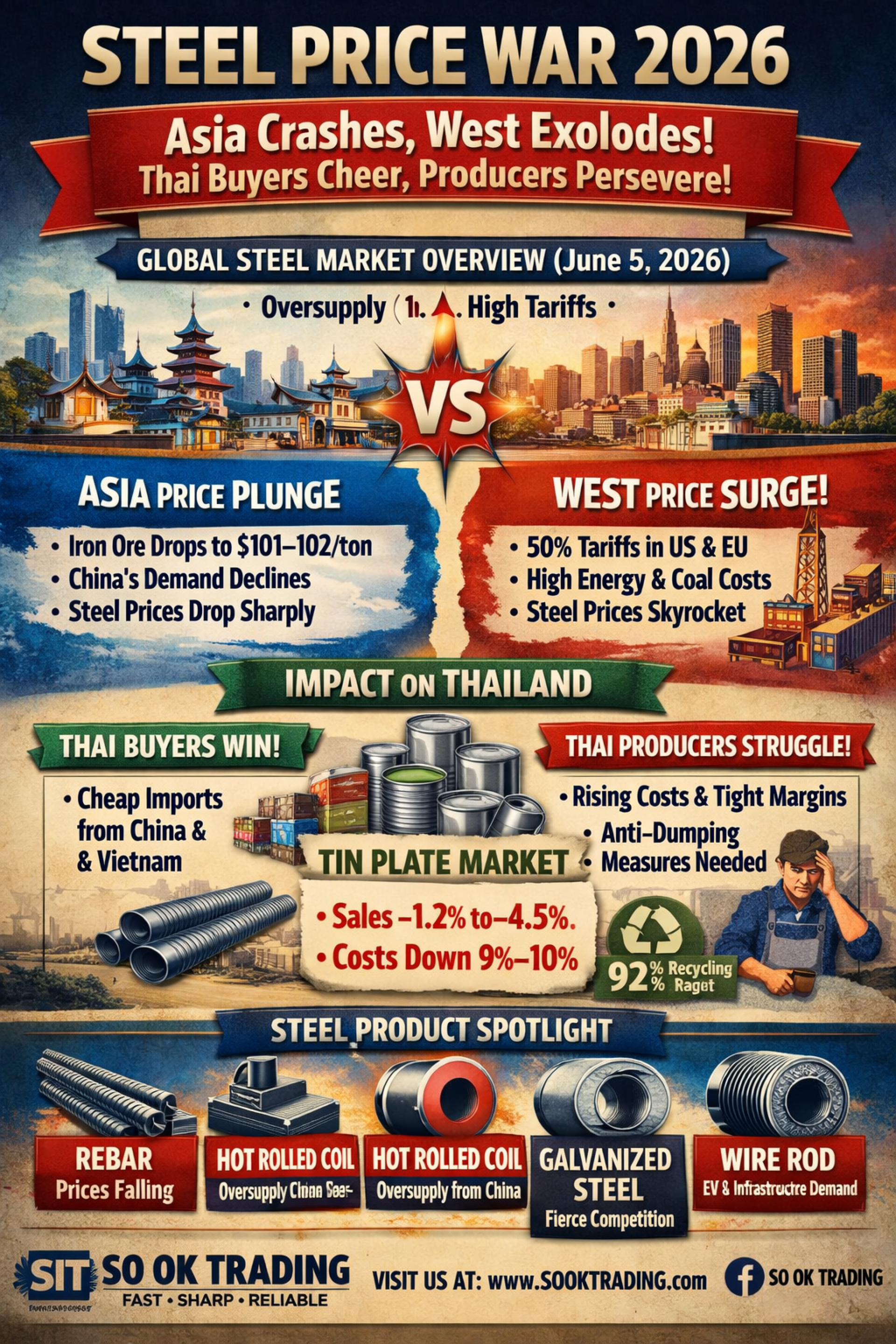
Steel Price War 2026: Asia Plunges, West Soars — Thai Buyers Gain, Producers Fight to Survive
Global and Thai Steel Market Overview (June 5, 2026)
The steel market is now split into “two worlds” — Asia facing sharp price declines due to oversupply and China’s demand slowdown, while the West surges under tariff walls and rising energy costs.
Global Market Dynamics
Today’s steel market resembles a battlefield of two sides — Asia’s prices are tumbling, while the West climbs higher, pressured by tariffs and energy costs. Thai buyers benefit, but Thai producers must fight hard to survive.
Asia: Prices Under Pressure
Global iron ore prices have dropped to a two‑month low, around USD 101–102/ton, as China — the world’s largest steel consumer — slows construction and real estate activity. This has dragged down rebar, hot‑rolled coil, and wire rod prices across Asia.
In Thailand, retail prices fell more than 8% in a month. Yet factories face a cost crisis, with electricity and sea freight charges soaring over 50%. Producers are forced to push selling prices upward against the market trend.
West: Prices Rising Against the Tide
In the U.S. and Europe, steel import tariffs as high as 50% shield domestic markets. Even with weak demand, finished steel products such as HRC steel hit record highs.
Coking coal costs — essential for steelmaking — have risen 16%, squeezing mills to raise selling prices further. The result is a “bull market” in stark contrast to Asia.
Impact on Thailand
Buyers benefit: Retail prices drop thanks to dumping from China and Vietnam.
Producers suffer: Costs rise while selling prices fall, forcing reliance on state measures such as Anti‑Dumping and CBAM.
Metal packaging (Tin Plate): Sales shrink by -1.2% to -4.5%, but raw material costs fall 9–10%, cushioning margins.
Competition from substitutes: Aluminum and plastics share the market, but Tin Plate retains strength with a 92% recycling rate.
Key Steel Products to Watch
Rebar → For foundations and reinforced concrete. Prices continue to fall as real estate demand weakens.
H‑Beam / I‑Beam → For high‑rise and industrial structures. Prices fluctuate with imports, relying on state mega‑projects.
Steel box / pipes → For wall and roof structures. Fierce domestic competition with price cuts.
Hot‑rolled coil (HRC) → For structures and pipes. Prices down due to Chinese oversupply.
Cold‑rolled coil (CRC) → For auto parts and appliances. Narrow fluctuations tied to auto production and exports.
Coated steel (GI/GA/PPGI) → For metal roofing and wall panels. Intense price wars from informal mills.
Tin Plate → For food cans and bottle caps. Prices fall with raw material costs, though orders slow.
Wire rod / welding rod → For EVs and engineering. Upstream prices fall, downstream supported by tariffs.
Thai Market Takeaways
“Prices down, costs up” → Buyers gain, producers must adapt strategies.
Green Steel as opportunity → Low‑carbon steel producers gain advantage in public and private tenders.
Metal packaging has a future → Despite slower sales, 100% recyclability and thinner innovation are global selling points.
✨ In short: The steel market today is “two worlds in one picture” — Asia pressured by China, the West buoyed by tariffs. Thai buyers benefit, but producers must urgently adapt on cost and sustainability to survive in a fiercely competitive arena.
SO OK TRADING: Your Business Partner SO OK TRADING: FAST SHARP RELIABLE VISIT US AT: WWW.SOOKTRADING.COM FACEBOOK: SO OK TRADING
Interested in construction rebar or structural steel? Please contact SO OK TRADING. Thank you very much!