Share

“SO OK TRADING Insight: Aluminium Reigns Supreme — The Golden Era of ASEAN Beverage Market, From Craft Beer to Premium Coffee”
Last updated: 27 Oct 2026
124 Views

SO OK TRADING’s INSIGHT : Aluminium Reigns Supreme — The Golden Era of ASEAN Beverage Cans

 
Market Overview
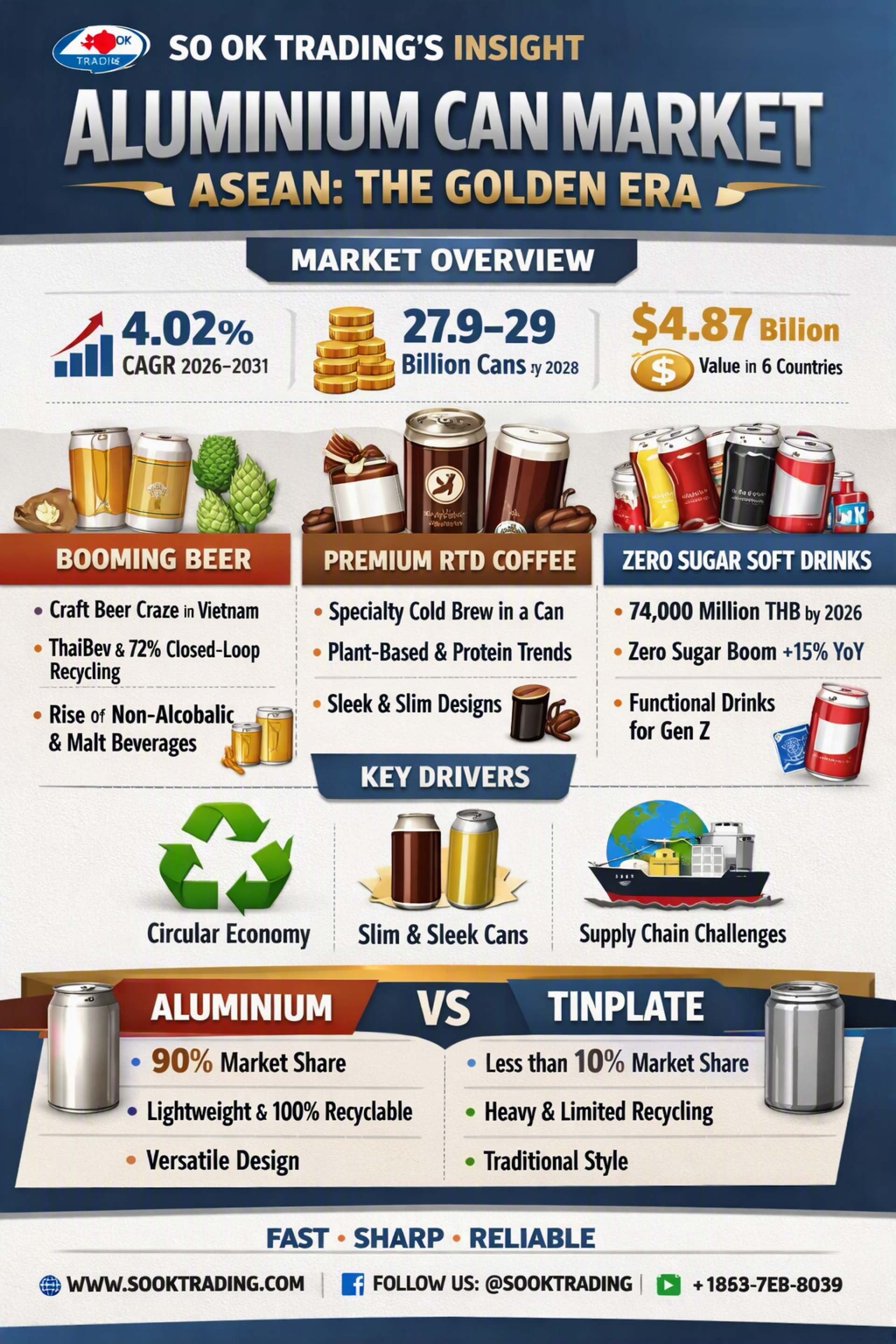
ASEAN is becoming a key battleground in the beverage packaging industry, with aluminium cans gaining increasing popularity. The average growth rate (CAGR) between 2026–2031 is projected at 4.02%. Demand is expected to surpass 27.9–29 billion cans by 2026–2028, while the aluminium packaging market in six major countries will reach USD 4.87 billion.

 
Beer Market: From Craft to Non-Alcoholic
Canned beer is overtaking bottled beer with an annual growth rate of 6.04%
Vietnam: Craft beer is the fastest-growing segment in the region (CAGR 7.65%), attracting foreign investment
Thailand: ThaiBev dominates the market and leads in Closed-Loop Recycling, with a can recycling rate of 72%
New Trend: Non-alcoholic beer and malt beverages are booming (CAGR 7.92%), appealing to health-conscious consumers
 
☕ RTD Coffee Market: From Mass to Premium
RTD coffee is evolving from low-cost products into Specialty Coffee in a Can
Innovations such as Cold Brew and premium coffee beans encourage consumers to pay more
Health trends: high-protein coffee, plant-based milk, natural caffeine for smooth energy
Packaging design emphasizes Slim & Sleek cans for modernity and portability
 
Soft Drink Market: The Zero Sugar Era
Thailand: Market value projected to reach 74 billion THB by 2026
Zero Sugar beverages: fastest-growing segment with 15% annual growth, driven by sugar tax policies
Functional soft drinks: enriched with vitamins, prebiotics, and fiber, targeting Gen Z who seek fun yet care about health
 
♻️ Key Drivers
Circular Economy & Plastic Ban: Government regulations on single-use plastics make 100% recyclable aluminium cans the preferred choice
Packaging Innovation: Slim & Sleek cans are trending in functional drinks and RTD coffee
Supply Chain Challenges: Price volatility of aluminium and tin, geopolitical risks, and shipping disruptions
 
⚖️ Aluminium vs Tinplate
Aluminium: Over 90% market share in beer, soft drinks, and RTD coffee; lightweight, infinitely recyclable, versatile in design
Tinplate: Less than 10% market share, used mainly in condensed milk and traditional drinks; heavier with design limitations
 
✨ Conclusion
The ASEAN aluminium can market is entering its Golden Era, driven by craft beer, premium coffee, Zero Sugar soft drinks, and sustainability trends. Major brands are shifting to 100% recyclable aluminium packaging, making aluminium the clear “winner” in the beverage industry, while tinplate remains confined to niche markets.

 
SO OK TRADING : Your Trusted Business Partner FAST • SHARP • RELIABLE www.sooktrading.com SOOKTRADING@SOOKTRADING.COM Facebook: SOOK TRADING

SO OK TRADING : The True Leader in Aluminium Packaging from Thailand

Related Content
Aluminum Recycling the Circle and How it work
Aluminium is the most abundant metal in the earth’s crust. Approximately 75% of aluminium ever produced is still in use today as it can be recycled endlessly without compromising any of its unique properties or quality. Aluminium’s lifecycle provides significant benefits through recycling, saving 95% of the energy it would take to make new aluminium metal. More information on recycling may be found here. Recycling aluminium has five steps: Step 1: Collecting Scrap There are two categories of aluminium scrap: New Scrap New Scrap is surplus material that arises during the manufacture and fabrication of aluminium products, up to the point where they are sold to the final consumer. For example, off cuts of aluminium sheet or extrusions are considered new scrap. Sometimes, this new scrap can be safely recycled by aluminium smelters as its composition is known. Old Scrap Old Scrap is material that has been used by the consumer and subsequently discarded. For example, used beverage cans, window frames, electrical cabling and car cylinder heads are all considered old scrap. Aluminium smelters are unable to safely accept this old scrap as its composition is usually unknown and it can be contaminated. Scrap aluminium is also collected from the community – from households, scrap merchants, local and regional authorities, etc. Step 2: Sorting Scrap The scrap is then sorted – grouping all coated (painted or lacquered) aluminium together, and grouping all uncoated aluminium together. Paper, plastic and other non-aluminium recycling needs to be removed. Step 3: Crushing The sorted aluminium is then crushed into bales – by compacting the aluminium scrap, it reduces freight, storage and handling costs Step 4: Remelting Uncoated scrap is loaded directly into a large furnace called a remelter, where it is heated at high temperatures and turned into molten form. If the scrap aluminium is coated, it is processed through a gas fired rotary furnace to remove any coating and then transferred to the remelter. Step 5: Casting The molten aluminium is cast at a temperature of just over 700°C to form ingots
13 Nov 2025
ZINC INGOT สังกะสีแท่ง และ การใช้งาน
สังกะสีแท่ง (Zinc Ingot) ส่วนใหญ่ใช้ในงานอุตสาหกรรม เช่น ทำแผ่นสังกะสีสำหรับชิ้นส่วนยานยนต์เพื่อลดน้ำหนักและประหยัดน้ำมัน, ทำสังกะสีสำหรับเคลือบกันสนิม (Galvanizing), และใช้ในการผลิตสังกะสีอัลลอยด์ ในการใช้งานกับโลหะ สังกะสีจะทำหน้าที่เป็นขั้วบวกเพื่อป้องกันการกัดกร่อน (Zinc Anode) การใช้งานหลักของ Zinc Ingot อุตสาหกรรมยานยนต์: ใช้ทำชิ้นส่วนต่างๆ เพื่อให้น้ำหนักเบาและประหยัดน้ำมันเชื้อเพลิง การเคลือบกันสนิม: นิยมนำไปใช้ในกระบวนการเคลือบสังกะสี (Galvanizing) เพื่อป้องกันการผุกร่อนของโลหะ เช่น เหล็ก สังกะสีอัลลอยด์: ใช้ในการผลิตสังกะสีอัลลอยด์สำหรับงานต่างๆ
26 Nov 2025
This website uses cookies for best user experience, to find out more you can go to our Privacy Policy and Cookies Policy
Powered By MakeWebEasy Logo MakeWebEasy