Share

“SO OK TRADING Insight: Aluminium Reigns Supreme — The Golden Era of ASEAN Beverage Market, From Craft Beer to Premium Coffee”
Last updated: 27 Oct 2026
112 Views

SO OK TRADING’s INSIGHT : Aluminium Reigns Supreme — The Golden Era of ASEAN Beverage Cans

 
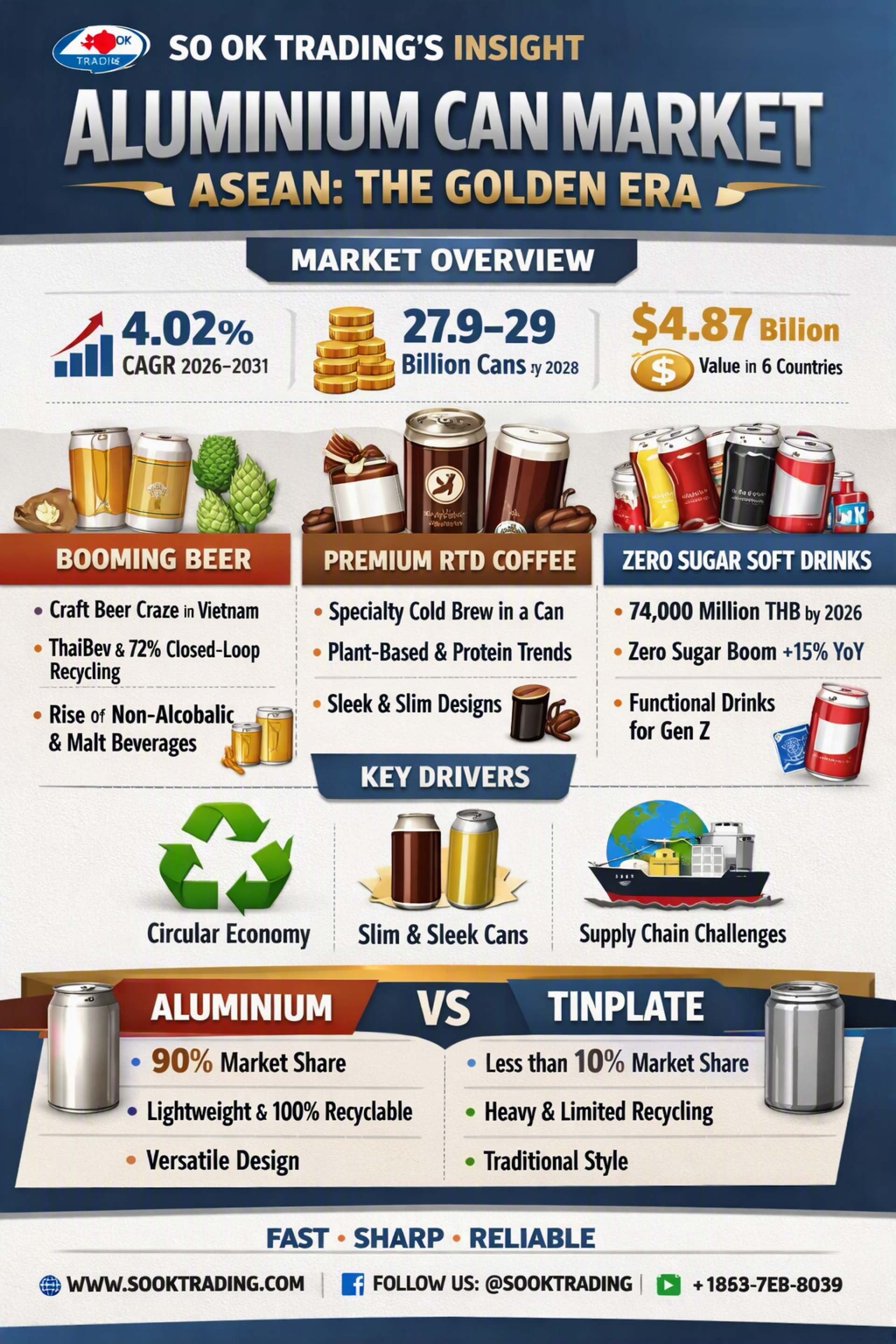
Market Overview
ASEAN is becoming a key battleground in the beverage packaging industry, with aluminium cans gaining increasing popularity. The average growth rate (CAGR) between 2026–2031 is projected at 4.02%. Demand is expected to surpass 27.9–29 billion cans by 2026–2028, while the aluminium packaging market in six major countries will reach USD 4.87 billion.

 
Beer Market: From Craft to Non-Alcoholic
Canned beer is overtaking bottled beer with an annual growth rate of 6.04%
Vietnam: Craft beer is the fastest-growing segment in the region (CAGR 7.65%), attracting foreign investment
Thailand: ThaiBev dominates the market and leads in Closed-Loop Recycling, with a can recycling rate of 72%
New Trend: Non-alcoholic beer and malt beverages are booming (CAGR 7.92%), appealing to health-conscious consumers
 
☕ RTD Coffee Market: From Mass to Premium
RTD coffee is evolving from low-cost products into Specialty Coffee in a Can
Innovations such as Cold Brew and premium coffee beans encourage consumers to pay more
Health trends: high-protein coffee, plant-based milk, natural caffeine for smooth energy
Packaging design emphasizes Slim & Sleek cans for modernity and portability
 
Soft Drink Market: The Zero Sugar Era
Thailand: Market value projected to reach 74 billion THB by 2026
Zero Sugar beverages: fastest-growing segment with 15% annual growth, driven by sugar tax policies
Functional soft drinks: enriched with vitamins, prebiotics, and fiber, targeting Gen Z who seek fun yet care about health
 
♻️ Key Drivers
Circular Economy & Plastic Ban: Government regulations on single-use plastics make 100% recyclable aluminium cans the preferred choice
Packaging Innovation: Slim & Sleek cans are trending in functional drinks and RTD coffee
Supply Chain Challenges: Price volatility of aluminium and tin, geopolitical risks, and shipping disruptions
 
⚖️ Aluminium vs Tinplate
Aluminium: Over 90% market share in beer, soft drinks, and RTD coffee; lightweight, infinitely recyclable, versatile in design
Tinplate: Less than 10% market share, used mainly in condensed milk and traditional drinks; heavier with design limitations
 
✨ Conclusion
The ASEAN aluminium can market is entering its Golden Era, driven by craft beer, premium coffee, Zero Sugar soft drinks, and sustainability trends. Major brands are shifting to 100% recyclable aluminium packaging, making aluminium the clear “winner” in the beverage industry, while tinplate remains confined to niche markets.

 
SO OK TRADING : Your Trusted Business Partner FAST • SHARP • RELIABLE www.sooktrading.com SOOKTRADING@SOOKTRADING.COM Facebook: SOOK TRADING

SO OK TRADING : The True Leader in Aluminium Packaging from Thailand

Related Content
“Post-Middle East Conflict 2026: Economic Recovery, Lower Costs, Revived Logistics, and Capital Flows — New Opportunities for Thai and Global Businesses” : SO OK TRADING · June 27
“Post-Middle East Conflict 2026 — A Turning Point for the Global Economy and New Opportunities for Thai Businesses” When the echoes of war fade, the world does not return to the “old normal.” Instead, it enters a structural recovery era, where every industry — from energy, metals, and fertilizers to logistics and finance — resets its cost base and opens new opportunities for those who can see ahead. Oil and naphtha prices continue to decline, easing petrochemical and plastic costs. Shipping rates normalize, while agriculture benefits from falling fertilizer prices. Heavy industries such as steel, aluminum, and copper are rebounding, driven by clean energy and EV demand. Although the global economy in 2026 still faces high inflation, 2027 is expected to bring clear relief. Central banks worldwide are signaling monetary easing, and investors are turning back to emerging markets. Thailand, with its strong production and logistics base, is well-positioned to capture this momentum. The end of conflict is not the “end of change” but the beginning of new opportunities. With lower costs, revived logistics, and returning capital flows, Thai businesses are entering a golden window for strategic growth. SO OK TRADING Your trusted business partner in a fast-changing world
27 Jun 2026
Trump 2.0: The Tariff Game Isn’t Over The Supreme Court halts global tariffs — but Trump strikes back instantly! Old tariffs are gone, new ones arrive: a fresh 10% global tariff kicks in on February 24, 2026. How much will this hit our wallets? Stay tuned
February 20, 2026 – The day “Global Tariffs” were halted by the U.S. Supreme Court But the game isn’t over… President Donald Trump strikes back with a brand-new 10% global tariff! Dollar weakens Gold surges Stock markets rebound Currencies swing worldwide Precious metals return as Safe Haven The full article by SO OK TRADING analyzes the impact on the global economy, currencies, equities, and safe-haven assets — plus strategies to navigate the coming era of High Volatility. Check out the English Infographic summary Interested in agricultural products, industrial goods, or clean energy fuels? Contact us directly: www.sooktrading.com sooktrading@outlook.com
21 Feb 2026
“Steel Price War 2026: Asia Falls, the West Rises — Thai Buyers Gain the Edge While Producers Battle with New Strategies, Exploring Global Trends and Green Steel Opportunities”
“Steel Price War 2026: Asia Falls, the West Rises — Thai Buyers Gain the Edge While Producers Struggle to Survive, Analyzing Global Trends and Green Steel Opportunities” The global steel market has entered one of the fiercest “two‑world battles” of the year: Asia: Oversupply and China’s slowdown have pushed iron ore prices down to around $101–102 per ton, dragging rebar, hot‑rolled coil, and wire rod prices lower across the region. The West: The US and EU imposed import tariffs of up to 50%, while energy and coking coal costs surged by 16%, driving steel prices upward despite weak demand. Thailand’s situation: Buyers benefit: Cheaper imports from China and Vietnam have pulled retail prices down by more than 8%. Producers under pressure: Electricity and shipping costs have soared by over 50%, squeezing margins and forcing reliance on state measures such as Anti‑Dumping and CBAM. Tin Plate packaging: Sales dropped by -1.2% to -4.5%, but raw material costs fell 9–10%. With a recycling rate of 92%, Tin Plate remains aligned with ESG and Green Steel trends.
5 Jun 2026
This website uses cookies for best user experience, to find out more you can go to our Privacy Policy and Cookies Policy
Powered By MakeWebEasy Logo MakeWebEasy