“Aluminum: The Metal of the Future — Driving the Green Transition and Clean Energy Towards a Sustainable Global Hub” SO OK TRADING: 18 OCT 2026
Global and Thai Aluminum Industry: Roles, Challenges, and Future Outlook in the Era of Green Transition SO OK TRADING | 18 October 2026
Introduction
Aluminum has become one of the most strategic materials of the 21st century. With its unique properties — lightweight, strong, corrosion-resistant, and infinitely recyclable — aluminum is increasingly vital across industries such as automotive, construction, packaging, electronics, and aerospace.
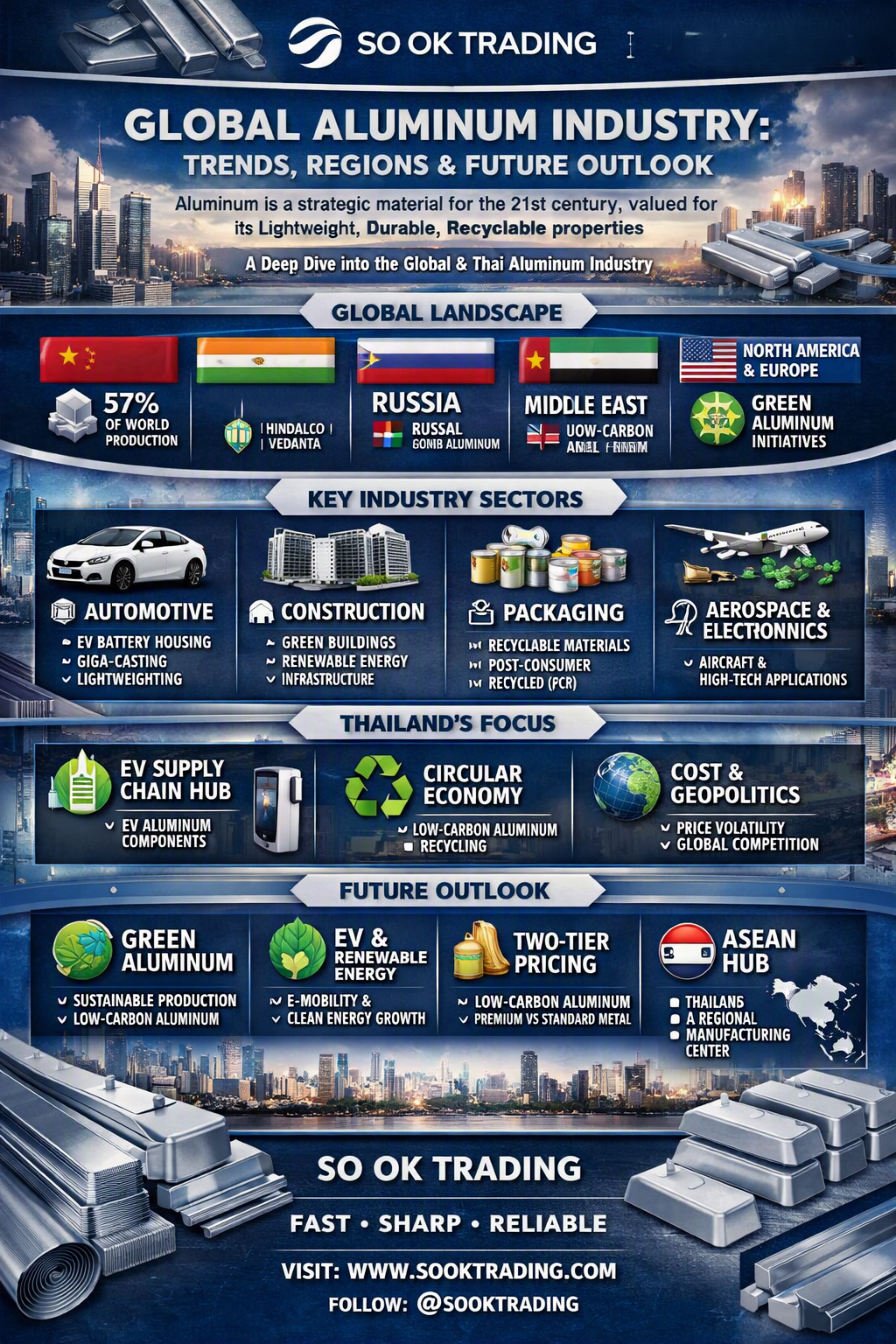
Today, China dominates the global aluminum market, accounting for more than 57% of global production, while other regions such as India, Russia, the Middle East, North America, and Europe each play distinctive roles in balancing the global supply chain.
1. Global Industry Overview
China: The global leader, home to major companies such as China Hongqiao Group and Chalco, producing both primary aluminum and downstream products like EV battery foils and food packaging. However, Chinese producers face challenges from tariffs and environmental restrictions.
India: Rapid growth driven by infrastructure and automotive demand, with Hindalco and Vedanta as key players.
Russia (Rusal): Known for low-carbon aluminum production, with over 90% of smelting powered by hydropower.
Middle East (UAE, Bahrain): Competitive due to low-cost natural gas energy, but vulnerable to regional instability.
North America & Europe: Focused on sustainable production, with companies like Alcoa, Rio Tinto, and Norsk Hydro. Europe is pushing “Green Aluminum” to align with CBAM (Carbon Border Adjustment Mechanism).
2. Key Industry Applications
Automotive: Lightweighting, EV battery housing, precision foils, and giga-casting technology.
Construction: Accounts for over 25% of global aluminum use, applied in green buildings, renewable energy structures, and modular construction.
Packaging: Replacing single-use plastics, expanding demand for food foils and PCR (Post-Consumer Recycled) aluminum.
Other sectors: Electronics, aerospace, and high-voltage electrical grids.
3. Popular Aluminum Grades
Construction: 6063 (Curtain Walls, window frames), 3003 (roofing, HVAC pipes), 1100/1050 (facades, signage).
Automotive: 6061 (vehicle frames), 5052/5083 (marine grade), 7075 (high-strength racing and aerospace parts), A356 (alloy wheels, engine blocks).
4. Thailand’s Aluminum Industry
EV Supply Chain Hub: Thailand is adapting to rising demand for EV battery housings and lightweight chassis, requiring advanced casting technologies to meet OEM standards.
Circular Economy & Low-Carbon Aluminum: Thai producers are developing recycling models to reduce energy use by up to 95% compared to primary smelting, lowering carbon footprints for exports to strict markets like Europe and the U.S.
Challenges: High raw material price volatility and geopolitical competition.
Outlook: Future Directions
Global Trend: Demand for “Green Aluminum” will continue to rise, especially in Europe and the U.S.
EV & Renewable Energy: These sectors will be the main drivers of aluminum demand.
Two-Tier Pricing: A dual market structure will emerge between low-carbon aluminum and conventional aluminum.
Thailand Outlook: With investment in recycling and compliance with EV OEM standards, Thailand has the potential to become ASEAN’s leading downstream aluminum hub.
Conclusion
Aluminum is not just another metal — it is the material of the future, meeting the dual demands of sustainability and energy efficiency. Producers who can demonstrate clean energy use or recycling practices will gain a competitive edge in exporting to environmentally strict markets such as the EU and U.S. For Thailand, embracing the EV supply chain and advancing low-carbon aluminum technologies will be the key to building a stronger, more sustainable industry.
SO OK TRADING — Your trusted partner in the aluminum industry FAST • SHARP • RELIABLE www.sooktrading.com Facebook: SO OK TRADING