“SO OK TRADING Insight: Green Aluminium and Australia’s Net Zero Transition — New Opportunities in the Thailand–Australia EV Supply Chain” : 16 OCT 2026
SO OK TRADING | 16 OCT 2026 In-Depth Article: Outlook and Trends of the Aluminium Industry in Australia
Australia’s aluminium industry is at a critical turning point — facing challenges in production, global competition, and the transition to clean energy, while moving toward a more sustainable future.
Production Status and Capacity
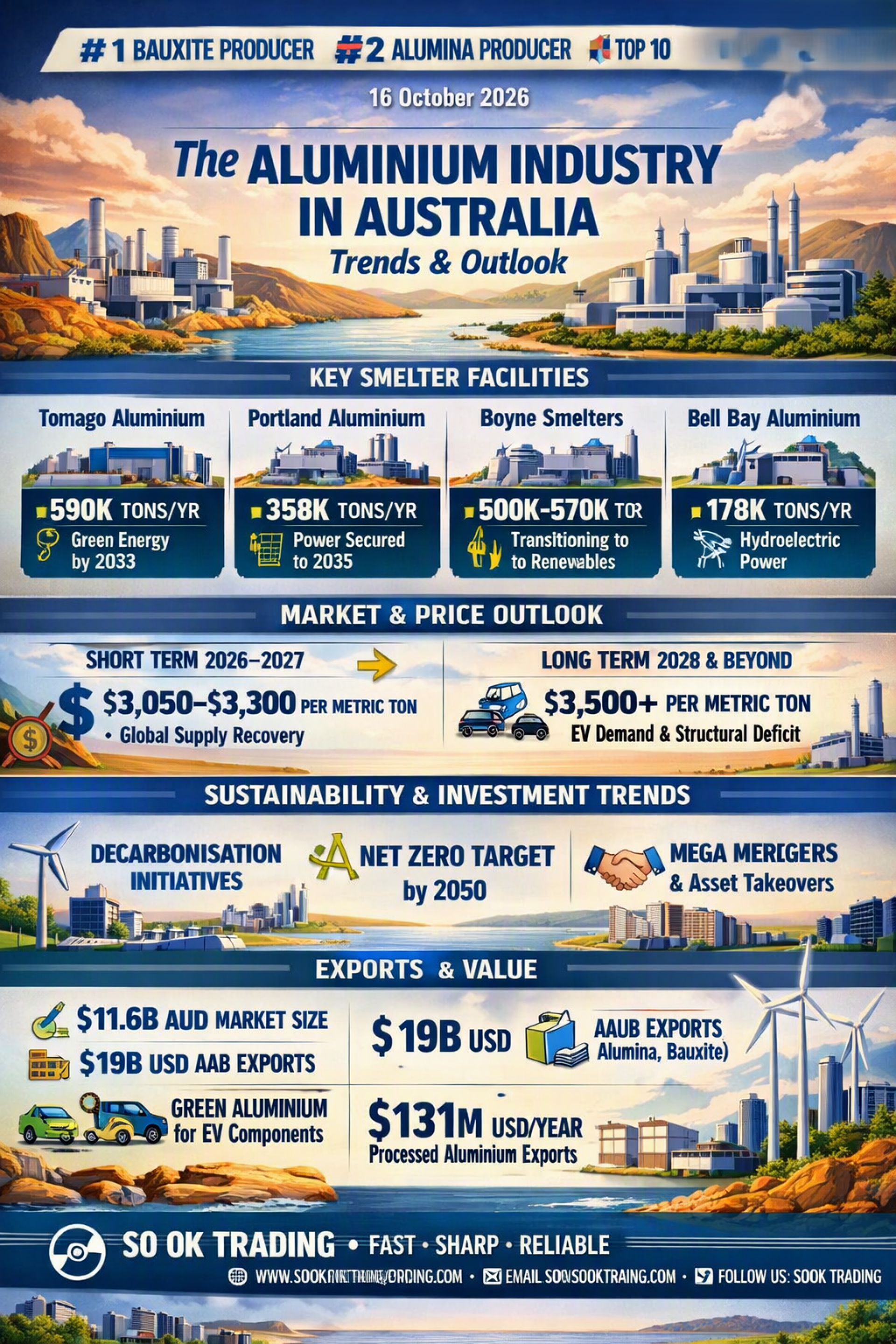
Australia is the world’s largest bauxite producer, the second-largest alumina producer, and ranks among the top 10 aluminium producers, under the guidance of the Australian Aluminium Council.
Tomago Aluminium (New South Wales): ~590,000 tons/year. Supported by federal and state governments with a $2.5 billion power contract, ensuring stable operations until 2038 and full renewable energy transition by 2033.
Portland Aluminium (Victoria): ~358,000 tons/year. Production restored to over 90% after previously dropping to 75% due to high energy costs. Long-term contract with AGL Energy secures power supply until 2035.
Boyne Smelters (Queensland): ~500,000–570,000 tons/year. Undergoing a major transition to renewable energy, reducing reliance on coal.
Bell Bay Aluminium (Tasmania): ~178,000 tons/year. Powered by hydroelectricity, a stronghold for Green Aluminium.
Market and Price Outlook
Short Term (2026–early 2027): LME aluminium prices average $3,050–$3,300 per ton, influenced by supply recovery in the Middle East and Indonesia, while demand from China remains subdued.
Medium to Long Term (late 2027 onward): Analysts from Goldman Sachs, Macquarie, and CRU forecast structural deficits driving prices toward $3,500 per ton. Some expect new Indonesian supply to cap average prices at $2,700.
Transition to Sustainability
Aluminium smelting is highly energy-intensive. Australia is accelerating Decarbonisation, adopting renewable sources such as hydro and wind power to achieve Net Zero and maintain competitiveness in a global market increasingly focused on the Circular Economy and eco-friendly supply chains.
Additionally, major consolidation is reshaping the industry — notably Alcoa’s $4.1 billion acquisition of South32’s bauxite and alumina assets, concentrating market power among a few dominant players.
Market Value and Exports
Australia’s aluminium market value: ~AUD 11.6 billion, projected to grow at 5.8% annually until 2035.
Export revenue from AAB (Aluminium, Alumina, Bauxite): ~USD 19 billion.
Export structure: Raw aluminium accounts for 99.8% of total exports.
Impact on Thailand
Thailand imports aluminium from Australia worth ~USD 370–420 million annually, making it a key raw material source.
Australia’s Green Aluminium supports Thai EV component manufacturers in meeting low-carbon standards for exports to Europe and the U.S.
Thailand exports processed aluminium products back to Australia worth ~USD 131 million annually, with opportunities to expand in high-value products such as structural components and aluminium sheets.
✨ Conclusion
Australia remains a global leader in aluminium supply. Despite challenges from energy costs and price volatility, investments in renewable energy and industry consolidation will strengthen stability and sustainability. For Thailand, the rise of EV markets and Green Aluminium adoption presents both cost pressures and new opportunities in the evolving global supply chain.
SO OK TRADING — FAST • SHARP • RELIABLE Your trusted partner in the international Non-Ferrous metals market
E-mail: SOOKTRADING@SOOKTRADING.COM Website: WWW.SOOKTRADING.COM Facebook: SO OK TRADING