“Outlook of Thailand’s Seafood & Beverage Industry 2026: Economic Perspectives and Thailand’s Role in the Global Market”
Overview of Thailand’s Seafood & Beverage Industry 2026
Article by SO OK TRADING | July 19, 2026
In 2026, Thailand’s seafood and beverage industries stand at a critical turning point. These two pillars remain vital to the nation’s economy, yet they face mounting challenges from a slowing global economy, intensifying trade barriers, and shifting consumer behavior toward health and sustainability.
Seafood Industry: From Ocean to Sustainable Transformation
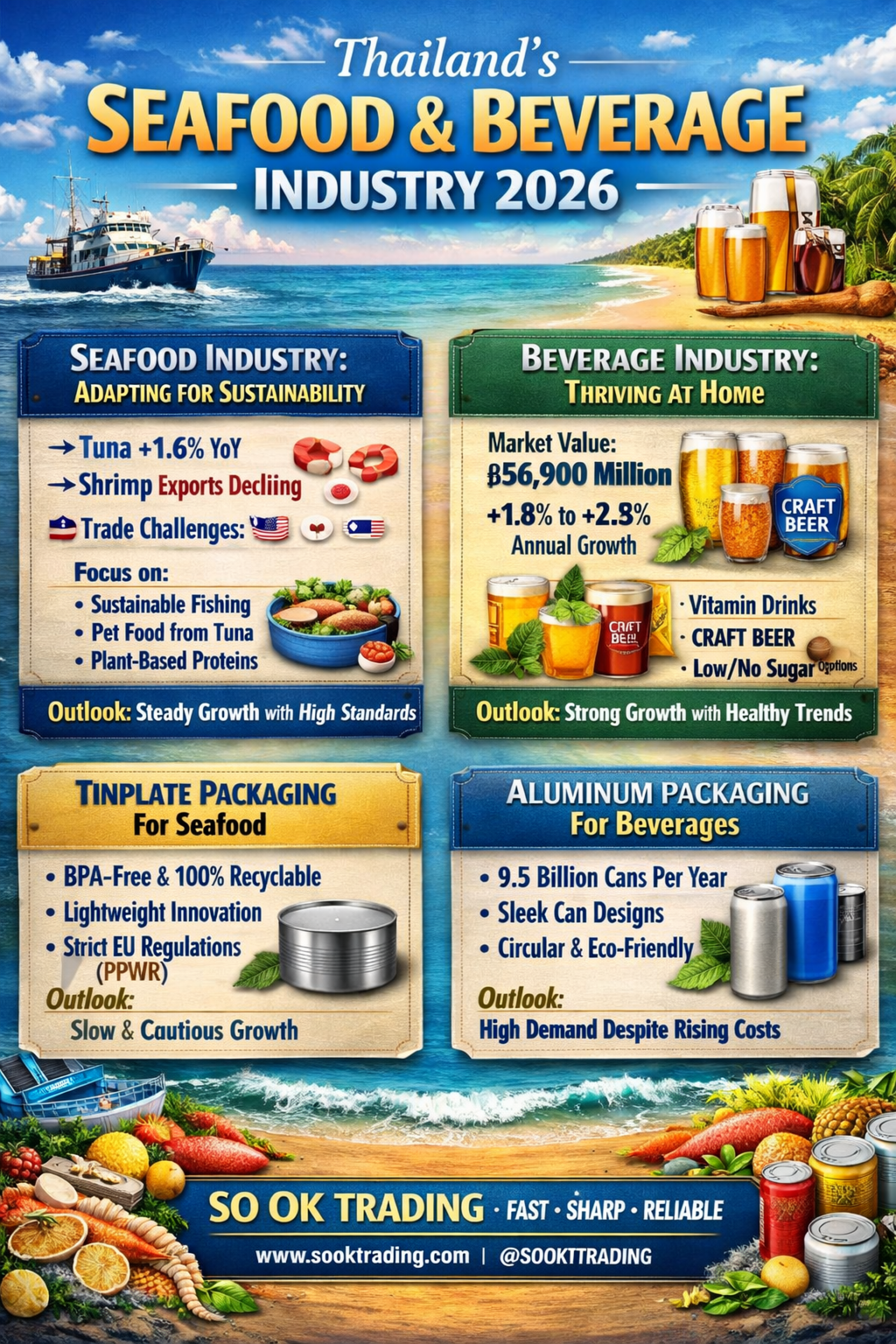
Thailand’s seafood exports are under heavy pressure. Demand in key markets such as the U.S., Japan, and China has weakened, while import tariffs add further strain. Shrimp, once Thailand’s flagship product, has lost cost competitiveness to Ecuador and India. Canned tuna, however, still shows modest growth at around +1.6% YoY.
Major players like Thai Union are adapting by strengthening sustainability standards and developing high‑value products such as tuna‑based pet food and plant‑based protein alternatives. This reflects a shift: the future of Thai seafood will not be about price competition, but about creating new value aligned with global health and environmental priorities.
Outlook: Growth will be modest, but if Thailand can firmly establish sustainability and innovation, it will continue to play a significant role in the global market as a trusted, high‑standard producer.
Beverage Industry: Domestic Market Remains Strong
In contrast to seafood, Thailand’s beverage industry shows brighter prospects, particularly in the domestic market driven by tourism and health trends. Modern consumers increasingly choose vitamin‑infused water, alkaline water, and reduced‑sugar sodas. Alcoholic beverages are also rebounding alongside the recovery of services and entertainment, with craft beer and local spirits gaining popularity.
Although exports to CLMV markets have slowed, domestic demand continues to grow. The market value has surpassed THB 56.9 billion, with an expected average annual growth of 1.8%–2.8%.
Outlook: Thai beverages will remain a growth sector, especially products that meet health and convenience demands. Producers who can adjust formulas to comply with sugar taxes and manage rising packaging costs will maintain their competitive edge.
Metal Packaging: A Critical Transition
Tinplate — Seafood Packaging
Canned seafood products such as tuna and sardines still rely on Tinplate/TFS as the primary material. However, usage is slowing in line with declining exports. Producers must comply with international regulations such as the EU’s PPWR, which requires cans to be BPA‑free and 100% recyclable. Research into lightweight packaging is underway to reduce transport costs and carbon footprints, but volatile raw material prices remain a major challenge.
Outlook Tinplate: The seafood packaging market will remain fragile with slow growth. Thailand can preserve its export markets by meeting safety and environmental standards, but future expansion will depend more on value creation than price competition.
Aluminum — Beverage Packaging
The beverage can market is more promising. Aluminum meets modern consumer preferences for “on‑the‑go” convenience and aligns with circular economy principles, being infinitely recyclable. Thailand’s aluminum packaging market exceeds 9.5 billion cans annually, expanding with the popularity of craft beer, sugar‑free sodas, and ready‑to‑drink coffee. A new trend, Sleek Cans with direct printed designs, is gaining traction and helping reduce mixed plastic waste.
The key challenge is soaring aluminum prices due to supply constraints and geopolitical tensions, which significantly raise production costs.
Outlook Aluminum: Despite high costs, aluminum will remain the dominant material in beverage packaging. Effective cost management and packaging innovation will be crucial for securing long‑term competitive advantage.
Conclusion
In 2026, Thailand’s seafood and beverage industries face major challenges. Overall export growth is expected to slow to just 1.3%–2.0% (valued at approximately USD 36.09 billion). Yet the most significant shift is the move away from price competition toward value creation — through health‑oriented products, premium offerings, and environmentally friendly packaging.
This transition is critical. If Thailand adapts successfully, these industries will remain strong pillars of the economy and resilient against the rapidly changing global landscape.
SO OK TRADING — FAST • SHARP • RELIABLE Your trusted partner in Tinplate & Aluminum packaging www.sooktrading.com Facebook: SOOK TRADING
With over 15 years of expertise, we are the true specialists in Thailand’s metal and aluminum packaging industry.