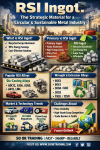
“RSI Ingot: Transforming the Global Metal Industry with Recycling Technology Towards a Sustainable Future” SO OK TRADING: September 24, 2026
RSI Ingot: A Strategic Raw Material for the Circular Economy and the Future of the Metal Industry
Article by SO OK TRADING | September 24, 2026
Introduction
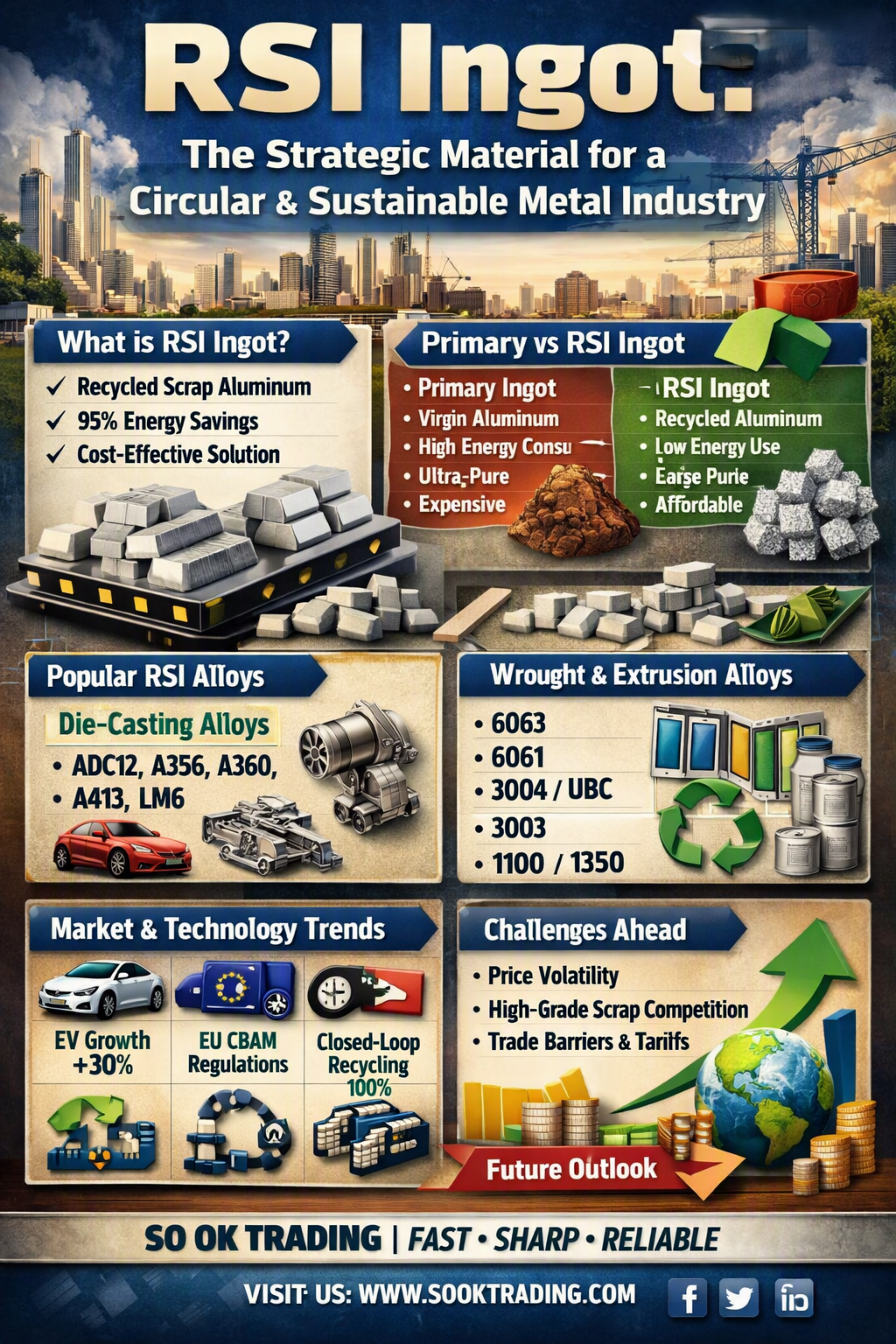
The world is facing unprecedented challenges in energy and the environment. Reducing the use of natural resources and shifting towards recycled materials has become the core of the Circular Economy. One of the most prominent materials is RSI Ingot (Remelt Scrap Ingot) — recycled aluminum ingots that can save up to 95% of energy compared to traditional production from bauxite ore.
Content
Characteristics and Applications
RSI Ingot is produced by remelting scrap aluminum, resulting in lower costs and reduced energy consumption. It is widely used in industries such as:
Automotive → Engine parts and structural components
Packaging → Beverage cans and aluminum foil
Construction → Window frames, doors, and building structures
⚠️ Important note: RSI may contain moisture or air pockets. If remelted without proper drying, it can cause steam explosions.
⚖️ Primary Ingot vs RSI Ingot
A simple comparison:
Source → Primary ingot comes from bauxite ore; RSI comes from recycled aluminum scrap
Energy → Primary requires ~14,000 kWh per ton; RSI uses only 5% of that energy
Purity → Primary is highly consistent; RSI varies depending on scrap quality
Cost → Primary is expensive; RSI is more affordable and cost-efficient
Applications → Primary suits high-performance needs (aircraft, advanced vehicles); RSI is used in general applications (construction, packaging)
Popular Grades of RSI Ingot
Die-Casting Alloys
ADC12 → Automotive parts, machinery covers
A356 → Alloy wheels, suspension systems
A360 → Water pumps, hydraulic valves
A413 → Thin-wall castings, small engines
LM6 → Ship structures, marine equipment
Wrought & Extrusion Alloys
6063 → Architectural window frames, HVAC systems
6061 → Truck structures, railway parts, bicycle frames
3004 / UBC → Recycled beverage cans
3003 → Packaging foil, radiators
1100 / 1350 → High-voltage cables, electronics
Outlook and Industry Direction
Growth
The RSI Ingot market is expected to grow steadily, with a CAGR of 4.5–5.8% projected through 2031–2034.
Key Drivers
EU CBAM Policy → Pressure to adopt low-carbon raw materials
EV Industry → Aluminum usage per vehicle increases by 20–30%
Closed-Loop Recycling → 100% scrap recycling systems
Technology Trends
AI + X-ray Sorting → High-precision scrap separation
Blockchain Traceability → Transparent carbon footprint tracking
High-Efficiency Furnaces → Lower energy use, higher yield
Challenges
Price volatility linked to global markets (LME)
Competition for high-quality scrap
Trade barriers and export restrictions
Outlook in Thailand and ASEAN
Thailand (EEC) → Transition to EV, facing scrap shortages, moving towards green industry
Vietnam → Hub for eco-packaging and electronics
Indonesia → Resource giant with strict upstream policies
ASEAN overall → Emerging as a global hub for metal recycling
Conclusion
RSI Ingot is no longer just a “low-cost option.” It has become a mandatory raw material for sustainability and business survival. Companies that can control their supply chain, adopt advanced sorting technologies, and provide internationally recognized low-carbon certification will hold the greatest advantage in the coming decade.
SO OK TRADING: Your Trusted Business Partner SO OK TRADING | FAST • SHARP • RELIABLE www.sooktrading.com Facebook: SO OK TRADING