Share

“Global Non-Ferrous Metals Market: Price Trend Analysis and Weekly Outlook (September 21–25, 2026) — Supply Tightness Sustains High Prices”: SO OK TRADING
Last updated: 20 Sept 2026
87 Views

Global Non-Ferrous Metals Price Outlook (September 21–25, 2026)
Market Overview with Ceiling–Average–Floor Forecasts Article by SO OK TRADING | September 20, 2026

 
Introduction
The global non-ferrous metals market this week remains under pressure from key macroeconomic factors, particularly interest rate hikes by the U.S. Federal Reserve (Fed) and Gulf States. These moves have strengthened the U.S. dollar, exerting short-term downward pressure on commodity prices. However, supply tightness across major metals continues to provide crucial support, preventing prices from breaking below key levels.

 
Market Outlook
The London Metal Exchange (LME) is currently in a “Consolidation to Rebound” phase. While prices faced downward pressure in mid-September, strong physical demand helped them recover by the end of last week. Copper and Zinc, in particular, are supported by supply disruptions, keeping prices elevated.

 
Metal-Specific Trends
Copper

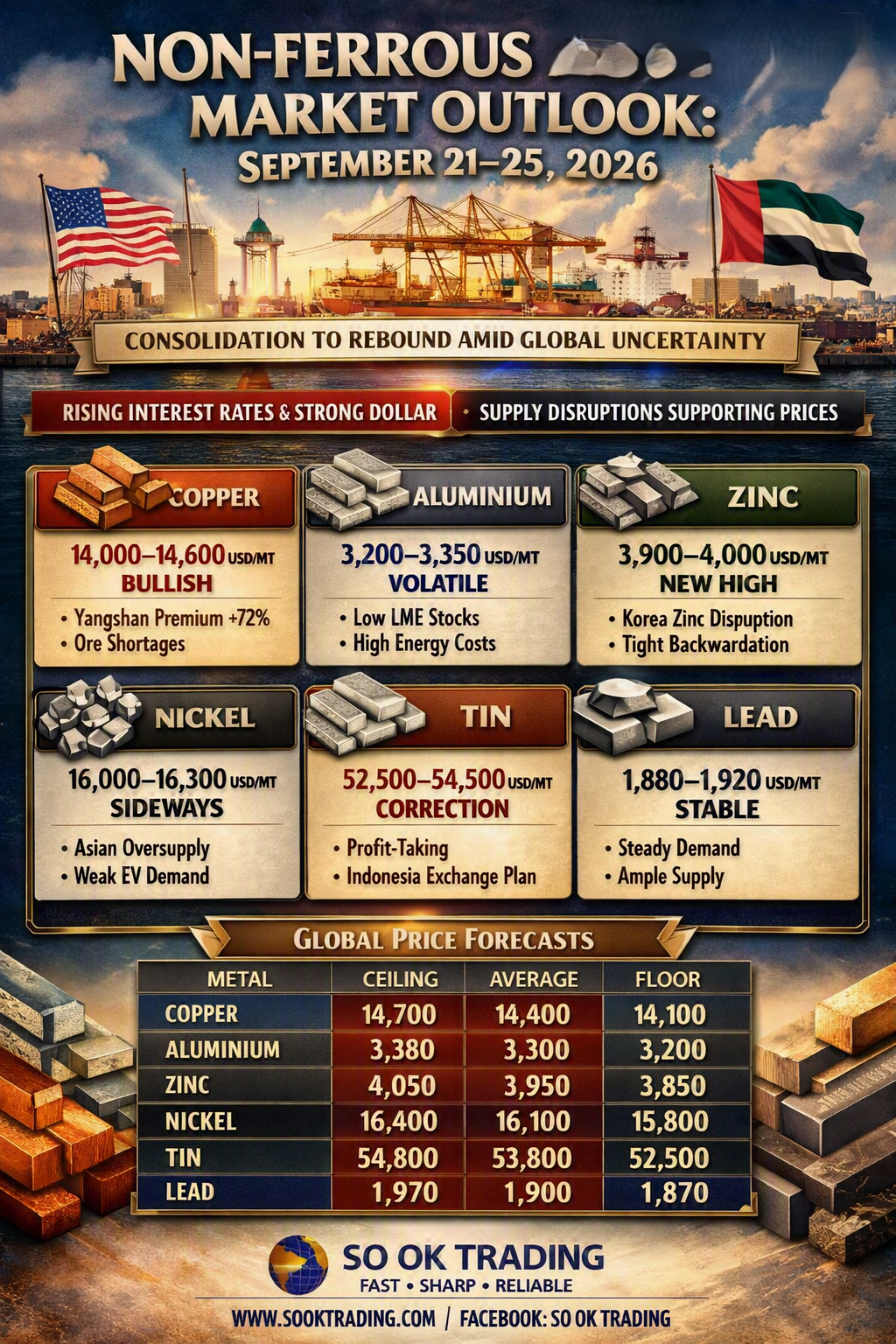
Price Range: 14,000–14,600 USD/MT
Trend: Sideways / Bullish Bias
Drivers: Yangshan premium surged +72%, severe concentrate shortages, global mines struggling to meet demand
Aluminium

Price Range: 3,200–3,350 USD/MT
Trend: High Volatility / Correction Risk
Drivers: LME stocks at century-low levels, geopolitical risks in the Middle East, rising energy costs pushing production costs higher
Zinc

Price Range: 3,900–4,000 USD/MT
Trend: Bullish
Drivers: Korea Zinc smelter accident, backwardation structure signaling tight market, prices hitting multi-year highs
Nickel

Price Range: 16,000–16,300 USD/MT
Trend: Sideways
Drivers: Oversupply in Asia, slow recovery in EV battery demand
Tin

Price Range: 52,500–54,500 USD/MT
Trend: Correction from profit-taking
Drivers: Indonesia planning to launch a commodity exchange for tin and nickel
Lead

Price Range: 1,880–1,920 USD/MT
Trend: Stable
Drivers: Steady downstream demand, sufficient supply
 
External Factors
EU restrictions on scrap metal exports → impacting recycling markets in Asia
China’s PMI data → key indicator for physical demand trends
Strong U.S. dollar → continued downward pressure on commodity prices
Internal Factors
Extremely low LME stocks, especially Aluminium and Zinc → risk of supply shortages
Unusually high premiums:

Copper Cathode: 145–160 USD/MT (CIF Thailand)
Aluminium Ingot (P1020): Q3 MJP settlement at 11-year high of 395 USD/MT; Q4 negotiations expected around 350–370 USD/MT, with potential to revisit 395–400 USD/MT if oil prices remain elevated
 
Procurement Strategies (Thailand & Global)
Copper: Avoid large spot purchases due to high premiums → use monthly averages or term contracts
Aluminium: Review delivery terms; switching to FOB may reduce freight costs
Zinc & Copper: Watch for volatility from supply disruptions
Hedging Strategy: Gradual purchases or partial price locking during dips to mitigate risk
 
Price Forecasts (Ceiling–Average–Floor, September 21–25, 2026)
Copper: Ceiling 14,700 / Average 14,400 / Floor 14,100 USD/MT
Aluminium: Ceiling 3,380 / Average 3,300 / Floor 3,200 USD/MT
Zinc: Ceiling 4,050 / Average 3,950 / Floor 3,850 USD/MT
Nickel: Ceiling 16,400 / Average 16,150 / Floor 15,800 USD/MT
Tin: Ceiling 54,800 / Average 53,800 / Floor 52,500 USD/MT
Lead: Ceiling 1,930 / Average 1,900 / Floor 1,870 USD/MT
 
Conclusion
Despite ongoing pressure from interest rates and a strong dollar, supply tightness continues to support non-ferrous metal prices, with Copper and Zinc showing strong resilience due to supply disruptions. Aluminium remains at risk due to historically low stocks and high energy costs. For buyers, risk diversification, long-term contracts, and hedging strategies are essential to navigate the volatility in global markets.

 
SO OK TRADING
FAST • SHARP • RELIABLE Your trusted partner in the global non-ferrous metals market

www.sooktrading.com Facebook: SO OK TRADING


Related Content
“Hormuz War 2026: Global Energy in Turmoil – Oil, Fertilizer, Naphtha & Aluminum Shaking the World Economy”   SO OK TRADING | 18 August 2026
Middle East War 2026: The Hormuz Time Bomb – Global Energy in Turmoil When the ceasefire agreement (MoU) between the United States and Iran expired on August 17, the world entered one of the most critical “energy turning points” of the decade. The Strait of Hormuz, the lifeline of global oil trade, has been blockaded, shipping nearly paralyzed, and energy prices soaring to unprecedented levels. The impact is not confined to the Middle East — it is spreading across the globe. From petrochemical production costs to fertilizer and food prices in supermarkets, every corner of the global economy is being shaken. In this report, SO OK TRADING takes you deep into the four key commodities now driving the global economic shockwaves — Oil, Fertilizer, Naphtha, and Aluminum — and provides an Outlook for the second half of 2026 that could reshape the structure of global energy trade for years to come.
18 Aug 2026
ALUMINUM PRICE TREND 2026
An analysis of the aluminum market in 2026 indicates a likely continued market deficit and upward price pressure, driven by constrained supply and resilient demand from green energy sectors. However, significant volatility is expected due to policy uncertainties and the potential for new Indonesian supply to eventually balance the market. Key Drivers and Projections for 2026 Supply Side Analysis Capacity Constraints: China's primary aluminum output is approaching its self-imposed 45 million-tonne capacity cap, limiting global supply growth. Power Challenges: Smelters outside of China face intense competition for power from energy-intensive sectors like AI data centers, which are willing to pay higher prices for long-term contracts. This has kept significant capacity offline in Europe and the US. Production Disruptions: Outages and potential shutdowns at existing smelters in Iceland and Mozambique further tighten the market. Scrap Supply Pressure: The EU's planned implementation of the Carbon Border Adjustment Mechanism (CBAM) and potential scrap export tariffs in spring 2026 are expected to impact global scrap flows, creating regional shortages and price volatility. New Capacity: Indonesia is a key source of new supply, with several projects in the pipeline. However, analysts suggest the pace of the ramp-up may be slower than expected due to infrastructure and policy challenges, meaning it is unlikely to fully offset near-term tightness. Demand Side Analysis Green Transition Demand: Demand from "green" sectors such as solar panels, new energy vehicles, and energy transition infrastructure remains strong, providing fundamental support for the market. Substitution Effect: Aluminum's wide price discount relative to copper has encouraged substitution in electrical applications, acting as a tailwind for demand and prices. Construction and Automotive: The construction and automotive industries continue to be major consumers, with growing demand for lightweight, low-carbon aluminum products. Price Forecasts and Volatility The market is expected to remain in a deficit in 2026, with estimates ranging from 200,000 to 600,000 tonnes. This structural tightness is leading most analysts to forecast sustained or rising prices. Bullish Views: Analysts at Bank of America project prices of $3,000/tonne as early as 2026. J.P. Morgan also expects prices to approach $3,000/tonne in Q1 2026. ING forecasts an average price of $2,900/tonne for the year. Bearish/Conservative Views: Goldman Sachs is an outlier, forecasting prices to decline to $2,350/tonne by Q4 2026, anticipating a market surplus later in the year. SMM forecasts a "high first, then lower" pattern, with prices finding equilibrium in the $2,700–$2,800/tonne range by year-end. Premiums: Regional premiums, particularly the US Midwest premium, are expected to remain high and volatile due to tariffs and regional supply dynamics, creating a disconnect from the LME benchmark price. In essence, 2026 is projected to be a year of high volatility where participants need to focus on scenario readiness rather than relying on a single price forecast, as geopolitical and energy policies significantly influence regional supply and costs
31 Dec 2025
This website uses cookies for best user experience, to find out more you can go to our Privacy Policy and Cookies Policy
Powered By MakeWebEasy Logo MakeWebEasy