Share

“Aluminum of the Future: Green Aluminum Revolution — CBAM Pressure Drives China to Reshape the Global Metal Market, From Coal to Clean Energy” SO OK TRADING | 18 SEP 2026
Last updated: 18 Sept 2026
1133 Views

China’s Transition to Green Aluminum: From Coal-Fired Smelters to a Clean Energy Future
SO OK TRADING : 18 SEP 2026

 
✨ Introduction

As the world’s largest producer and consumer of aluminum, accounting for more than 60% of global capacity, China is undergoing a profound structural transformation. An industry once driven by sheer volume and coal-based energy is now being forced to pivot toward quality-driven production, clean energy, and high-value products. This shift is fueled by both domestic pressures and international environmental measures such as the EU’s Carbon Border Adjustment Mechanism (CBAM).

 
Current Situation
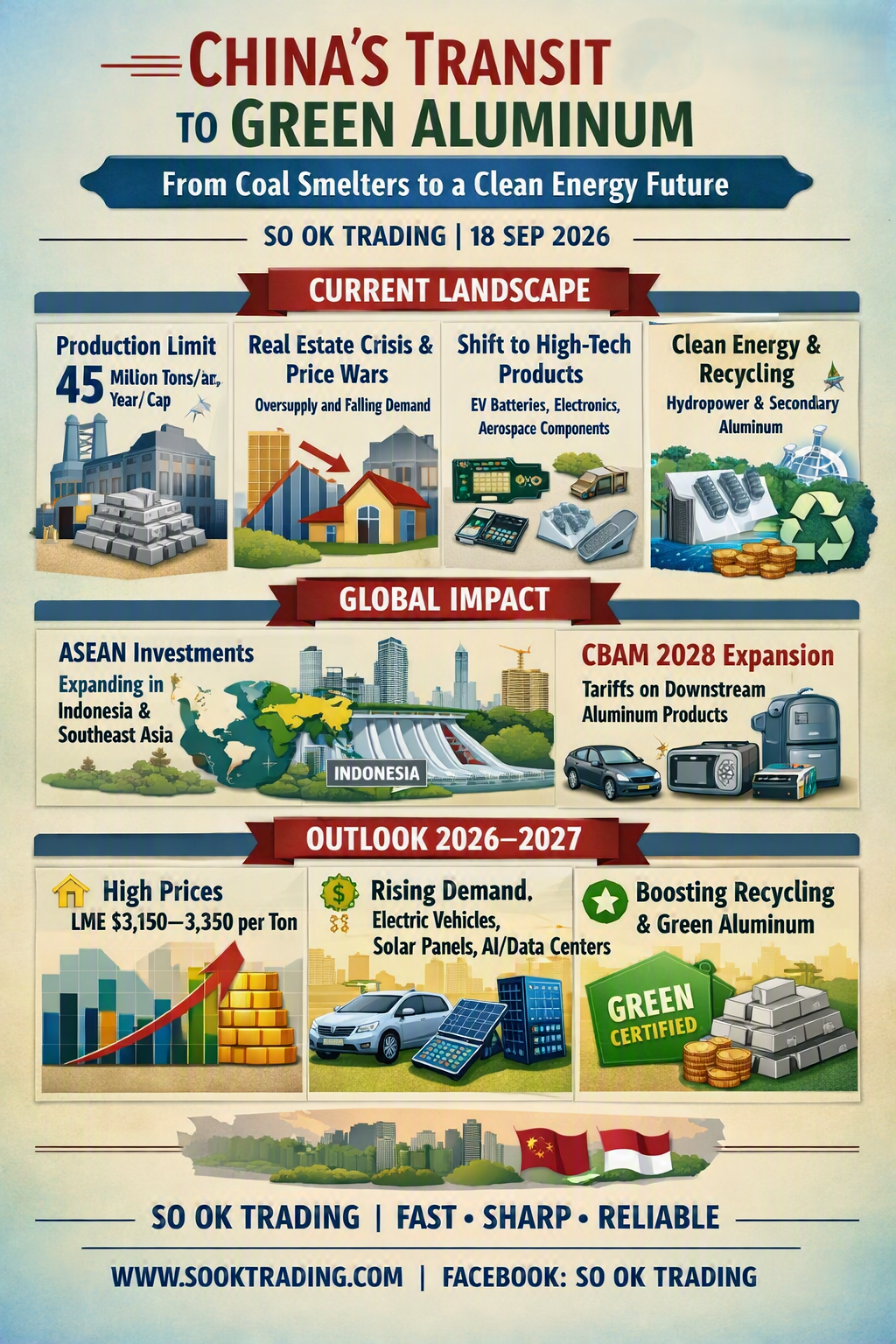
Supply Control Policy The Chinese government has capped primary aluminum output at 45 million tons per year to reduce energy consumption and carbon emissions, creating a “structural tightness” in the global market.
Real Estate Crisis and Price War Weak demand from the property sector has led to oversupply and intensified price competition.
Shift to High-Tech Products Smelters are moving into high-value segments such as EV battery foil, electronic components, and aerospace materials, in line with the “New Quality Productive Forces” policy.
Clean Energy and Recycling Smelters are relocating to Yunnan and Sichuan to leverage hydropower and renewables. Secondary aluminum production is being accelerated, with a target of 15 million tons by 2027—requiring only 5% of the energy used in primary smelting.
Impact of EU CBAM Carbon tariffs significantly raise China’s export costs. Without verified carbon data, the EU applies high average values, putting China at a disadvantage. By 2028, CBAM will extend to downstream products such as auto parts and appliances.
 
Global Impact: China’s Aluminum
ASEAN Investments: China is expanding production bases in Indonesia and across the region to access bauxite resources and bypass tariff barriers.
CBAM Comparison: China’s carbon tax is around $11/ton, versus Europe’s $75–80/ton, eroding China’s price competitiveness.
2028 Expansion: Downstream products will be included, affecting China’s entire supply chain.
 
Leading Green Aluminum Companies in China
China Hongqiao Group: Relocated to Yunnan, powered 100% by hydropower, ASI certified.
Chinalco (State-Owned): Investing in advanced technologies, producing clean materials for aerospace and EVs.
Henan Shenhuo Coal & Power: Transitioning operations toward clean energy.
Shandong Nanshan Aluminium: Specializing in EV battery foil and recycling to cut carbon emissions.
 
Outlook (2026–2027)
Global Tightness Continues: Prices remain elevated (LME $3,150–3,350/ton, SHFE >24,000 RMB/ton).
New Economy Drivers: Demand from EVs, solar, and AI/data centers will be key growth engines.
Recycling and Green Aluminum: China is pushing recycled aluminum and green certification to stay competitive.
Geopolitical Factors: Middle East conflicts position China and Indonesia as swing suppliers in the global market.
 
Conclusion
China’s aluminum industry is entering a new era—no longer defined by volume, but by quality, sustainability, and innovation. The focus on Green Aluminum, Circular Economy, and high-tech products will not only secure China’s leadership in the global market but also ensure long-term resilience amid environmental regulations and global competition.

 
SO OK TRADING : Your Trusted Business Partner SO OK TRADING : FAST SHARP RELIABLE

VISIT US AT : WWW.SOOKTRADING.COM FACEBOOK : SO OK TRADING

SO OK TRADING : The True Leader in Non-Ferrous Metals and ALUMINUM PACKAGING from Thailand


Related Content
ALUMINUM PRICE TREND 2026
An analysis of the aluminum market in 2026 indicates a likely continued market deficit and upward price pressure, driven by constrained supply and resilient demand from green energy sectors. However, significant volatility is expected due to policy uncertainties and the potential for new Indonesian supply to eventually balance the market. Key Drivers and Projections for 2026 Supply Side Analysis Capacity Constraints: China's primary aluminum output is approaching its self-imposed 45 million-tonne capacity cap, limiting global supply growth. Power Challenges: Smelters outside of China face intense competition for power from energy-intensive sectors like AI data centers, which are willing to pay higher prices for long-term contracts. This has kept significant capacity offline in Europe and the US. Production Disruptions: Outages and potential shutdowns at existing smelters in Iceland and Mozambique further tighten the market. Scrap Supply Pressure: The EU's planned implementation of the Carbon Border Adjustment Mechanism (CBAM) and potential scrap export tariffs in spring 2026 are expected to impact global scrap flows, creating regional shortages and price volatility. New Capacity: Indonesia is a key source of new supply, with several projects in the pipeline. However, analysts suggest the pace of the ramp-up may be slower than expected due to infrastructure and policy challenges, meaning it is unlikely to fully offset near-term tightness. Demand Side Analysis Green Transition Demand: Demand from "green" sectors such as solar panels, new energy vehicles, and energy transition infrastructure remains strong, providing fundamental support for the market. Substitution Effect: Aluminum's wide price discount relative to copper has encouraged substitution in electrical applications, acting as a tailwind for demand and prices. Construction and Automotive: The construction and automotive industries continue to be major consumers, with growing demand for lightweight, low-carbon aluminum products. Price Forecasts and Volatility The market is expected to remain in a deficit in 2026, with estimates ranging from 200,000 to 600,000 tonnes. This structural tightness is leading most analysts to forecast sustained or rising prices. Bullish Views: Analysts at Bank of America project prices of $3,000/tonne as early as 2026. J.P. Morgan also expects prices to approach $3,000/tonne in Q1 2026. ING forecasts an average price of $2,900/tonne for the year. Bearish/Conservative Views: Goldman Sachs is an outlier, forecasting prices to decline to $2,350/tonne by Q4 2026, anticipating a market surplus later in the year. SMM forecasts a "high first, then lower" pattern, with prices finding equilibrium in the $2,700–$2,800/tonne range by year-end. Premiums: Regional premiums, particularly the US Midwest premium, are expected to remain high and volatile due to tariffs and regional supply dynamics, creating a disconnect from the LME benchmark price. In essence, 2026 is projected to be a year of high volatility where participants need to focus on scenario readiness rather than relying on a single price forecast, as geopolitical and energy policies significantly influence regional supply and costs
31 Dec 2025
“Copper Supercycle: Copper — The Lifeblood of the EV Industry and Circular Economy — From Mines to Motors, the Red Metal Becomes the Heart of the Global Economy and the Driving Force of the Future Transition”
⚡ Copper — The Strategic Metal of the Future Article by SO OK TRADING | July 18, 2026 As the world transitions toward clean energy and electric vehicles (EVs), copper is no longer just an ordinary industrial metal. It has become the lifeblood of the modern global economy, powering every system from batteries and motors to charging stations. With its superior conductivity and ability to be 100% recycled without loss of quality, copper is at the heart of the Circular Economy and a critical raw material driving the growth of the EV industry. SO OK TRADING takes you on a deep dive into copper’s role in the clean energy era—from recycling technologies and usage across different EV types to global price trends as the market enters a new Supercycle. ✨ Read the full article in this post Discover how copper, the strategic metal of the future, is reshaping the global economy for generations to come. SO OK TRADING — FAST | SHARP | RELIABLE
18 Jul 2026
“SO OK TRADING — 5 Million Visitors, 1 Trusted Partner. Thailand’s Non‑Ferrous Expert Delivering Just‑In‑Time for Uninterrupted Production.”
Company Introduction (English Version) SO OK TRADING — Thailand’s True Expert in Non‑Ferrous Metals We are your trusted partner, guided by the philosophy of FAST • SHARP • RELIABLE to deliver excellence in every aspect of our business. FAST — Speed and responsiveness, ensuring timely solutions for your production needs. SHARP — Precision and accuracy, maintaining uncompromising standards at every stage. RELIABLE — Dependability and trust, building long‑term partnerships with transparency and responsibility. With over 5 million visitors to our official website www.sooktrading.com, we proudly supply high‑quality non‑ferrous metals such as Aluminium, Copper, and Brass. Our Just‑In‑Time delivery system integrates seamlessly into your production line, ensuring uninterrupted manufacturing and maximum efficiency. SO OK TRADING — Delivering Non‑Ferrous Excellence, Just in Time.
21 Oct 2026
This website uses cookies for best user experience, to find out more you can go to our Privacy Policy and Cookies Policy
Powered By MakeWebEasy Logo MakeWebEasy