“Copper Supercycle: Copper — The Lifeblood of the EV Industry and Circular Economy — From Mines to Motors, the Red Metal Becomes the Heart of the Global Economy and the Driving Force of the Future Transition”
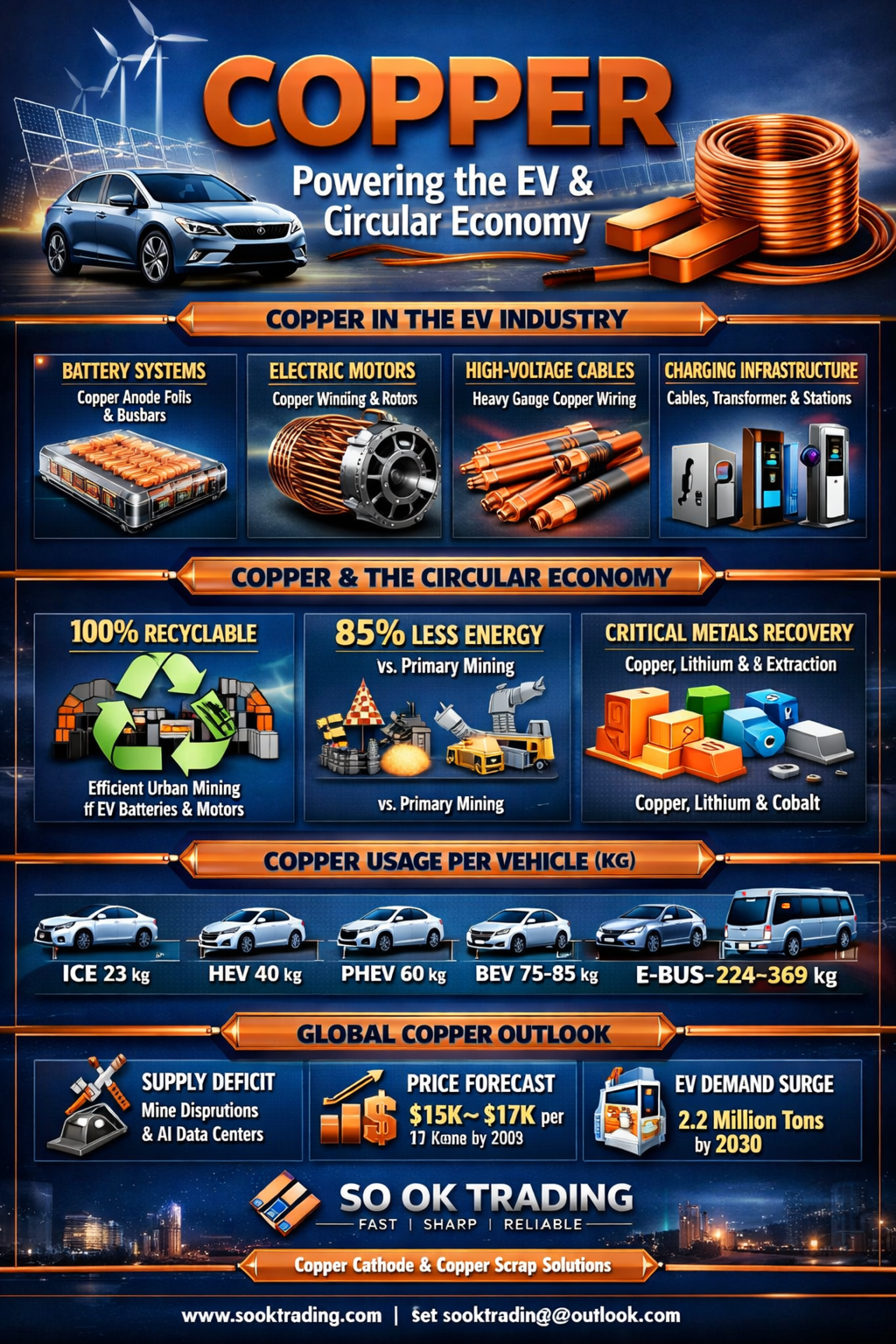
Copper: The Backbone of the EV Industry and Circular Economy
Article by SO OK TRADING | July 18, 2026
Copper is not just an ordinary industrial metal—it is the “lifeblood” driving the global transition to clean energy and electric vehicles (EVs). An EV requires three to four times more copper than a conventional internal combustion engine (ICE) vehicle. From batteries and motors to wiring systems and fast-charging stations, copper has become an indispensable strategic resource in the era of the Circular Economy.
Copper’s Role in the EV Industry
Battery Pack: Copper foil is used as the anode, while busbars connect battery cells.
Electric Motor: Copper windings around the stator generate the magnetic field that powers the wheels.
Wiring Harness: EVs require thicker and longer copper cables to handle high-voltage systems.
Charging Infrastructure: Fast-charging stations rely heavily on copper cables and transformers.
Copper is not merely a component—it is the “heart” of the EV propulsion system.
Copper and the Circular Economy
Copper perfectly aligns with the principles of the Circular Economy:
100% Recyclable: Copper can be recycled endlessly without losing conductivity.
85% Less Energy: Recycling copper consumes 85% less energy compared to mining new ore, significantly reducing carbon emissions.
Urban Mining: End-of-life EV batteries and motors are recycled to recover copper, lithium, and cobalt, reducing the risk of global resource shortages.
Copper Usage by Vehicle Type
ICE: ~23 kg
HEV: ~40 kg
PHEV: ~60 kg
BEV: ~70–83 kg
Electric Bus: ~224–369 kg
The more a vehicle depends on electricity, the greater its copper demand.
Global Copper Price Trends
The copper market is facing a structural supply shortage due to disruptions at major mines in Indonesia and Chile. Meanwhile, demand from AI data centers is surging, with each megawatt requiring 20–40 tons of copper.
Financial institutions such as J.P. Morgan and BMI forecast copper prices to remain at $11,000–12,500 per ton in the medium term, potentially rising to $15,000–17,000 per ton in the next decade as the world embraces the “Green Premium.”
Copper Recycling Technologies from EVs
Motors: Robotic disassembly and AI sorting recover 98–99% pure copper.
Batteries: Hydrometallurgical processes extract and regenerate copper foil for reuse.
EU Regulations: By 2031, new EV batteries must include recycled materials, with copper, cobalt, and nickel recovery rates of at least 90%.
Major Consumers and Producers of Copper
Consumers: China (~54–57% of global demand), followed by the U.S., Germany, Japan, and South Korea.
Producers: Chile (~5.3–5.6 million tons annually), followed by the DRC, Peru, China, and Russia.
While Chile and Peru dominate raw copper ore production, China leads in refining, underscoring its control over the global supply chain.
Global Copper Market Outlook
EV Demand: Expected to grow from 1.2 million tons to 2.2 million tons by 2030.
Clean Energy & Grid: Renewable energy requires far more copper than fossil fuel power plants.
New Supercycle: S&P Global projects global copper demand to rise from 28 million tons to 42 million tons by 2040.
✨ Conclusion
Copper is the “strategic metal of the future,” powering EVs, clean energy, and the Circular Economy. As the world advances toward a full-scale Green Economy, copper will be the critical resource shaping the trajectory of the global economy in the 21st century.
SO OK TRADING — Your Trusted Business Partner FAST | SHARP | RELIABLE www.sooktrading.com sooktrading@outlook.com