“Aluminum of the Future: Green Aluminum Revolution — CBAM Pressure Drives China to Reshape the Global Metal Market, From Coal to Clean Energy” SO OK TRADING | 18 SEP 2026
China’s Transition to Green Aluminum: From Coal-Fired Smelters to a Clean Energy Future
SO OK TRADING : 18 SEP 2026
✨ Introduction
As the world’s largest producer and consumer of aluminum, accounting for more than 60% of global capacity, China is undergoing a profound structural transformation. An industry once driven by sheer volume and coal-based energy is now being forced to pivot toward quality-driven production, clean energy, and high-value products. This shift is fueled by both domestic pressures and international environmental measures such as the EU’s Carbon Border Adjustment Mechanism (CBAM).
Current Situation
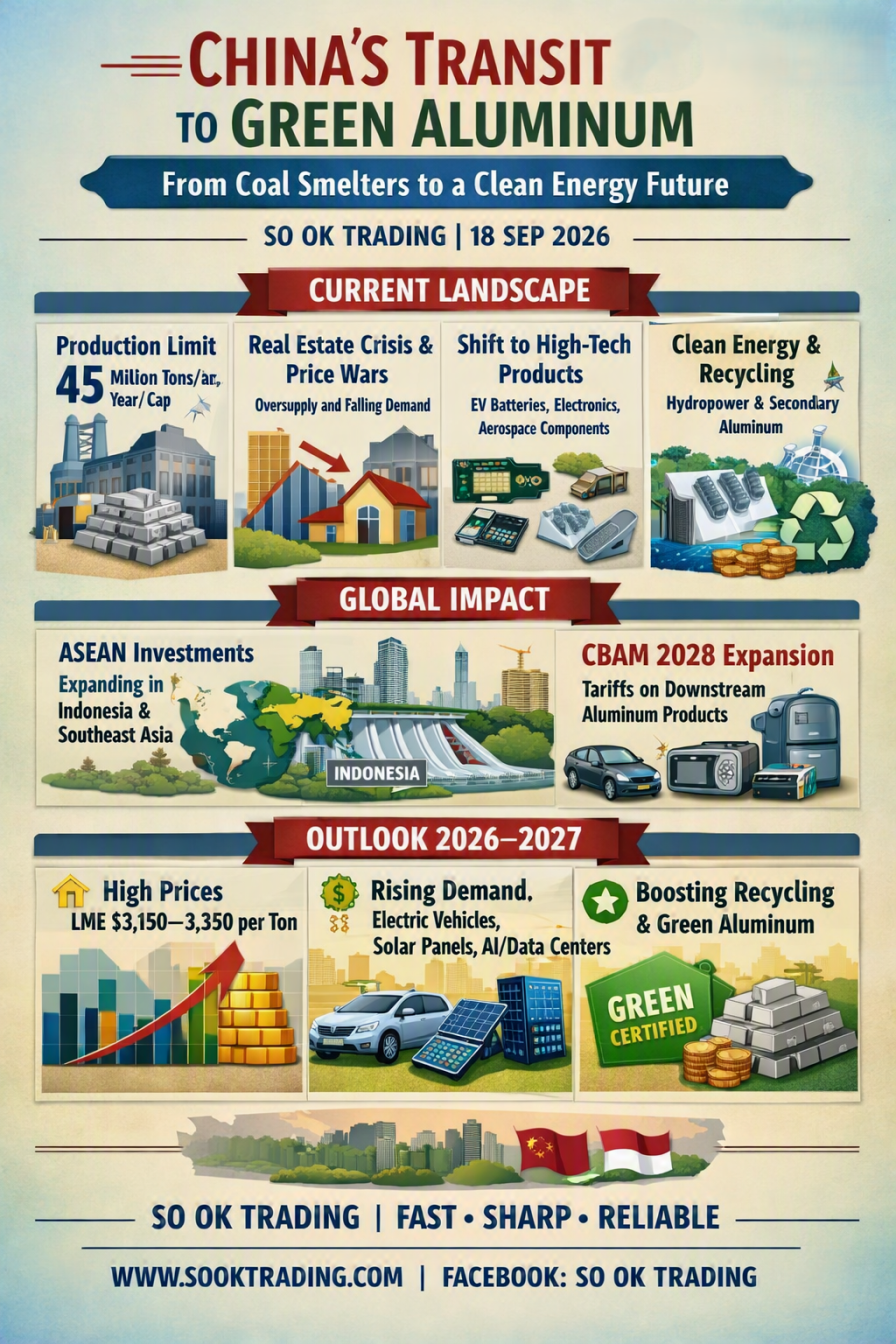
Supply Control Policy The Chinese government has capped primary aluminum output at 45 million tons per year to reduce energy consumption and carbon emissions, creating a “structural tightness” in the global market.
Real Estate Crisis and Price War Weak demand from the property sector has led to oversupply and intensified price competition.
Shift to High-Tech Products Smelters are moving into high-value segments such as EV battery foil, electronic components, and aerospace materials, in line with the “New Quality Productive Forces” policy.
Clean Energy and Recycling Smelters are relocating to Yunnan and Sichuan to leverage hydropower and renewables. Secondary aluminum production is being accelerated, with a target of 15 million tons by 2027—requiring only 5% of the energy used in primary smelting.
Impact of EU CBAM Carbon tariffs significantly raise China’s export costs. Without verified carbon data, the EU applies high average values, putting China at a disadvantage. By 2028, CBAM will extend to downstream products such as auto parts and appliances.
Global Impact: China’s Aluminum
ASEAN Investments: China is expanding production bases in Indonesia and across the region to access bauxite resources and bypass tariff barriers.
CBAM Comparison: China’s carbon tax is around $11/ton, versus Europe’s $75–80/ton, eroding China’s price competitiveness.
2028 Expansion: Downstream products will be included, affecting China’s entire supply chain.
Leading Green Aluminum Companies in China
China Hongqiao Group: Relocated to Yunnan, powered 100% by hydropower, ASI certified.
Chinalco (State-Owned): Investing in advanced technologies, producing clean materials for aerospace and EVs.
Henan Shenhuo Coal & Power: Transitioning operations toward clean energy.
Shandong Nanshan Aluminium: Specializing in EV battery foil and recycling to cut carbon emissions.
Outlook (2026–2027)
Global Tightness Continues: Prices remain elevated (LME $3,150–3,350/ton, SHFE >24,000 RMB/ton).
New Economy Drivers: Demand from EVs, solar, and AI/data centers will be key growth engines.
Recycling and Green Aluminum: China is pushing recycled aluminum and green certification to stay competitive.
Geopolitical Factors: Middle East conflicts position China and Indonesia as swing suppliers in the global market.
Conclusion
China’s aluminum industry is entering a new era—no longer defined by volume, but by quality, sustainability, and innovation. The focus on Green Aluminum, Circular Economy, and high-tech products will not only secure China’s leadership in the global market but also ensure long-term resilience amid environmental regulations and global competition.
SO OK TRADING : Your Trusted Business Partner SO OK TRADING : FAST SHARP RELIABLE
VISIT US AT : WWW.SOOKTRADING.COM FACEBOOK : SO OK TRADING
SO OK TRADING : The True Leader in Non-Ferrous Metals and ALUMINUM PACKAGING from Thailand