“Zinc Prices Soar! 4-Year High – Global Market Deep Dive: Supply Tightness & Demand Surge with SO OK TRADING”: 4 SEP 2026
Global Zinc Market Surges to 4-Year High
LME ZINC PRICE ANALYSIS : SO OK TRADING : September 4, 2026
Introduction
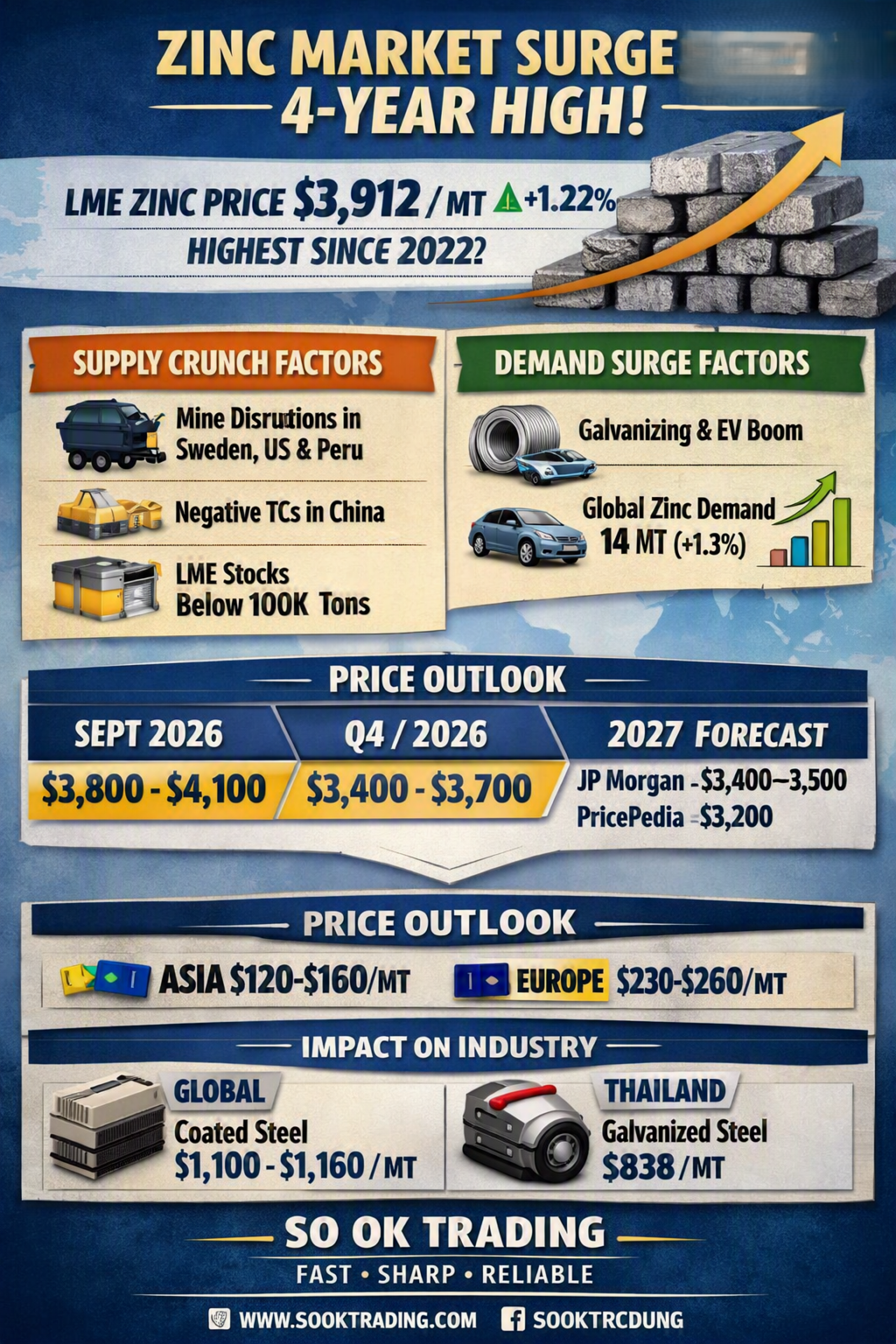
In September 2026, the global zinc market is making waves. The 3‑month closing price on the London Metal Exchange (LME) reached USD 3,912 per ton, up 1.22%. The global average trading price stood at USD 3,900 per ton — the highest level since 2022. This movement reflects a supply squeeze and a clear continuation of bullish momentum.
Price Drivers
Supply Side
Mining crisis: Mines in Sweden, the U.S., and Peru underperformed, while exports from Iran dropped by 15,000–20,000 tons per month.
Negative treatment charges (TCs): Chinese smelters face high costs, leading to production cuts totaling over 800,000 tons per year.
Global stocks at 3-year low: LME inventories fell below 100,000 tons.
Demand Side
Galvanizing: Accounts for over 50% of global zinc use, supported by renewable energy projects and electric vehicles.
Global demand growth: ILZSG forecasts zinc demand to reach 14 million tons in 2026, up 1.3%, resulting in a market deficit of around 19,000 tons.
Price Outlook (LME – Zinc)
Short Term (September 2026) Prices are expected to fluctuate within USD 3,800–4,100 per ton, under strong backwardation (spot prices higher than futures) and continuously declining LME stocks.
Q4 2026 A slight correction is anticipated, but prices will remain elevated, averaging USD 3,400–3,700 per ton. A key factor will be China’s export of refined zinc to ease global tightness.
2027 JP Morgan: Prices likely to hold at USD 3,400–3,500 per ton, with upside risk if smelter cuts exceed expectations. PricePedia: Predicts a mild correction of about 2.5%, averaging USD 3,200 per ton, as new supply enters the market, including the Kipushi project in Congo.
Regional Premiums (Zinc Premium)
Asia (Shanghai / Southeast Asia): USD 120–160 per ton, driven by Chinese import demand and regional competition.
Europe (Rotterdam): USD 230–260 per ton, due to energy crises and smelter closures, increasing reliance on Asian imports.
Thailand Import Cost Formula (Excluding Tax): 3,912 + 145 = 4,057 USD/MT (Not including interest, warehousing, handling, and domestic logistics costs.)
Impact on the Galvanizing Industry
Global: Galvanized steel costs surged to USD 1,100–1,160 per ton, yet growth continues, fueled by clean energy and EV projects.
Thailand: Local galvanizers face rising costs, with average galvanized steel prices at only USD 838 per ton, squeezing margins. However, demand is supported by EEC projects, rail systems, and new infrastructure.
✨ Conclusion
As of September 2026, global zinc prices stand firmly above the psychological threshold of USD 3,900–4,000 per ton — the highest in four years. With supply squeeze and expanding demand, businesses must adapt strategies to manage high costs and intensifying regional competition.
SO OK TRADING : Your Trusted Business Partner SO OK TRADING : FAST SHARP RELIABLE
Visit us at: WWW.SOOKTRADING.COM Facebook: SO OK TRADING
SO OK TRADING : The True Leader in Thailand’s Non-Ferrous Business