Share

“Deep Dive into the Aluminum Market 2026: Price Breakthrough, Supply Crisis, and the Future of Clean Energy — From Basic Metal to Strategic Metal” Article by SO OK TRADING April 2, 2026
Last updated: 2 Apr 2026
4772 Views

 
Impact: Automotive and construction industries worldwide face soaring costs and shortages
China’s Limitation: Production capped at 45.5 million tons, preventing additional supply to the market
 
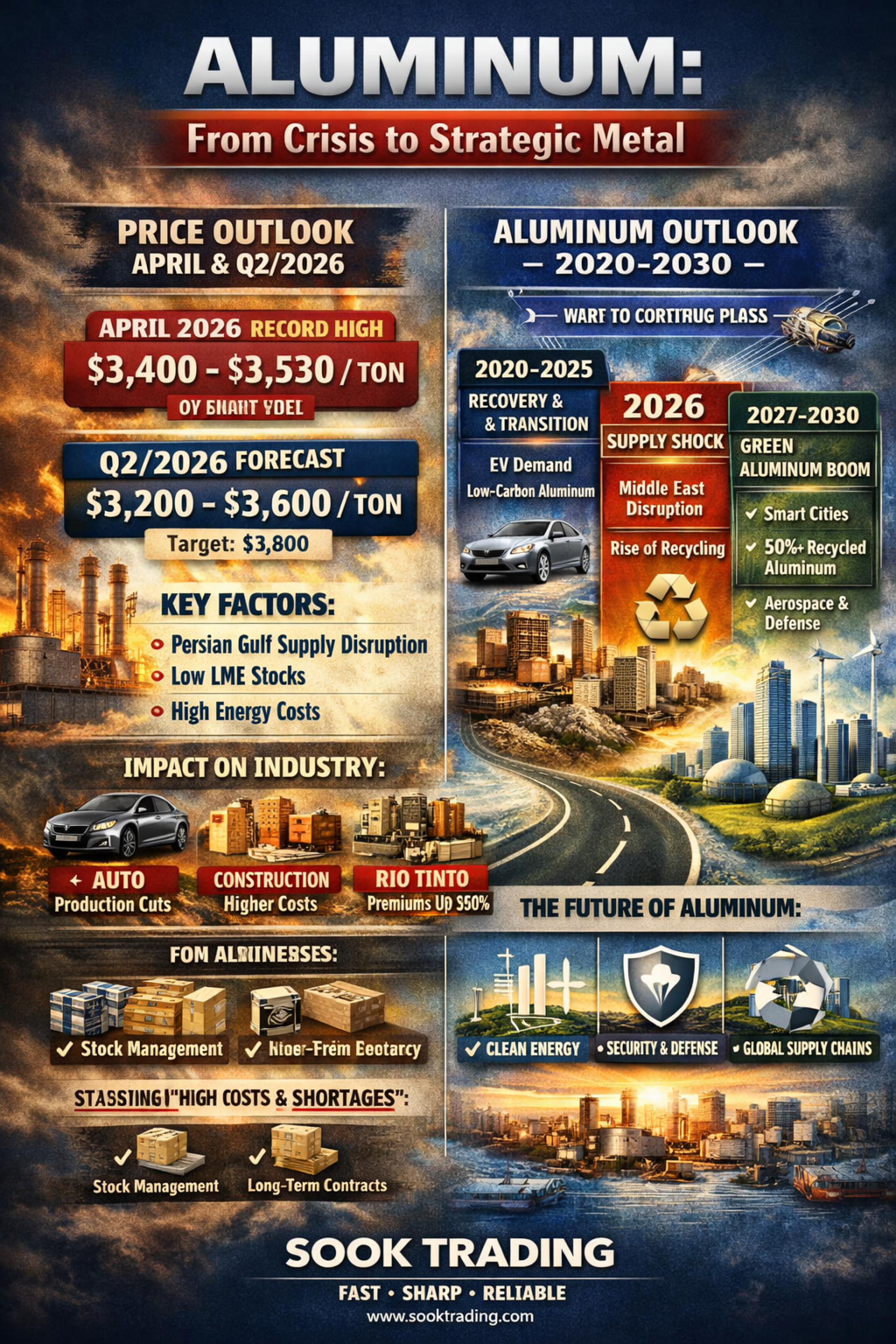
Aluminum Price Outlook – Q2/2026 (April–June)
Average Price: $3,200–$3,600/ton
Key Resistance: $3,800 if conflicts continue
Supply Gap: Persian Gulf smelters not yet fully recovered, creating a 5–10% global supply shortfall
Seasonal Demand: Q2 is the high season for construction projects worldwide, including Thailand
Impact in Thailand: Retail aluminum profiles and sheets expected to rise another 5–10% by May–June
 
Insights from Mining & Producers
Rio Tinto: Set Q2/2026 premiums for Japanese customers at $350/ton, up 79% from Q1 (MJP Premium was $215–220/ton)
EGA & Alba: Smelters in Abu Dhabi and Bahrain suffered severe damage, forcing declarations of Force Majeure
Observation: Producers are using “premium pricing” to reflect transport risks and production disruptions
 
Outlook 2020–2030: Aluminum’s Path to Becoming a “Strategic Metal”
2020–2025: Recovery & Transition COVID-19 slowed demand temporarily, but packaging and electronics rebounded quickly. EVs and clean energy became key drivers. Push for low-carbon aluminum aligned with Net Zero goals.
2026: The Supply Shock Year Demand remains strong, but supply disruptions from the Middle East dominate. Automotive and aerospace industries shift toward recycled aluminum and long-term contracts.
2027–2030: The Green Aluminum Boom Demand surges from Smart Cities and global power grids. Circular Economy makes recycled aluminum the industry standard (40–50% of total usage). Aerospace and defense sectors require more specialized aluminum grades.
 
Price Forecast Summary
April 2026: Record highs at $3,400–$3,530/ton
Q2/2026: Prices expected to remain elevated at $3,200–$3,600/ton, with potential to test $3,800
The Next Decade: Aluminum will evolve from a “basic metal” into a “strategic metal” vital for clean energy, security, and global economic stability
For businesses relying on aluminum as raw material: stock management and long-term contracts are essential strategies to navigate a market defined by “high costs and shortages.”

 
SO OK TRADING: Your Trusted Business Partner
FAST • SHARP • RELIABLE

Visit us: www.sooktrading.com Inquiries & quotations: sooktrading@outlook.com

Related Content
Aluminum For Packaging How it used and it application
Aluminum is ideal for beverages due to its light weight, strength for carbonation, and excellent barrier properties (blocking light/air) to keep drinks fresh, plus it's infinitely recyclable, requiring much less energy to recycle than to produce new, making it highly sustainable for packaging sodas, beers, juices, and more. Its high recycling rate and ability to form a perfect, airtight seal make it a superior choice for preserving flavor, extending shelf life, and reducing environmental impact. Key Benefits of Aluminum for Beverages: Preserves Freshness: Blocks 100% of light and oxygen, preventing contamination and spoilage, protecting flavor. Sustainable & Recyclable: Infinitely recyclable in a true closed-loop system, using 95% less energy to recycle than to make new aluminum, with high recycled content. Lightweight & Efficient: Easier and cheaper to transport, store, and display, reducing carbon footprints. Durable & Strong: Withstands the pressure of carbonated drinks and resists breakage during transport, unlike glass. Versatile: Used for soda, beer, hard seltzers, energy drinks, juices, and more. Cooling: Has a natural cooling effect, keeping drinks cool with minimal energy. How it Works: Manufacturing: Bauxite ore is refined into pure aluminum, then rolled into thin sheets, stamped into discs, and drawn into the can shape. Lining: An epoxy lacquer or polymer lining is sprayed inside to prevent the aluminum from corroding and imparting a metallic taste. Sealing: A double-seam process creates an airtight, hygienic seal for the lid, locking in freshness. Recycling: Cans can be melted and reformed into new cans in as little as 60 days, making aluminum a circular packaging material.
20 Dec 2025
Global Recycled Lead Market 2026: Green Metal Transforming Energy and Circular Economy SO OK TRADING | May 1, 2026
Global Recycled Lead Market 2026: Green Metal Driving Energy and Circular Economy As the world accelerates toward clean energy and a circular economy, “Recycled Lead” is emerging as the true hero of the heavy metals industry. 2026 marks a pivotal turning point, with the global lead ingot market powered by the concept of Green Metal — a clean material that reduces carbon emissions by more than 99% and consumes 65% less energy compared to primary mining. From electric vehicle (EV) batteries to backup power systems for Data Centers and AI, recycled lead is the raw material that meets both cost efficiency and sustainability. Major economies such as China, Japan, South Korea, and the European Union have introduced strict regulations, aiming to push recycled lead usage to 90% by 2027. SO OK TRADING has identified this opportunity ahead of the curve — delivering high-quality Recycled Lead Ingots (99.97% purity) certified to international standards. We are your trusted business partner, committed to the future of clean metals and a sustainable circular economy. SO OK TRADING FAST • SHARP • RELIABLE
1 May 2026
This website uses cookies for best user experience, to find out more you can go to our Privacy Policy and Cookies Policy
Powered By MakeWebEasy Logo MakeWebEasy