Share

ADC12 – Japanese Standard Aluminum Alloy Leading Thailand and Global Die Casting Market BY SO OK TRADING
Last updated: 17 Jan 2026
874 Views

ADC12 Japanese Standard Aluminum Alloy: The Core Material of Thailand and Global Die Casting Industry

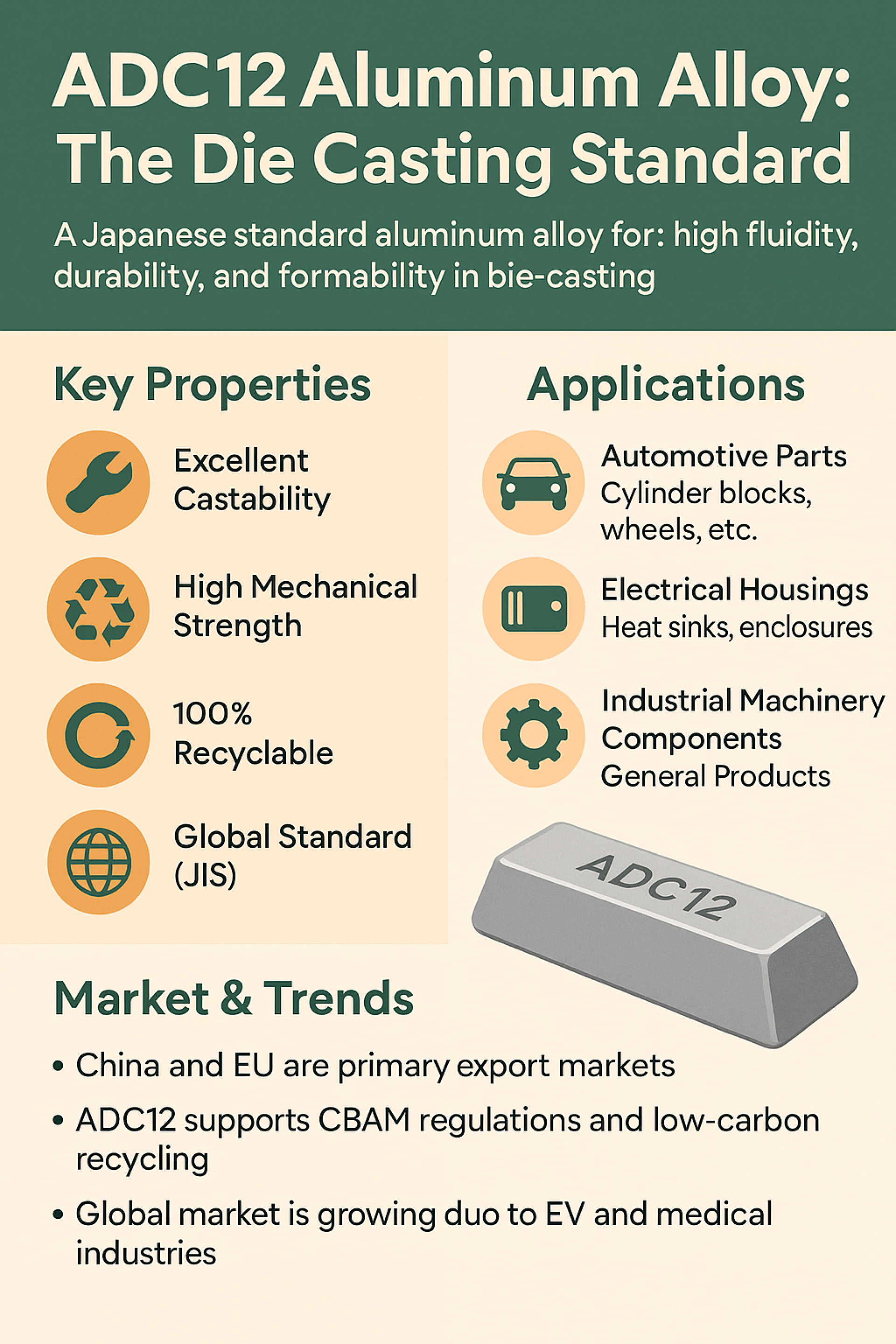
ADC12 is a Japanese Industrial Standard (JIS) aluminum alloy, widely recognized as the most popular grade in die casting worldwide. With a perfect balance of strength, dimensional accuracy, and ease of casting, ADC12 accounts for over 90% of all die casting applications. It is the backbone material for automotive components, electrical appliances, and industrial machinery.

Key Properties

High Fluidity: High silicon content enables casting of complex shapes and thin walls.
Dimensional Stability: Low shrinkage ensures high precision in finished products.
Mechanical Strength: Tensile strength ~310 MPa, excellent durability and heat dissipation.
100% Recyclable: Environmentally friendly, compliant with CBAM standards.
Easy to Source: A standard grade widely available in both Thai and global markets.
 
⚙️ Main Applications

Automotive Industry: Cylinder blocks, cylinder heads, gear housings, wheels, and structural parts.
Electrical Appliances: Heat sinks, casings, and lightweight structural components.
Industrial Machinery: Strong yet lightweight precision parts.
General Products: Durable and aesthetic components for household and electronic devices.
 

Chemical Composition (JIS H 5302 Standard)

Silicon (Si): 9.6–12.0%
Copper (Cu): 1.5–3.5%
Iron (Fe): ≤1.3%
Magnesium (Mg): ≤0.3%
Aluminum (Al): Balance
 

Export Market & 2026 Outlook

Main Destinations: China (68,000 tons in H1 2025), Vietnam, Indonesia, Philippines, USA.
Growth: CBAM-related exports surged 29%.
Forecast 2026: Thailand’s aluminum exports expected to reach USD 2.2 billion, with 2.4% average annual growth.
Competition: Thailand remains a key player alongside Malaysia and Vietnam in Southeast Asia.
 

Price Situation (January 2026)

Spot price in Thailand: 93.28–94.07 THB/kg
Volatility driven by scrap aluminum shortages and rising LME prices (USD 3,050–3,150/MT).
Downstream demand remains weak, keeping prices unstable.
 

✅ Why Choose ADC12 from SO OK TRADING

Japanese Standard Quality (JIS): Every ingot meets international standards.
Global Export Ready: Serving China, Japan, India, USA, and Europe.
Comprehensive Service: From sourcing and logistics to technical consultation.
Future-Proof: CBAM compliance and support for low-carbon recycled materials.
sooktrading@outlook.com
+66 955564255
www.sooktrading.com

SO OK TRADING – Premium ADC12 Partner for Automotive & Industrial Excellence


Related Content
“Global Energy Crisis 2026: Strait of Hormuz at Boiling Point – The Supply Shock the World Is Watching” Scenario Analysis By SO OK TRADING
“Global Energy Crisis: When the Strait of Hormuz Is Blocked” In March 2026, Iran announced the closure of the Strait of Hormuz, a strategic passage that carries more than 30% of the world’s crude oil. The move sent oil prices soaring, accelerated inflation, and shook the global economy.
7 Mar 2026
เกร็ดความรู้ การใช้งาน ALUMINUM INGOT (อลูมิเนียม INGOT) P1020 A7
Aluminum Ingot P1020 , A7 อลูมิเนียมเป็นหนึ่งในรูปแบบทั่วไปของโลหะผสมอลูมิเนียมที่ใช้ในอุตสาหกรรมสมัยใหม่ การผสมผสานคุณสมบัติที่เป็นเอกลักษณ์ของอลูมิเนียมทำให้เป็นวัสดุที่มีคุณค่าสำหรับการใช้งานที่หลากหลาย รวมถึงการก่อสร้าง การบินและอวกาศ การขนส่ง และสินค้าอุปโภคบริโภค ในบทความนี้ เราจะพิจารณากระบวนการผลิตแท่งอลูมิเนียมอย่างละเอียดมากยิ่งขึ้น กระบวนการผลิตแท่งอลูมิเนียมเริ่มต้นด้วยการสกัดแร่บอกไซต์ แร่นี้จะถูกบดเป็นผงละเอียดก่อนแล้วจึงผสมกับโซเดียมไฮดรอกไซด์ในกระบวนการที่เรียกว่ากระบวนการไบเออร์ สารละลายที่ได้จะถูกบำบัดด้วยความร้อนและความดันเพื่อสร้างอะลูมิเนียมไฮดรอกไซด์ ซึ่งจะถูกทำให้แห้งเพื่อผลิตผงอะลูมินาจากนั้นนำผงอลูมินามาผสมกับไครโอไลต์ ซึ่งเป็นแร่ธาตุหายากที่ทำหน้าที่เป็นฟลักซ์ ส่วนผสมจะถูกวางในเซลล์อิเล็กโทรไลต์ขนาดใหญ่ที่เต็มไปด้วยเกลือหลอมเหลว และกระแสไฟฟ้าจะถูกส่งผ่านเซลล์ กระบวนการนี้เรียกว่ากระบวนการ Hall-Héroult ทำให้อะลูมิเนียมออกไซด์แยกตัวออกจากออกซิเจน เหลือแต่อโลหะอะลูมิเนียมบริสุทธิ์ จากนั้นโลหะอลูมิเนียมจะถูกเทลงในแม่พิมพ์เพื่อสร้างรูปทรงลิ่ม แม่พิมพ์มักทำจากเหล็กหรือกราไฟต์และมีหลายขนาดและรูปร่าง แท่งอโลหะจะถูกทำให้เย็นและแข็งตัว จากนั้นนำออกจากแม่พิมพ์และตัดตามความยาว (Aluminum Slab) ก่อนที่แท่งอโลหะจะสามารถนำมาใช้ในอุตสาหกรรมได้ จะต้องผ่านกระบวนการต่อไป โดยทั่วไปแล้วจะละลายและหล่อเป็นรูปแบบเฉพาะสำหรับการใช้งานเฉพาะ ซึ่งอาจเกี่ยวข้องกับการผสมอลูมิเนียมกับอโลหะอื่นเพื่อให้ได้คุณสมบัติเฉพาะ เช่น ความแข็งแรง ความทนทานต่อการกัดกร่อน หรือการทนความร้อน แท่งอะลูมิเนียมมีขนาดตั้งแต่ไม่กี่ปอนด์ไปจนถึงหลายตัน ขึ้นอยู่กับการใช้งาน โดยปกติแล้วจะจัดส่งในปริมาณมากไปยังผู้ผลิต ซึ่งจะนำไปแปรรูปเป็นผลิตภัณฑ์ที่หลากหลายต่อไป (Aluminum Ingot, Aluminum Billet, Aluminum Slab) ETC. โดยสรุปแล้ว การผลิตแท่งอะลูมิเนียมเป็นกระบวนการที่ซับซ้อนซึ่งเกี่ยวข้องกับการเปลี่ยนแปลงทางเคมีและกายภาพหลายขั้นตอน จำเป็นต้องมีความเข้าใจอย่างลึกซึ้งเกี่ยวกับวัสดุศาสตร์และหลักการทางวิศวกรรม เช่นเดียวกับแรงงานที่มีทักษะในการใช้งานอุปกรณ์ที่ซับซ้อนที่ใช้ในกระบวนการ แท่งอลูมิเนียมมีบทบาทสำคัญในอุตสาหกรรมสมัยใหม่ และความสามารถรอบด้านและความน่าเชื่อถือทำให้เป็นวัสดุที่ขาดไม่ได้สำหรับการใช้งานที่หลากหลาย ตั้งแต่เครื่องครัว ไปจนถึง เครื่องบิน และ ชิ้นส่วนในยานอวกาศ
28 Nov 2025
This website uses cookies for best user experience, to find out more you can go to our Privacy Policy and Cookies Policy
Compare product
0/4
Remove all
Compare
Powered By MakeWebEasy Logo MakeWebEasy