“Aluminum Remelt Revolution – Transforming Scrap into the Power of Tomorrow, in the Era of Circular Economy & Net Zero” SO OK TRADING · 23 MAY 2026
Aluminum Remelt – Transforming Scrap into the New Power of Industry in the Era of Circular Economy & Net Zero By SO OK TRADING | May 23, 2026
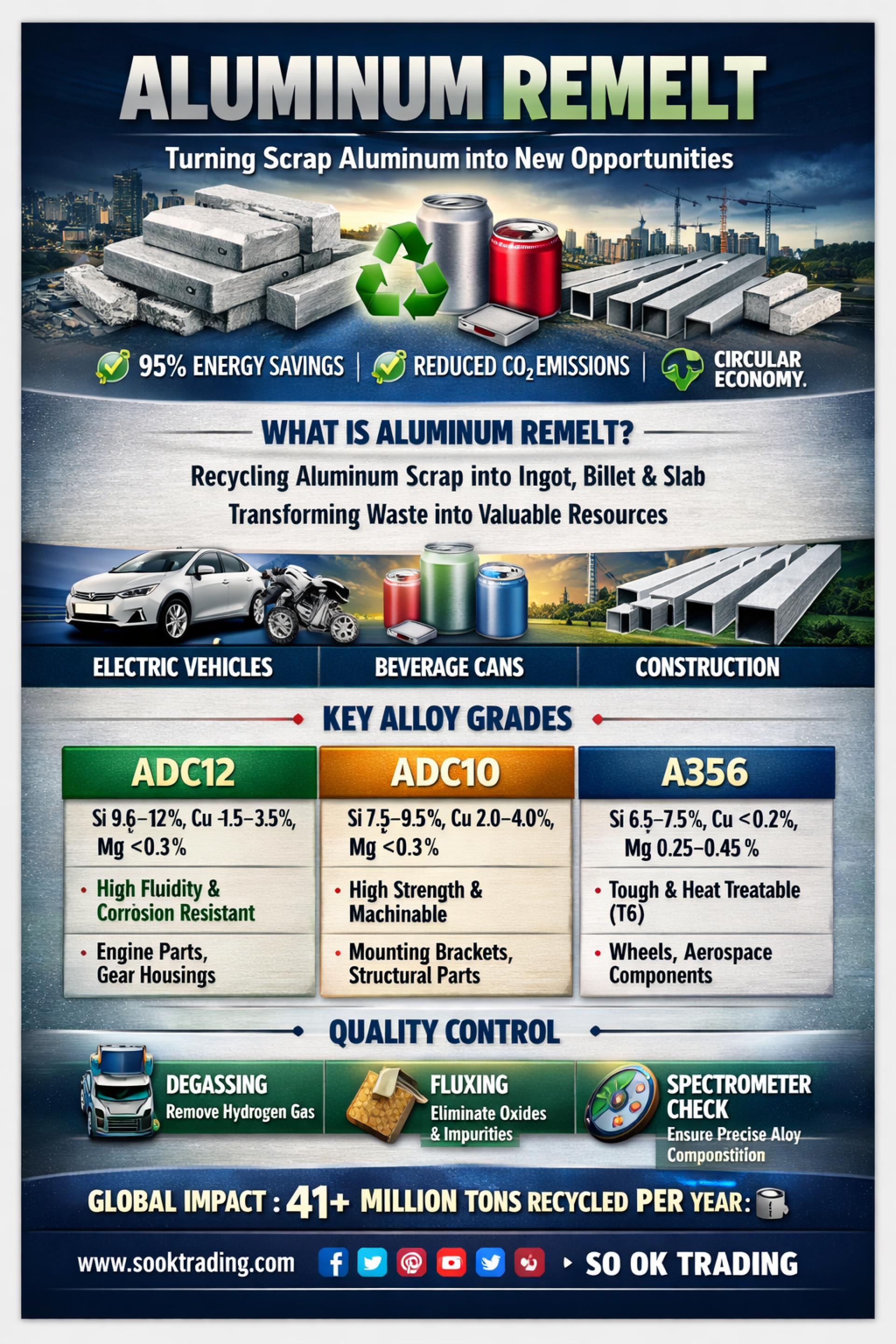
♻️ What is Aluminum Remelt? Aluminum Remelt is the process of taking aluminum scrap from production or end‑of‑life products, re‑melting it, improving its properties, and casting it into ingots, billets, or slabs to be reused by industries. The highlight: it saves up to 95% of energy compared to primary aluminum production, while reducing carbon emissions — directly supporting Circular Economy and Net Zero goals.
Main Industrial Applications
Automotive: ADC12 and ADC10 grades are used for high‑pressure die casting of engine covers, gear housings, and structural components. These alloys can be recycled repeatedly, and demand will rise further with the growth of EVs, which rely heavily on aluminum for body frames, wheels, and battery housings.
Packaging: Slabs are rolled into beverage cans, which can be recycled endlessly.
Construction: Billets are extruded into lightweight yet durable building structures — recycled aluminum can be used infinitely in this sector.
⚙️ Alloy Specifications
ADC12 (JIS Standard)
Composition: Si 9.6–12.0%, Cu 1.5–3.5%, Mg <0.3%
Properties: Excellent fluidity, corrosion resistance, high mechanical strength
Applications: Engine covers, gear housings, electrical and electronic casings
Highlight: The most versatile and widely used die‑casting grade
ADC10 (JIS Standard)
Composition: Si 7.5–9.5%, Cu 2.0–4.0%, Mg <0.3%
Properties: Higher strength and tensile resistance than ADC12, but slightly less fluidity and corrosion resistance
Applications: Engine mounts, high‑stress components, parts requiring additional machining
Highlight: Ideal for applications needing strength and impact resistance
A356 (ASTM/AA Standard)
Composition: Si 6.5–7.5%, Cu <0.2%, Mg 0.25–0.45%
Properties: High toughness and impact resistance, can be heat‑treated (T6) for enhanced strength
Applications: Alloy wheels, suspension components, aircraft parts, hydraulic pumps
Highlight: Perfect for safety‑critical structural components
Quality Enhancement Techniques
Degassing: Removes hydrogen gas to prevent porosity
Fluxing: Eliminates oil residues and oxide films
Spectrometer Check: Ensures precise Si, Cu, Mg ratios to meet alloy standards
Global and Thai Market
Global: Over 41 million tons/year of recycled aluminum are used, projected to reach 51 million tons by 2031
Thailand: Annual demand of 3.5–4 million tons, with a market value of USD 8.23 billion. Automotive and packaging lead the way, with aluminum can recycling rates as high as 78%, among the highest in ASEAN.
Demand Drivers
CBAM Policies (EU & US): Mandating low‑carbon aluminum in exports
EV Boom: Lightweight yet strong aluminum structures are increasingly essential
Conclusion
Aluminum Remelt is not just recycling — it is the creation of new value from scrap metal. It delivers both environmental and economic advantages, giving industries a competitive edge in sustainability and global market access.
SO OK TRADING — Your Business Partner FAST | SHARP | RELIABLE www.sooktrading.com Facebook: SO OK TRADING