Share

UBC: The Recycling Treasure of the Century – The Heart of the Green Supply Chain from Cans to Strategic Resource
Last updated: 11 Feb 2026
370 Views

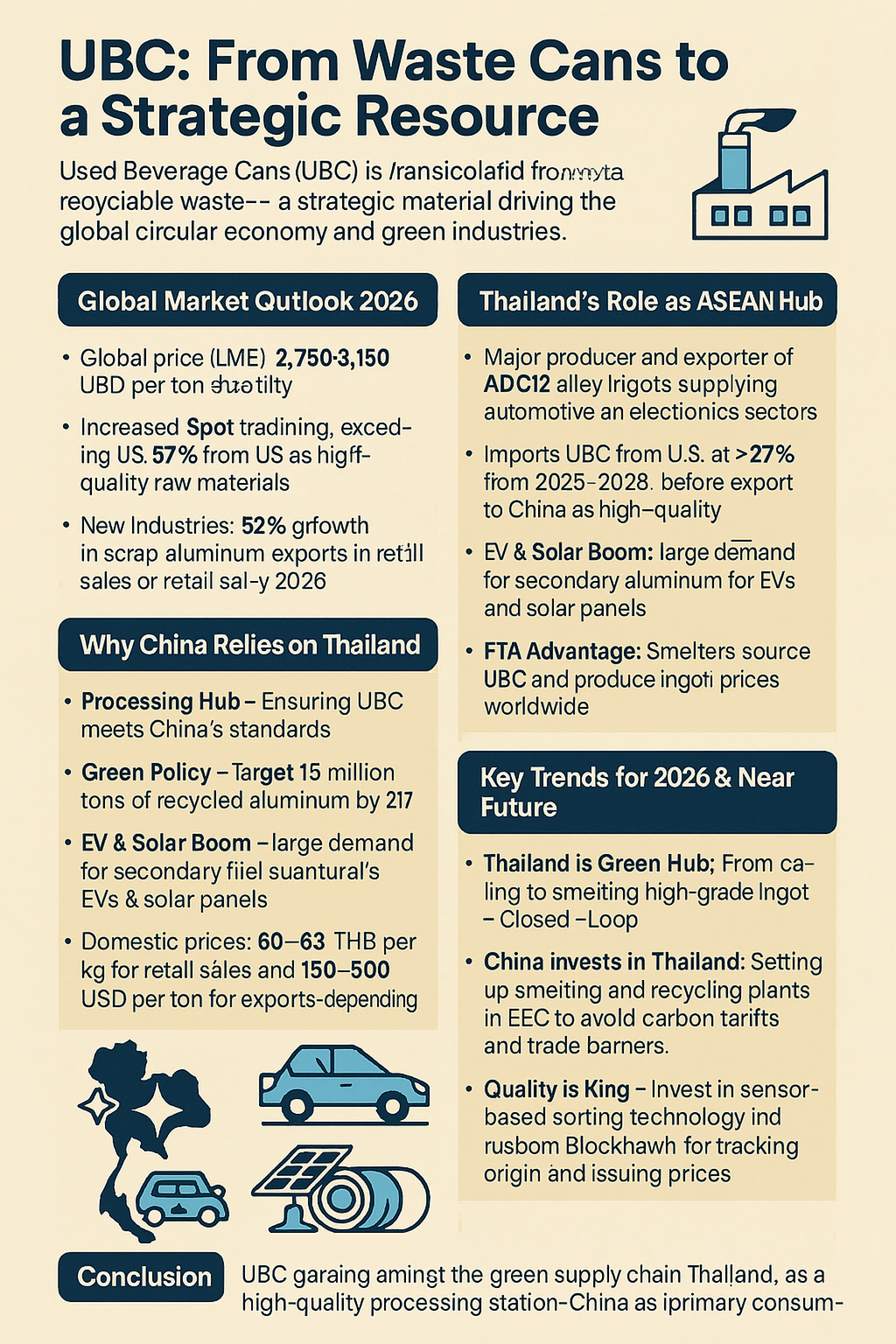
UBC: From Waste Cans to a Global Strategic Resource

UBC (Used Beverage Cans) are being elevated from “recyclable waste” to “strategic raw material,” driving the global circular economy and green industries. The strengths of UBC are clear: easy recycling, purity above 99%, and energy savings of up to 95% compared to primary aluminum production.


Global Market Outlook 2026

Price (LME): USD 2,750–3,150 per ton, driven by tight supply and China’s production limits
Trading Trend: US and Europe shifting toward spot trading to reduce tariff and policy risks
Growth: Global UBC recycling market CAGR 5.5–7.9%, expected to reach multi‑billion USD scale this decade
New Industries: EVs projected to use up to 514 lbs of aluminum per vehicle by 2026
 

Thailand as ASEAN Hub

Major producer and exporter of ADC12 alloy ingots, supplying automotive and electronics industries in Japan, China, and India
2025–2026: Thailand imported 27% of US UBC exports, reprocessed them, then shipped to China as high‑quality feedstock
Scrap aluminum exports grew 52% YoY in 2025, with China as the top destination, followed by South Korea and ASEAN
Domestic prices: 60–63 THB/kg retail; USD 150–500/ton export depending on baling format
 

Why China Relies on Thailand

Processing Hub: Thailand ensures UBC meets China’s strict import standards
Green Policy: China targets 15 million tons of recycled aluminum by 2027
EV & Solar Boom: Massive demand for secondary aluminum in EV and solar industries
FTA Advantage: China–Thailand and ASEAN trade agreements reduce tariffs, making Thai imports more cost‑effective than Western sources
 

Key Players in Thailand

UACJ (Thailand): ASEAN’s largest rolling mill, producing high‑quality coils for cans and cars
Nikkei Siam Aluminium: Japanese technology, recycling‑focused to reduce environmental impact
Varopakorn: Major sheet and coil producer, exporting globally
Daiki, Anglo‑Thai Metals: Smelters purchasing UBC and producing ingots for coil plants
 

Key Trends 2026 & Beyond

Thailand as Green Hub: Moving from baling to high‑grade ingot production, adopting closed‑loop “Can‑to‑Can” systems
China’s Investment in Thailand: Establishing smelting and recycling plants in the EEC to avoid carbon tariffs and trade barriers
Quality is King: Sensor‑based sorting and blockchain tracking to guarantee >99% purity and certified recycled content
Price War: Rising demand keeps UBC prices high and volatile, closely tied to global LME benchmarks
 

Conclusion
UBC is becoming the backbone of the green supply chain. Thailand serves as the “high‑quality processing station,” while China is the “primary consumer” driving demand for recycled aluminum in EVs and clean technologies. The world is entering an era where waste cans are recognized as strategic resources, creating both value and sustainability.


Contact
If you are interested in purchasing UBC Scrap (baled) or have demand for this product, please contact:
SOOK TRADING : sooktrading@outlook.com


Would you like me to also craft a short executive summary version in English (around 150 words) for quick posts on LinkedIn or newsletters?


Related Content
ADC 12: ALUMINUM INGOT ตัวรับจบสำหรับการขึ้นรูปอลูมิเนียม
อลูมิเนียมอัลลอยด์ ADC 12 นิยมใช้ในการผลิตชิ้นส่วนยานยนต์, อุปกรณ์อิเล็กทรอนิกส์ และเครื่องใช้ไฟฟ้า เนื่องจากมีคุณสมบัติที่ดีในการหล่อขึ้นรูป, ทนทาน, และกระจายความร้อนได้ดี. การใช้งานหลักๆ เช่น การผลิตฝาสูบรถยนต์, แผงระบายความร้อนสำหรับแล็ปท็อป, และชิ้นส่วนภายในอื่นๆ ที่ต้องการความแม่นยำ. การใช้งานในอุตสาหกรรมต่างๆ ยานยนต์: ใช้ทำฝาสูบ, บล็อกกระบอก, และชิ้นส่วนภายในอื่นๆ ที่ต้องการความแข็งแรงและทนทาน. อิเล็กทรอนิกส์และเครื่องใช้ไฟฟ้า: ส่วนห่อหุ้มและแผงระบายความร้อน: ใช้ผลิตเปลือกหุ้มและแผงระบายความร้อนสำหรับอุปกรณ์ต่างๆ เช่น แล็ปท็อป, สมาร์ทโฟน, และแท็บเล็ต เพื่อกระจายความร้อนและรักษาอุณหภูมิการทำงานให้ปลอดภัย. ชิ้นส่วนภายใน: ใช้ทำตัวเชื่อมต่อและส่วนประกอบภายในที่ต้องการความแม่นยำและความทนทานสูง. อื่นๆ: ใช้ทำชิ้นส่วนที่ต้องการความสมดุลของคุณสมบัติการตัดเฉือน, การฉีดขึ้นรูป, และความแข็งแรง. คุณสมบัติที่ทำให้เหมาะสมกับการใช้งาน หล่อขึ้นรูปได้ดี: มีความสมดุลที่ดีในคุณสมบัติการแมชชีนนิ่งและประสิทธิภาพการฉีดขึ้นรูป. กระจายความร้อนได้ดี: มีความสามารถในการนำความร้อนสูง ช่วยให้ชิ้นส่วนไม่ร้อนเกินไป. ทนทานต่อการกัดกร่อน: มีความต้านทานต่อการกัดกร่อนได้ดี เหมาะสำหรับใช้งานในสภาพแวดล้อมที่หลากหลาย. แข็งแรง: มีความแข็งและความแข็งแกร่ง เหมาะสำหรับงานที่ต้องทนแรงอัดสูง. ชุบผิวได้ดี: สามารถชุบ Anodize และเคลือบผิวด้วยไฟฟ้าได้ดี.
19 Nov 2025
Aluminum Recycling the Circle and How it work
Aluminium is the most abundant metal in the earth’s crust. Approximately 75% of aluminium ever produced is still in use today as it can be recycled endlessly without compromising any of its unique properties or quality. Aluminium’s lifecycle provides significant benefits through recycling, saving 95% of the energy it would take to make new aluminium metal. More information on recycling may be found here. Recycling aluminium has five steps: Step 1: Collecting Scrap There are two categories of aluminium scrap: New Scrap New Scrap is surplus material that arises during the manufacture and fabrication of aluminium products, up to the point where they are sold to the final consumer. For example, off cuts of aluminium sheet or extrusions are considered new scrap. Sometimes, this new scrap can be safely recycled by aluminium smelters as its composition is known. Old Scrap Old Scrap is material that has been used by the consumer and subsequently discarded. For example, used beverage cans, window frames, electrical cabling and car cylinder heads are all considered old scrap. Aluminium smelters are unable to safely accept this old scrap as its composition is usually unknown and it can be contaminated. Scrap aluminium is also collected from the community – from households, scrap merchants, local and regional authorities, etc. Step 2: Sorting Scrap The scrap is then sorted – grouping all coated (painted or lacquered) aluminium together, and grouping all uncoated aluminium together. Paper, plastic and other non-aluminium recycling needs to be removed. Step 3: Crushing The sorted aluminium is then crushed into bales – by compacting the aluminium scrap, it reduces freight, storage and handling costs Step 4: Remelting Uncoated scrap is loaded directly into a large furnace called a remelter, where it is heated at high temperatures and turned into molten form. If the scrap aluminium is coated, it is processed through a gas fired rotary furnace to remove any coating and then transferred to the remelter. Step 5: Casting The molten aluminium is cast at a temperature of just over 700°C to form ingots
13 Nov 2025
Aluminum Scrap, Copper Scrap Usage and it  background
Aluminum and copper scrap are vital for new products, with aluminum used in lightweight automotive/aerospace parts, packaging (cans), and construction (siding, windows) for its strength-to-weight ratio, while copper excels in electrical wiring, plumbing, and electronics due to its superior conductivity and corrosion resistance, with both metals significantly reducing energy and resources compared to virgin material. Aluminum Scrap Usage Transportation: Car parts, airplane components, trains (reducing weight for fuel efficiency). Packaging: Beverage cans, foil, food containers (lightweight, non-toxic). Construction: Window frames, roofing, siding, structural elements. Electronics: Casings, heat sinks. Copper Scrap Usage Electrical: Wiring (household, industrial), motors, generators, transformers (best conductor). Plumbing: Pipes, fittings (corrosion-resistant). Electronics & Renewables: Circuit boards, solar panels, wind turbines, EVs (high demand). Industrial: Machinery, heat exchangers, decorative items (as brass). Key Benefits of Recycling Both Energy Savings: Significantly less energy needed than mining new ore. Resource Conservation: Reduces mining impact and conserves natural resources like bauxite. Circular Economy: Creates a sustainable loop, especially crucial for growing green tech demand.
25 Dec 2025
This website uses cookies for best user experience, to find out more you can go to our Privacy Policy and Cookies Policy
Compare product
0/4
Remove all
Compare
Powered By MakeWebEasy Logo MakeWebEasy