Share

“Recycling 5.0: The New Business Game — How AI and the Circular Economy Transform Waste into the Strategic Capital of the Future” SO OK TRADING|May 16, 2026

Last updated: 16 May 2026
1377 Views

Recycling – From “Waste” to “Strategic Capital” In today’s world racing toward Net Zero and the Circular Economy, recycling is no longer just about protecting the environment. It has become a new global business mandate that every industry must adapt to — both to reduce carbon footprints and to secure future resource stability.

 
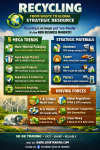
♻️ 5 Recycling Trends Transforming Global Business

Mono-Material Packaging: Single-material packaging simplifies sorting and produces higher-quality recycled plastics.
Food-Grade Plastics: rPET and rHDPE are now widely used in food and beverage packaging after regulatory approval.
Upcycled Premium Products: PET bottles become sportswear; glass and metal waste turn into luxury furniture.
Regulation & Carbon Tax: Mandatory recycled content ratios and carbon footprint accounting reshape supply chains.
Advanced Recycling: Chemical recycling restores complex plastics into pure raw materials, enabling endless reuse.
 
⚡ Metal Recycling: From Scrap Yard to Strategic Industry

Aluminum: The green metal of EVs, saving 95% energy when recycled, enhanced by AI sorting for high purity.
Copper: The heart of clean energy; urban mining from e-waste supplies strategic copper, cutting emissions by 85%.
Lead: Over 90% recycled in closed-loop systems, powering UPS batteries for data centers and solar storage.
Plastics: Global supply chains now mandate recycled content, with chemical recycling delivering virgin-like quality.
 
Driving Forces of the Recycling Economy

Market value soaring to $1.6 trillion.
Global regulations like PPWR and EPR enforce producer responsibility.
AI & robotics achieve 95% precision in waste sorting.
Blockchain transparency prevents greenwashing.
Urban mining supplies critical resources for EVs and data centers.
 
Global Landscape: Opportunities & Contradictions

Worldwide recycling rates average only 19%, despite growth.
Europe leads with strict regulations and rates above 50%.
Asia-Pacific holds 41% of the market, with China and South Korea leading EV battery recycling.
North America invests heavily in polymer centers and advanced technologies.
 
For Business Recycling is the New S-Curve, blending innovation, regulation, and sustainability.

Early adopters gain cost advantages and market access.
Late movers risk carbon taxes and exclusion from supply chains.
Conclusion: Recycling is not just “waste reused” — it is strategic capital that will define the future of global business and trade in the coming decade.

 
SO OK TRADING Your Business Partner FAST • SHARP • RELIABLE www.sooktrading.com Facebook: SO OK TRADING

Related Content
“Thailand Aluminum Packaging 2026: Turning Point Toward a Green Future of Innovation and 100% Recycling”:SO OK TRADING: 27 JUNE 2026
Thailand Aluminum Packaging Market 2026 – Cans, Ends & Tabs SO OK TRADING | June 27, 2026 In 2026, Thailand’s aluminum packaging market is entering a critical turning point — shifting from challenges of rising raw material costs and fierce competition from China, toward new opportunities driven by sustainability and 100% recycling. Although the market shows a slight contraction (-1.8% YoY), demand for aluminum in beverages and food continues to grow. Functional drinks, energy drinks, and premium products are the main drivers, pushing Thailand’s consumption to 7–7.5 billion cans per year. At the same time, UACJ (Thailand) remains the backbone of domestic supply, with production capacity exceeding 320,000 tons annually. The company is advancing its “Green Aluminum” strategy through a 18.2 MW solar rooftop system and a target of 80% recycling by 2030. Meanwhile, China continues to penetrate the market with 10–15% lower costs and expanded high-quality product lines. Yong Jie New Material invested $180 million to acquire Arconic China, strengthening its supply of body stock, ends, and tabs directly into Thailand.
27 Jun 2026
“Aluminum’s Black Swan: War and Energy Crisis from the Strait of Hormuz to a Global Supply Shock — March 2026”
Aluminum in March 2026 – From Pressure to a Supply Shock Shaking the Global Market March 2026 is not merely a month when the aluminum market must grapple with tariffs and environmental measures. It is also the month when the entire world faces a “Black Swan Event” triggered by the closure of the Strait of Hormuz, a consequence of the war between the United States and Iran that began at the end of February. This event has shifted the market equation from policy concerns to a true crisis of supply and energy. Soaring prices, panic buying from manufacturers worldwide, and rising energy costs are creating unprecedented tremors across both the global market and Thai businesses. Those who adapt quickly will not only survive but also seize opportunities from this crisis.
1 Mar 2026
Aluminum Price Outlook – February 2026 SO OK TRADING Insight
The global aluminum market remains elevated. On January 29, prices surged to USD 3,325/MT, the highest level in nearly four years, before closing at USD 3,110/MT on January 30. This represents a +8.78% increase in just four weeks, driven by strong investor confidence and tightening supply.
1 Feb 2026
This website uses cookies for best user experience, to find out more you can go to our Privacy Policy and Cookies Policy
Powered By MakeWebEasy Logo MakeWebEasy